
Provide executive protection when objective risk indicators or a credible escalation exist: prior threats, documented harassment, or a subject’s known access to weapons. Once those conditions are present, secure the termination room, convene the multidisciplinary threat-management team, and notify law enforcement immediately if the risk appears imminent. The checklist below walks HR and security teams through each step.
TL;DR:
- Most layoffs proceed safely, but the presence of threats, harassment, or access to weapons signals the need for executive protection plans.
- High-risk indicators include threats, violence history, obsession with weapons, stalking, or recent disciplinary actions combined with sensitive access.
- Security measures during termination should be proportional, with covert or visible presence, secured rooms, witness inclusion, and controlled access to reduce escalation risk.
- Coordination among HR, security, legal, and facilities is crucial, with a designated lead and detailed checklist to prepare room, routes, access suspension, and law enforcement notification.
- Post-meeting, badges and access are deactivated immediately, monitoring continues, and detailed incident documentation supports future risk management and legal actions.
Table of Contents
- Risk indicators and when a termination requires security planning
- What executive protection during a layoff actually looks like
- How to plan and coordinate the termination: a checklist for HR, security, legal, and leadership
- De-escalation and communication during the termination meeting
- Post-termination follow-up: access control and welfare checks
- Hub Investigative Group: practitioner method and proof points
- Psychological support and counseling for affected employees
- Protocols for handling media and public relations during layoffs
- Training requirements and skills for executive protection personnel specific to layoffs
- Incident documentation and reporting procedures specific to layoffs
- Why behavior-based threat assessment beats profiling
- Hub’s services for teams that need executive protection support
- Sources
- FAQ
Risk indicators and when a termination requires security planning
Not every separation carries the same weight. Most layoffs proceed without incident, but a smaller subset carries observable warning signs that change the calculus entirely. The goal is to spot those signs early and respond proportionally, not to treat every departing employee as a threat.
Behavioral threat assessment models built by practitioners recommend that multidisciplinary teams identify concerning behaviors early and manage them before they escalate. Key indicators include stalking, harassment, a sudden interest in weapons, or attempts to access security information outside someone’s normal role.
Watch for these warning signs during and before termination planning:
- Direct or veiled threats made toward managers, coworkers, or the organization.
- A documented history of violence, aggression, or intimidation in the workplace.
- Unusual fascination with weapons, tactical gear, or past workplace-violence incidents.
- Stalking behavior, unwanted contact, or harassment directed at a specific employee.
- Recent disciplinary action, a pending layoff notice, or termination combined with access to sensitive systems or physical spaces.
Guidance from CISA is clear that effective prevention shifts from profiling to behavior evaluation: financial stress or a rough divorce alone does not predict violence, but escalation and fixation do. Treating every stressed employee as a suspect erodes trust and misses the real signal, which is a documented pathway of behavior moving toward confrontation.
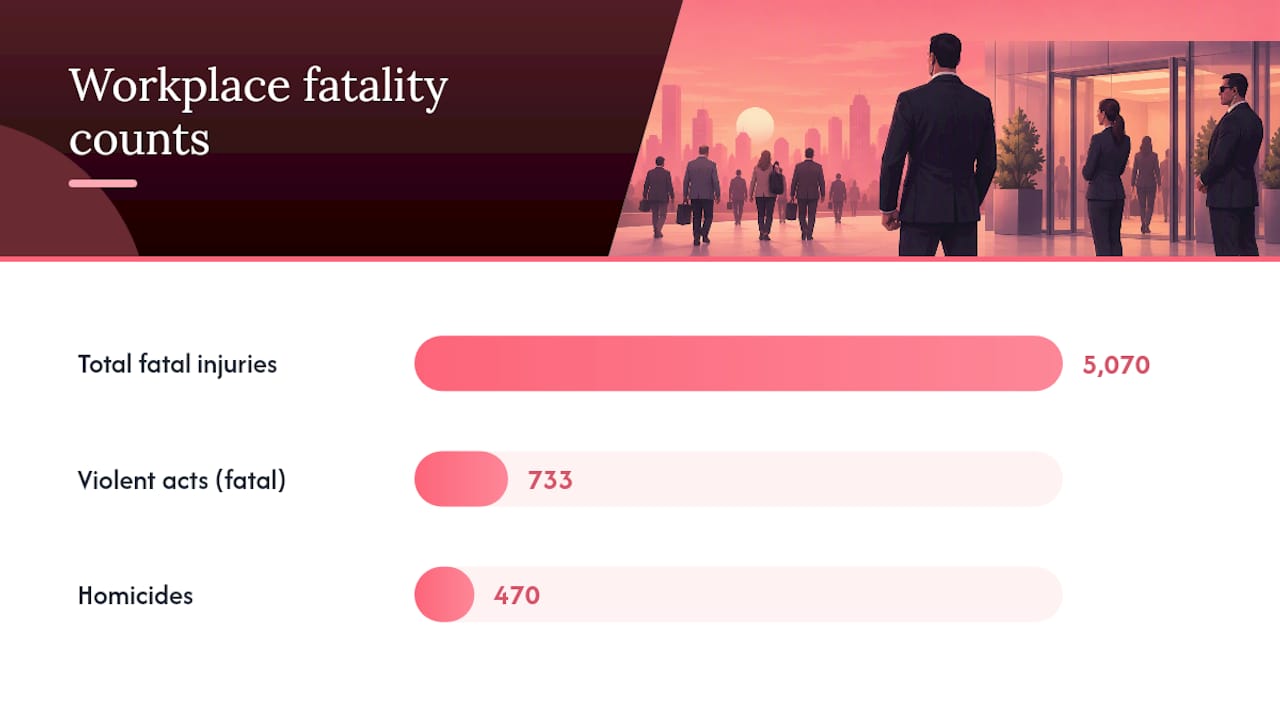
A total of 733 violent acts accounted for roughly 14.5% of the 5,070 fatal work injuries recorded in the United States in 2024, according to Bureau of Labor Statistics data, including 470 homicides. That baseline is why HR and security teams treat credible threat indicators as a planning trigger rather than an afterthought, even though the overwhelming majority of terminations do not approach that risk.
What executive protection during a layoff actually looks like
Once risk indicators are confirmed, the response should match the threat level rather than default to the most visible option available. A layered approach gives HR and security several proportional choices instead of one blunt instrument.
Covert presence works for moderate-risk cases: a plainclothes protection specialist positioned nearby, aware of exits and escalation cues, but not obvious to the employee being separated. Visible presence, meaning a uniformed guard stationed at or near the meeting room, fits higher-risk cases where deterrence matters more than discretion. The decision rests on the specific behavioral indicators gathered during planning, not on rank or title alone.
On-site tactics that reduce risk during the meeting itself include:
- Choosing a room with two exits and no items that could be used as improvised weapons.
- Positioning security near the door, not between the employee and their own exit path.
- Including a witness, typically a second HR representative, for every high-risk meeting.
- Suspending badge access and IT credentials to take effect the moment the meeting starts.
- Arranging a controlled, escorted exit through a route that avoids other employees.
Administrative controls matter as much as physical ones. Parking reassignment, temporary changes to building access schedules, and brief secure transport home cover the gap between the meeting and the moment the person is no longer on company property. The Secret Service’s NTAC guidance notes that practical safety planning often includes staging area changes, pre-arranged escort routes, and pre-checked exit points well before the meeting begins.
Extended close protection, meaning multi-day coverage for an executive or manager named in a specific threat, is reserved for cases involving a direct threat, a history of violence, or an active protective order.
Pro Tip: Walk the exit route yourself before the meeting; a route that looks clear on a floor plan can still cross a break room full of coworkers at the wrong time.
How to plan and coordinate the termination: a checklist for HR, security, legal, and leadership
Coordination fails when information stays siloed. HR sees the disciplinary file, security sees the badge logs, and legal sees the complaint history, but no one connects the three until after something goes wrong. A named lead and a shared checklist fix that.
CISA’s Insider Threat Mitigation Guide recommends a Senior Official who owns the program and a multidisciplinary group who can move fast when a separation turns high-risk. For a single termination, that translates into a short-term team: HR leads communication, security leads physical safety, legal reviews documentation and liability, and facilities or IT execute access changes on cue.
Before scheduling a high-risk termination:
- Assign a single lead who coordinates HR, security, legal, and facilities and who has authority to delay the meeting if conditions change.
- Gather documentation: disciplinary records, prior complaints, any protective orders, and notes on specific behavioral incidents.
- Confirm the room, the exit route, and the witness assignment at least 24 hours in advance.
- Set the law-enforcement notification threshold in writing: what triggers a call before, during, or after the meeting.
- Prepare the access-suspension sequence with IT so credentials lapse at the exact moment the meeting starts, not before or after.
- Brief every participant on their role and on the signal to end the meeting early if it escalates.
Our internal guide on before you schedule a high-risk termination walks through this sequencing in more detail, and a workplace threat assessment framework can help formalize the team structure for organizations building this capability from scratch.
Pro Tip: Put the notification threshold in writing before the meeting, not during it; deciding in the moment whether a comment rises to the level of a police call is exactly the wrong time to be deciding.
De-escalation and communication during the termination meeting
What gets said in the first ninety seconds shapes the rest of the meeting. Keep the language short, factual, and free of blame: state the decision, the effective date, and the next administrative step, then stop talking.
- Use neutral, non-accusatory phrasing: “This position has been eliminated” rather than language that assigns fault.
- Keep tone even and volume low; a calm voice does more to de-escalate than reassurance ever will.
- Avoid crossing arms, pointing, or standing over a seated employee, all of which read as confrontational.
- Position security near an exit, visible but not looming over the conversation.
- If the employee raises their voice, becomes physically agitated, or makes any statement referencing harm, pause the meeting and give security the lead.
CISA’s guidance on recognizing warning signs and de-escalation stresses reporting pathways so that a manager who notices concerning behavior mid-meeting has somewhere immediate to send that information. If the situation crosses from tense to threatening, that is the moment to call law enforcement rather than waiting to see whether it resolves on its own.
Post-termination follow-up: access control and welfare checks
The highest-risk window often opens after the meeting ends, not during it. Access needs to close instantly and monitoring needs to continue for a defined period afterward.
- Deactivate badges, VPN access, and email the moment the employee leaves the building, and review access logs for the prior 30 days.
- Provide a supervised, escorted exit and arrange secure transport when the risk profile warrants it.
- Place temporary monitoring on facilities or accounts tied to the individual if threats were made, and document every step taken.
- Log the incident in detail, including timestamps, statements made, and witnesses present, since that record supports any later protective order or law-enforcement referral.
- Offer employee assistance resources to both the departing employee and any coworkers who witnessed the situation.
Hub Investigative Group: practitioner method and proof points
A security and investigative group with extensive experience builds separation security plans that match the actual risk rather than a generic template. A typical engagement runs through four stages: a planning call to review the personnel file and behavioral indicators, a threat assessment that scores the risk level, an execution phase covering room selection and escort protocols, and a follow-up period with access monitoring. Services relevant to a high-risk termination include workplace executive protection, secure transport, and background investigations to verify any prior incidents surfaced during planning.
Psychological support and counseling for affected employees
A termination affects more than the person being let go. Coworkers who witness a tense separation often carry that stress for weeks, and the departing employee, even in a low-risk case, benefits from a clear path to support rather than a silent exit.
Employee assistance programs should be offered at the moment of termination, not mailed afterward as an afterthought. Give the departing employee contact information for counseling resources in writing, along with details on any severance-linked mental health coverage. For remaining staff, a brief, honest debrief, without violating the departed employee’s privacy, helps prevent rumor and anxiety from filling the information gap. Managers who led the meeting also need a check-in; delivering a high-risk termination is stressful work, and treating it as routine sets a bad precedent for the next one.
Protocols for handling media and public relations during layoffs
Layoffs draw outside attention faster than most companies expect, especially at scale or when an executive is involved. A single, designated spokesperson should handle every external inquiry, with HR, legal, and security all referring press calls to that one channel rather than responding individually.
Internal messaging should go out before external messaging leaks it. Employees deserve to hear the news from their own company first, not from a headline. Keep statements factual and brief: what changed, why, and what support is available, without disclosing individual performance details or the specifics of any security measures taken. If a termination involved visible security presence, having a prepared, neutral explanation ready avoids speculation. Coordinate this with the same lead who runs the cross-functional termination checklist, since media pressure often arrives within hours of the meeting itself.
Training requirements and skills for executive protection personnel specific to layoffs
Layoff-related protection work differs from standard executive protection because the person of interest is often someone the security team has never assessed before, with information arriving days or hours before the meeting rather than weeks.
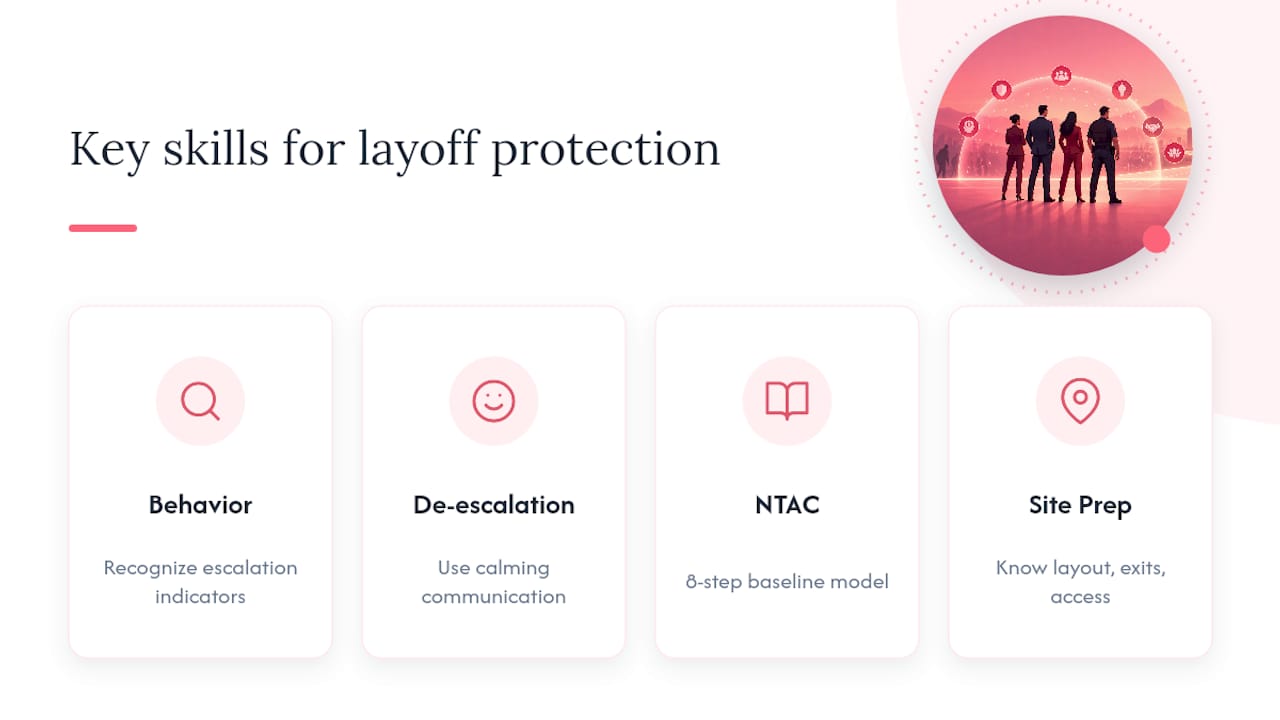
Personnel assigned to these engagements need working knowledge of behavioral threat assessment frameworks, not just physical protection tactics. That means training in recognizing escalation indicators, de-escalation communication, and close-quarters positioning that avoids provoking a person already under stress. A Secret Service NTAC framework offers an eight-step model that many practitioners use as a training baseline. Beyond that, personnel need familiarity with the client’s facility layout, exit routes, and access systems, since a termination-day plan depends on details specific to that building, not generic protocol. Active-shooter and high-threat response training, such as the courses outlined in this active shooter training resource, rounds out the skill set for personnel who may face the rare case that escalates beyond verbal conflict.
Incident documentation and reporting procedures specific to layoffs
Every high-risk termination generates a paper trail, and that trail matters well beyond the day of the meeting. OSHA’s General Duty Clause obligation means employers aware of a credible threat are expected to have implemented preventive measures, and documentation is the evidence that those measures existed.
Record the specific behavioral indicators that triggered the security plan, the risk assessment findings, every role assignment, and the exact sequence of access changes made before, during, and after the meeting. If the employee made any statement during the meeting, capture it verbatim with a timestamp and witness name. Store this alongside any prior complaints or disciplinary records tied to the individual, since a later protective order or law-enforcement referral depends on a documented history, not a manager’s memory of events. Route a copy to legal and to the Senior Official overseeing the threat-management program so the organization’s institutional record stays current for future risk reviews.
Why behavior-based threat assessment beats profiling
Profiling by demographic or personal stress alone flags the wrong people and misses the real signal. Threat assessment practitioners focus on concrete behavior and escalation pathways instead, which is both more accurate and less likely to invite legal exposure. Organizations need a named Senior Official who owns this program, reporting to leadership, and a standing relationship with local law enforcement established before a crisis, not during one.
— Derek
Hub’s services for teams that need executive protection support
Planning a high-risk termination without a security partner means HR and legal absorbing risk they aren’t equipped to assess alone. An experienced security and investigative team works directly with your existing HR and legal staff rather than replacing your process with a generic template.

An initial engagement typically starts with a risk assessment call, moves into a tailored security plan matched to your facility and the specific indicators involved, and ends with deployment on the day of the termination plus a defined follow-up window. Relevant services include:
- Executive protection planning for organizations building a termination-day security plan from scratch.
- Workplace executive protection for on-site coverage during the meeting itself.
- Protective escort services for secure transport immediately after a high-risk separation.
- Corporate investigations for verifying prior incidents surfaced during planning.
Visit our executive protection services page to schedule a planning call before your next high-risk termination.
Sources
- Bureau of Labor Statistics: Census of Fatal Occupational Injuries, 2024
- OSHA enforcement guidance on workplace violence
FAQ
What are the best practices for executive protection?
Best practices center on a behavioral threat assessment, a multidisciplinary team led by a named Senior Official, and pre-established law-enforcement liaison, following the framework laid out in the Secret Service NTAC guide. Proportional protection, meaning covert presence for moderate risk and visible presence or extended close protection for confirmed threats, matters more than defaulting to the most visible option every time.
How can employees protect themselves during layoffs?
Employees facing a layoff can request that HR follow a documented, private process and can ask about severance-linked counseling resources if the separation feels contentious. If an employee has safety concerns about a specific coworker or manager, reporting those concerns to HR or security before the meeting, rather than during it, gives the threat-management team time to plan appropriately.
What are the seven Ps often referenced in close protection work?
Definitions vary across the security industry, but a common version covers proper planning, positioning, personnel, protocols, procedures, personal protective equipment, and preparation. For a layoff-specific engagement, the most relevant elements are proper planning and positioning, since those two decisions shape everything else on termination day.
Who typically needs executive protection during a layoff?
Protection is warranted when objective risk indicators exist: documented prior threats, a history of workplace violence, harassment, or a known fixation on weapons tied to the individual being separated. Most terminations do not meet that threshold, but any separation involving a credible escalation pathway, as described in CISA’s pathway to violence resources, should trigger a security review before scheduling.