
Boston can and does require an approved fire watch when a fire protection or alarm system is impaired, and the decision belongs to Boston Fire, not the building owner. If your sprinklers, standpipes or alarm system go out of service, or you’re planning hot work near combustibles, your first call should be to Boston Fire to confirm whether a fire watch, an impairment permit, or both are required.
TL;DR:
- Boston Fire determines whether a fire watch is required during system impairments based on factors like occupancy, duration, and backup protections.
- A fire watch must patrol the area continuously, know valve locations, and be ready to shut down hot work or notify authorities immediately if hazards arise.
- Impairment documentation, including logs and permits, must be prepared in advance, with formal approval from Boston Fire needed for longer outages or full system shutdowns.
- Property managers often mistake fire watch as security staff duties or neglect proper documentation, risking permit violations and operational delays.
- Coordinating fire watch staffing and notifications with Boston Fire is complex but crucial, and professional support can streamline compliance and system restoration.
Table of Contents
- 1. What triggers a required fire watch in Boston
- 2. Operational must-dos while a system is impaired
- 3. Who can serve as a fire watch and what they need
- 4. How to work with Boston Fire on permits and notifications
- 5. What Boston property managers get wrong about fire watch
- How Hub Investigative Group supports fire watch compliance
- Sources
- FAQ
1. What triggers a required fire watch in Boston
Boston Fire and the state fire code do not wait for a full outage to act. A fire watch requirement typically follows one of a handful of predictable events, and knowing them ahead of time lets you plan staffing before an inspector tells you to.
Massachusetts adopted 527 CMR 1.00 as its comprehensive fire safety code, built on NFPA 1 with state amendments, and it gives the authority having jurisdiction, meaning Boston Fire in this city, discretion over how impairments are handled on the ground. That discretion is the reason two similar buildings can get two different answers from an inspector: the call depends on occupancy, duration and what backup protection exists while the system is down.
Common triggers include:
- Sprinkler, standpipe or fire alarm systems taken out of service for repair, testing or renovation
- Water main or hydrant outages that reduce or eliminate fire flow to a building or block
- Smoke control system failures in high-rise or below-grade spaces
- Hot work such as welding, cutting or grinding performed near combustible materials
Hot work carries its own trigger points under the Boston Fire Prevention Code, which describes fire watch conditions tied to exposures within 35 feet of combustibles, concealed spaces that could hide smoldering ignition, and situations where the suppression system covering that work area isn’t fully operative. A short outage handled by end of shift is one conversation with Boston Fire. An outage lasting longer than eight hours, or one that takes an entire system offline, generally requires an Extended Impairment Plan, which is a more formal document than a routine permit note and should be prepared before the outage starts, not after Boston Fire asks for it.
2. Operational must-dos while a system is impaired
Once a system goes down, the clock starts on a set of obligations that exist independent of whether a fire watch is ordered. Boston’s own sprinkler permit form spells out most of them, and treating this as a checklist rather than a suggestion is what keeps an inspection from turning into a citation.
- Tag the system at the moment of impairment: place red tags at the fire command center and at every affected control valve so anyone walking the building knows the status at a glance.
- Open an impairment log the same day, recording who shut the system down, when, why, and who is authorized to sign off on restoration.
- Notify tenants and staff in writing that the system is impaired, and post current inspection reports on site where an inspector or fire watch can find them.
- Confirm egress routes and emergency lighting remain fully functional, since impairment of one system should never compromise a building’s ability to evacuate.
- Stage portable fire extinguishers in any area left without suppression coverage, sized appropriately to the hazard in that space.
- Plan the repair or maintenance work to minimize downtime, then restore the system to service by the end of each working day wherever that’s practical.
- Once restored, run the acceptance or periodic tests the system requires before calling the impairment closed.
Pro Tip: Keep a standing impairment kit, red tags, a blank log, a laminated valve map and a printed contact sheet for the Fire Alarm Division, in the same spot every building manager knows, so nobody is hunting for supplies while a system is down.
3. Who can serve as a fire watch and what they need
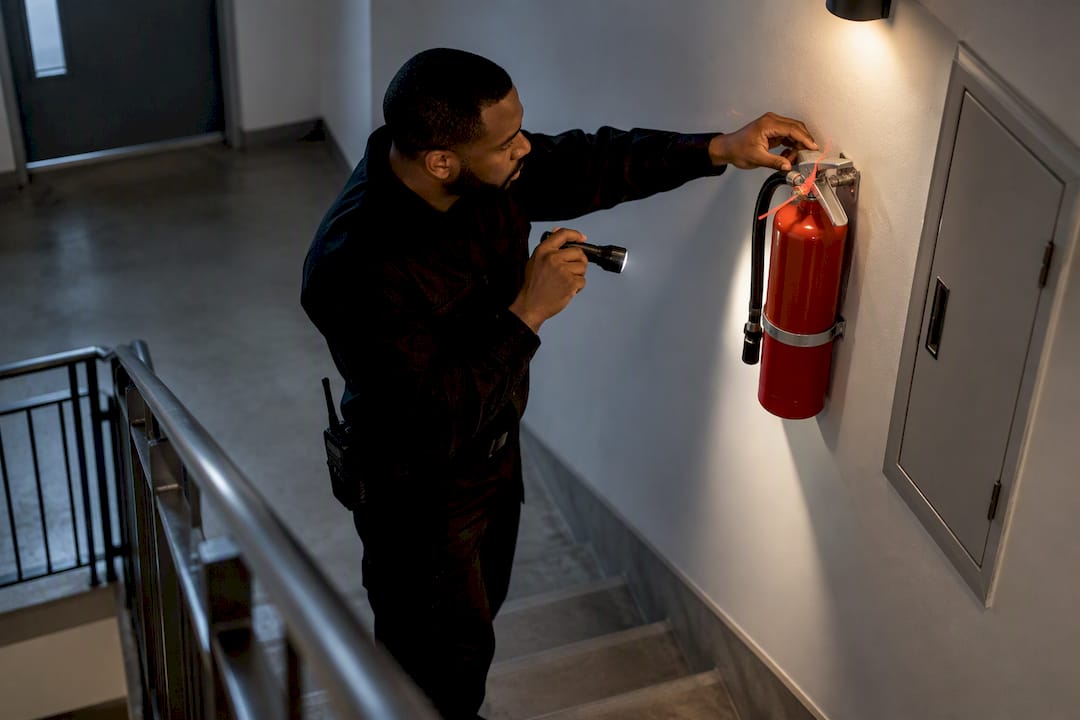
Not every guard on site is qualified to serve as a fire watch, and Boston Fire draws a real distinction between a hot work fire watch and a general impairment watch. Hot work assignments carry heavier equipment and training expectations because the ignition risk is immediate and localized, while an impairment watch is more about sustained observation across a wider area for as long as the system stays down.
Core duties look similar either way:
- Continuous observation or patrol of the affected area, never a fixed post at a lobby desk
- Immediate notification to 911 and building management the moment a hazard develops
- Authority to stop hot work on sight, with restart allowed only when a qualified person confirms it’s safe
- Working knowledge of valve locations, evacuation routes and the site’s specific impairment plan
A fire watch is a compensating measure Boston Fire approves for a specific impairment, not a staffing choice a building can make on its own. Reference: 527 CMR 1.00 FAQ. That approval, and the equipment that goes with it, matters as much as the person standing there: a communication device, a copy of the impairment log, extinguishers rated for the hazard, red tags, and written instructions with current contact numbers for the Fire Alarm Division and building engineer. A guard who can operate a radio but doesn’t know where the impaired valve is isn’t meeting the assignment.
4. How to work with Boston Fire on permits and notifications
Permitting is where most delays happen, usually because paperwork gets filed after the fact instead of before the outage. Boston Fire’s fire alarm system permitting page lists what a submittal needs, riser diagrams, sequence of operations, battery calculations, and notes that approved permits are valid for one year, so renewals should be tracked well ahead of expiration.
- File the sprinkler permit or fire alarm permit that matches the system going out of service, with supporting plans attached.
- Prepare an Extended Impairment Plan whenever the outage will run longer than eight hours or take a full system offline.
- Call the Fire Alarm Division to report the shutdown, then call again to report restoration, logging the exact times and any permit numbers on both calls.
- Hold onto acceptance and periodic test results and keep them accessible on site for the next inspection.
For places of assembly or events, the bar is higher still. Boston’s place of assembly permitting guidance expects current inspection reports, a working evacuation plan and functioning egress and emergency lighting. An impairment can be enough reason for Boston Fire to delay an event’s opening until those conditions are met.
5. What Boston property managers get wrong about fire watch
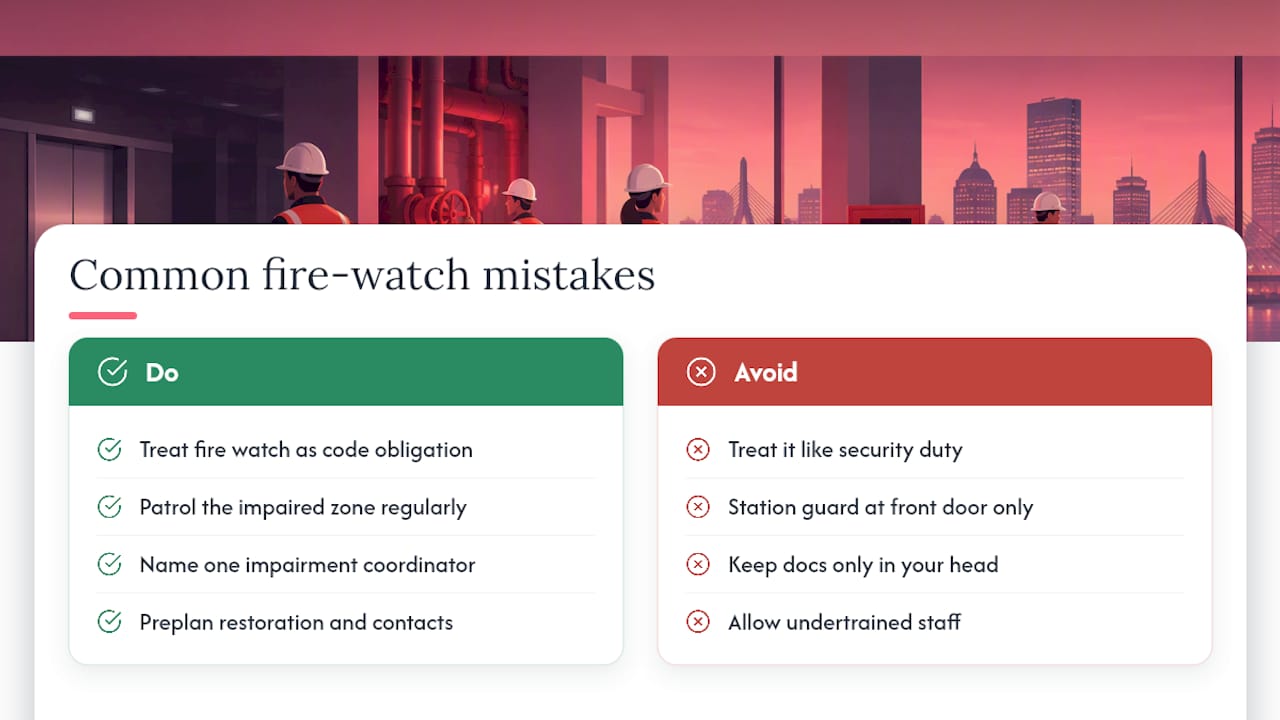
The most common mistake we see is treating a fire watch as a security assignment rather than a fire code obligation. A guard who watches the front door isn’t doing the job: the fire watch has to patrol the impaired zone, know the valve locations, and be ready to act, not just observe.
The second mistake is documentation that exists only in someone’s head. Missing impairment logs and undertrained staff are the two issues that turn a routine outage into a permit problem. The fix is straightforward: name one impairment coordinator per building, keep a preapproved contact sheet for the Fire Alarm Division, and plan restoration timing before the outage starts, not during it. Coordination with Boston Fire and with your licensed sprinkler or alarm contractor isn’t extra paperwork, it’s what gets your permit cleared and your system back in service without a second visit from an inspector.
— Derek
How Hub Investigative Group supports fire watch compliance
Coordinating a compliant fire watch while managing tenants, contractors and Boston Fire paperwork is a lot to carry alongside your regular workload. We provide trained fire watch staffing built around Boston’s impairment permit process, so your guard arrives already briefed on red-tag procedure, log requirements and evacuation routes rather than learning them on site.

Typical fire watch engagements often start with site assessments of impaired systems and building layouts, followed by staffing proposals sized to the hazard, documentation packages aligned with permits and impairment logs, and liaison with Boston Fire on notification and restoration timing. If your impairment overlaps with a planned event, our event emergency plan checklist covers the added requirements for larger assemblies. Property managers juggling repairs alongside the watch may also find value in coordinating maintenance workflow through resources like this emergency maintenance protocol guide for landlords. Visit our services page to request a site assessment and get a staffing proposal built around your building’s specific impairment.
Sources
FAQ
How long can a fire watch assignment last in Boston?
There’s no single fixed limit stated for every case: duration depends on how long the impairment lasts and what Boston Fire approves for that specific permit. An outage expected to run past eight hours, or one taking a full system offline, generally needs an Extended Impairment Plan rather than a standard same-day fix.
Who is qualified to serve as a fire watch person?
A fire watch needs someone trained on the site’s impairment plan, valve locations, evacuation routes and extinguisher use, not just a general security presence. Hot work assignments call for additional equipment and training compared with a general impairment watch, since the ignition risk is more immediate.
Do I need to notify Boston Fire when a system is restored, not just when it fails?
Yes. Boston’s Fire Alarm Division expects notification both when a system is shut down and again when it’s restored, with times and permit numbers logged on both calls, per the sprinkler permit requirements.
What NFPA standards apply to testing after an impairment ends?
Sprinkler, standpipe, pump and alarm systems are tested and inspected under the applicable NFPA standards, including NFPA 25 for water-based systems and NFPA 72 for alarms, referenced within Massachusetts’s fire code. Restoration isn’t complete until those acceptance or periodic tests are run and passed.
Can a building owner decide on its own to skip a fire watch during an impairment?
No. A fire watch is a compensating measure that Boston Fire approves for a given impairment, and owners shouldn’t assume one is or isn’t needed without confirming with the department first, according to the state’s 527 CMR 1.00 FAQ.