
The single most important step in hiring a Massachusetts private investigator is confirming state licensure before any money changes hands. Ask for the investigator’s license number, request proof of their surety bond and liability insurance, and put the scope of work in writing. Skip any of these three steps, and you’re gambling on a stranger’s word instead of the state’s oversight.
TL;DR:
- Verifying a private investigator’s license, bond, and insurance is quick, inexpensive, and essential to prevent legal issues or unreliable service.
- License verification involves checking the Massachusetts active investigators list, confirming the license type matches your needs, and obtaining proof directly from the investigator.
- Always ask for their license number, surety bond, and insurance before any engagement and confirm these details with the state’s Certification Unit.
- A reputable investigator explains legal boundaries upfront, avoids illegal methods like hacking or impersonation, and provides a written scope and terms of service.
- Cost varies depending on case complexity, with longer or digital searches inflating expenses, but licensed, experienced investigators generally reduce legal and court-related risks.
Table of Contents
- What Licenses and Credentials Massachusetts Law Requires for Private Investigators
- How Do I Verify a PI’s License Before Hiring?
- What Questions Should You Ask a Private Investigator?
- What Are the Legal Limits on Private Investigations in Massachusetts?
- What Does Hiring a Private Investigator Cost in Massachusetts?
- What Does a Reputable Massachusetts Investigative Firm Do Differently?
- Editorial Perspective: The Checklist Everyone Skips
- How Hub Investigative Group Can Help
- Where to Verify Licensing and Rules Yourself
- Sources
- FAQ
What Licenses and Credentials Massachusetts Law Requires for Private Investigators
Every private investigator operating in Massachusetts must be licensed by the Massachusetts State Police Certification Unit, the sole agency with authority to issue and revoke PI licenses statewide. The legal basis sits in Massachusetts General Laws Chapter 147, which spells out who needs a license and who’s exempt.
Getting licensed isn’t a rubber stamp. State law requires applicants to document three years of investigative work, or equivalent law enforcement or military experience, plus three character references from reputable citizens. Guard duty alone typically doesn’t count. Qualifying experience usually comes from private investigative firms, paralegal case work, insurance special investigation units, or documented bail recovery casework.
Before a license issues, the Certification Unit requires:
- A criminal background check and fingerprinting
- A $5,000 surety bond on file with the state
- Verified employment history and character references
- Proof of legal presence and minimum age requirements
Chapter 147 also carves out exceptions. Insurance adjusters, in-house corporate investigators handling internal matters, and certain limited inspection roles don’t need a separate PI license to do narrowly defined work. That doesn’t mean anyone can call themselves an investigator for hire.
How Do I Verify a PI’s License Before Hiring?
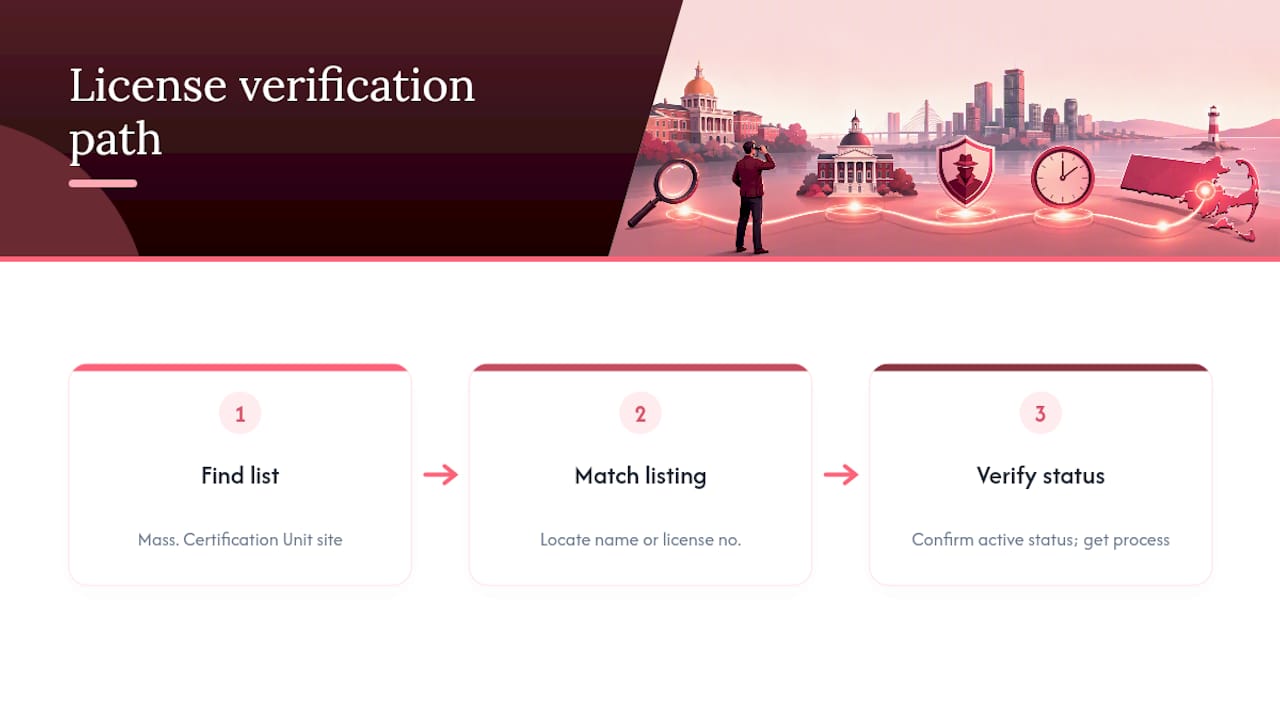
Verification takes fifteen minutes and it’s the cheapest insurance you’ll buy in this whole process. Here’s the order to do it in:
- Pull up the state’s active private investigators list and search the exact name and license number the investigator gave you.
- Review the PI license requirements page on Mass.gov to confirm the license type matches the work you need done.
- Ask the investigator directly for their license number, a copy of their surety bond certificate, and a current certificate of insurance. A licensed professional hands these over without hesitation.
- Call or email the Certification Unit to confirm the license is active, not suspended, and free of open complaints.
- Cross-check reviews and complaint history through the Better Business Bureau or your local consumer affairs office.
Pro Tip: Save a screenshot of the active license listing the day you verify it. If a dispute arises later, you’ll have a timestamped record that the investigator was properly licensed when you hired them.
What Questions Should You Ask a Private Investigator?
A legitimate investigator expects to be vetted. Treat the initial consultation like a job interview, because in every practical sense, it is one.
Ask about their experience with cases similar to yours whether that’s a background check, a fraud investigation, or a domestic matter. Ask what methods they intend to use and why. Ask how they document and preserve evidence, since a case can fall apart in court if the chain of custody has gaps. Ask how often they’ll update you and through what channel, phone calls, written reports, or a mix of both. And ask, point blank, to see their bond certificate and insurance proof if they haven’t already offered it.
Before signing anything, insist on a written agreement that covers:
- The exact scope of work and what “done” looks like
- Retainer amount, hourly rate, and how unused funds are handled
- Reimbursable expenses, such as travel, court filing fees, or database searches
- Confidentiality terms and how sensitive data will be stored and disposed of
- Termination and refund conditions if the case ends early
Watch for warning signs. An investigator who promises unrestricted access to someone’s phone or bank accounts, demands a large cash deposit with no contract, or can’t produce a single professional reference is telling you exactly what kind of engagement you’re about to have. Walk away.
What Are the Legal Limits on Private Investigations in Massachusetts?
Massachusetts is an all-party consent state for recorded conversations, which means an investigator generally can’t record a phone call or private conversation without every participant’s permission. This single rule trips up more amateur investigators, and self-styled “PIs,” than almost any other.
A licensed, experienced investigator will explain these boundaries before you hire them, not after something goes wrong. Legitimate Massachusetts firms prioritize legal compliance precisely because evidence gathered through illegal means, such as trespassing, unauthorized account access, or impersonating a police officer, is frequently thrown out of court and can expose both the investigator and the client to civil or criminal liability.
Red flags to avoid include any investigator who:
- Claims they can “get into” someone’s email, texts, or financial accounts without legal authorization
- Suggests posing as a utility worker, delivery driver, or officer to gain entry somewhere
- Guarantees a specific outcome, like winning a custody case or proving infidelity, before doing any work
No ethical investigator can promise a result. They can only promise a lawful, thorough process.
What Does Hiring a Private Investigator Cost in Massachusetts?
Costs vary by case type, but most Massachusetts investigators bill hourly, with flat fees reserved for standardized services like basic background checks. Surveillance and fraud cases tend to run longer and cost more because they require sustained hours in the field, sometimes across multiple days.
Factors that move the price include the complexity of the case, how much travel is involved, whether digital forensics or database searches are needed, and the investigator’s own experience level. Expect these general patterns:
- A retainer covering an initial block of hours, applied against the final invoice
- Additional charges for mileage, court appearance fees, or specialized database access
- A same-week initial consultation for most personal cases, with active investigative work typically starting within days
- Corporate due diligence or fraud cases running weeks longer than a routine background check or asset search
Investigators with verified licensing, insurance, and deeper case experience often charge more, but they also reduce your exposure if the case ever ends up in a courtroom.
What Does a Reputable Massachusetts Investigative Firm Do Differently?
A reputable Massachusetts investigative firm typically has a team built on combined law enforcement and loss prevention experience. That background shapes how the firm approaches every engagement, starting with the same verification standards this guide walks through.
A trustworthy Massachusetts firm should mirror this intake process:
- Confirm license, bond, and insurance status before discussing case details
- Put scope, cost, and reporting cadence in writing at the outset
- Explain legal boundaries up front, not after evidence is already collected
- Provide documented case handling that would hold up if challenged later
Ask any firm you’re considering to walk you through their own intake checklist before you commit.
Editorial Perspective: The Checklist Everyone Skips
Most hiring guides bury the license verification step under generic advice about “doing your research.” That’s backwards. The Massachusetts Certification Unit publishes an active investigators list specifically so clients don’t have to guess, and yet most people never open it before signing a contract.
The conventional wisdom treats cost as the primary decision factor. It shouldn’t be. A cheaper, unlicensed operator who records a private conversation without consent can hand you evidence that gets thrown out of court and a liability problem you didn’t have before you hired anyone. The state’s bonding and background check requirements exist because this industry has a real history of people overstepping legal lines when clients don’t ask hard questions.
What actually separates a good hire from a bad one in Massachusetts isn’t charisma or a slick sales pitch. It’s whether the investigator volunteers their license number before you ask, whether they explain wiretap law unprompted, and whether they’ll put their process in writing. If a firm hesitates on any of those three things, that hesitation tells you more than their résumé ever will.
— Derek
How Hub Investigative Group Can Help
Hub Investigative Group brings the same law enforcement and loss prevention background this guide recommends you look for, applied directly to private investigation services across Massachusetts. Some firms work from documented case handling and a scope-first process, helping clients understand costs before an investigator opens a file.

A first consultation is the right time to bring whatever documentation you already have: names, dates, prior reports, and a clear statement of what outcome you need. From there, Hub can scope surveillance investigations, background checks, asset searches, or corporate fraud matters based on the specifics of your situation, not a generic package. If your case involves a business relationship or a potential partner, the firm’s due diligence investigation work follows the same documentation standard. When contested facts or estate disputes are part of what’s driving your search, it’s worth reviewing common red flags in disputed matters so you know what kind of evidence actually holds weight later.
Reach out through Hub’s Boston hiring page to schedule a consultation and get a written scope for your case.
Where to Verify Licensing and Rules Yourself
- PI license requirements on Mass.gov
- Certification Unit contact information and applications
- M.G.L. Chapter 147, Section 23 on license requirements and exceptions
Sources
FAQ
Is Hiring a Private Investigator Worth It?
It depends on the stakes involved. For cases like fraud, missing persons, or high value asset searches, a licensed investigator can gather documented, legally sound evidence that you likely can’t obtain on your own without risking legal exposure.
Can a Private Investigator See My Text Messages?
Not without proper legal authorization, and never through hacking, phishing, or unauthorized account access. Massachusetts investigators who claim they can pull someone else’s texts without consent are describing an illegal act, not a service.
Can Hiring a Private Investigator Backfire?
Yes, particularly if the investigator uses illegal methods like unauthorized recording or trespassing. Evidence gathered that way is often inadmissible in court and can expose you to civil or criminal liability alongside the investigator.
Can a Regular Person Hire a Private Investigator?
Yes. Massachusetts residents and businesses alike can hire a licensed PI for personal matters, background checks, or corporate investigations. You should still verify the investigator’s license on the state’s active PI list before signing anything.