
Mobile patrol delivers three things a static guard post often can’t match at the same price: visible, unpredictable deterrence, verified check-ins across multiple locations, and cost-efficient after-hours coverage. Peer-reviewed research backs the deterrence effect, and modern GPS verification backs the accountability. The practical next step is knowing which contract terms actually prove a vendor is delivering, which is what the rest of this guide covers.
TL;DR:
- Mobile patrol’s deterrence effect increases with more frequent, unpredictable visits, as shown by research linking patrol dosage to crime reduction.
- Route planning efficiency depends on property clustering, with closely situated sites sharing officers more affordably than distant locations.
- Verification technology such as GPS or NFC checkpoints and timestamped photos is essential for proving patrols occur as scheduled.
- Contracts should specify minimum visit frequency, response times for alarms, incident report formats, and include a trial period with audit clauses for effective oversight.
- Chasing the lowest price without verifying patrol accountability often results in unreliable service and unconfirmed visitations.
Table of Contents
- Mobile Patrol Benefits Every Property Manager Should Know
- How Mobile Patrol Works, and When It Beats a Static Guard
- Proving the Patrol Actually Happened: Metrics That Matter
- Hub Investigative Group’s Approach to Mobile Patrol
- What Most Buyers Get Wrong About Patrol Contracts
- Get Verified Mobile Patrol Coverage for Your Property
- Sources
Mobile Patrol Benefits Every Property Manager Should Know
Mobile patrol security works because it multiplies presence across a footprint no single guard post could cover, then backs that presence with data you can audit. Below are the benefits worth putting on your checklist when comparing quotes, along with what each one should look like in a signed contract.
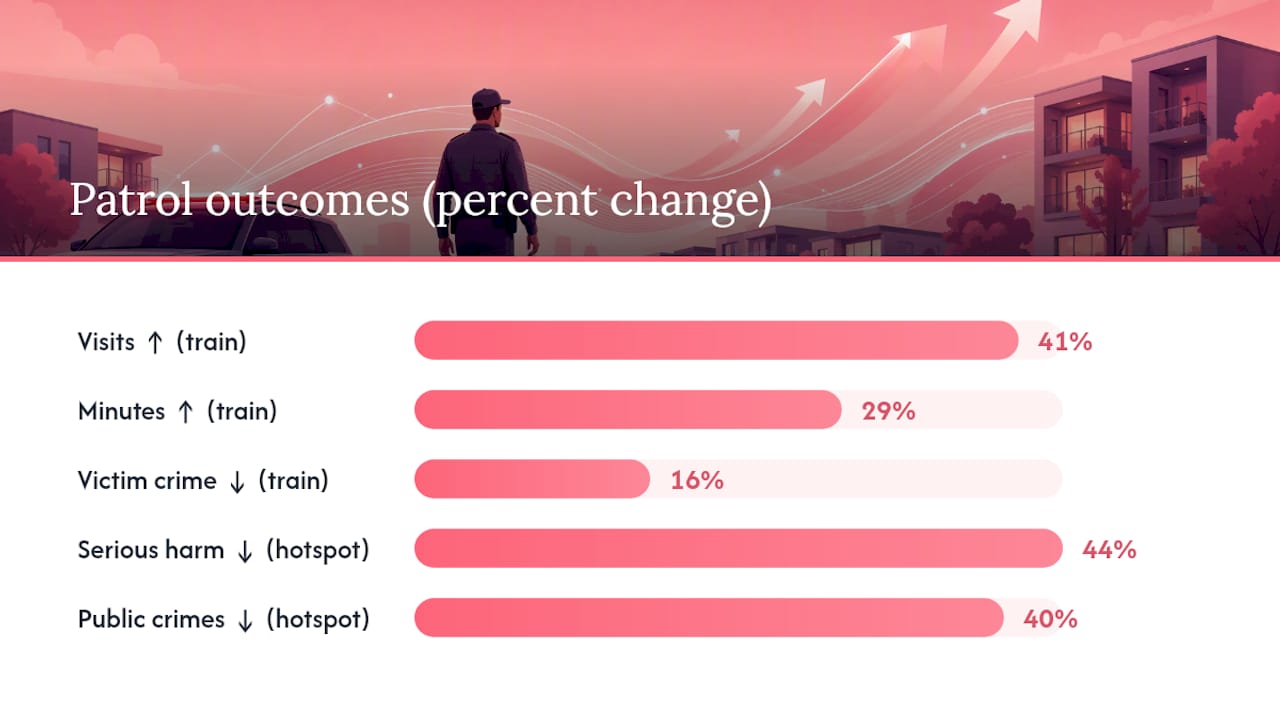
1. Visible deterrence backed by controlled research. A randomized controlled trial testing private security agents at train stations found that 41% more patrol visits and 29% more patrol minutes produced a 16% reduction in victim-generated crimes across the station complexes studied. That’s not a marketing claim. It’s a controlled experiment showing that more patrol dosage, delivered consistently, moves crime numbers down.
2. Surveillance of multiple locations from a single service. If you manage a multi-building campus, a string of vacant properties, or scattered retail sites, mobile patrol lets one officer cover ground a stationary post never could. Route density matters here: properties clustered close together share an officer more economically than sites spread across long drive distances, so ask any vendor how they build routes before you sign.
3. Alarm response and on-site verification. When an alarm trips at 2 a.m., a patrol officer already in the area can verify the cause in minutes rather than waiting for police dispatch on a call that’s often a false alarm. This single benefit is why many property owners pair patrol with their alarm systems rather than relying on either alone.
4. Cost-effectiveness compared to a static guard. A dedicated overnight guard post runs continuously whether or not anything happens. A roving patrol splits that cost across several properties or several scheduled visits per night, which is why the economics favor patrol for lower-traffic sites and reserve static staffing for locations with constant access-control needs.
5. Add-ons that extend the value of a visit. The strongest patrol contracts bundle services beyond the drive-by, including:
- Key holding and lockbox management for after-hours access
- Scheduled open/close services for retail or office tenants
- Escort services for staff walking to vehicles after dark
- Basic infrastructure checks (lights out, doors ajar, leaks, fencing damage)
6. Flexibility across armed, unarmed, and scheduling formats. Some properties need armed coverage because of prior incidents or higher-value assets; others need unarmed presence and reporting only. Good vendors also scale up patrol frequency seasonally, around holidays, construction phases, or known local crime spikes, rather than running one fixed schedule year-round.
7. Accountability through GPS and NFC verification. Every promise above is only as good as the proof behind it. Demand GPS or NFC checkpoint verification, timestamped photos, and digital incident reports in writing before you sign. A patrol log with no location data is just an invoice with a story attached.
How Mobile Patrol Works, and When It Beats a Static Guard
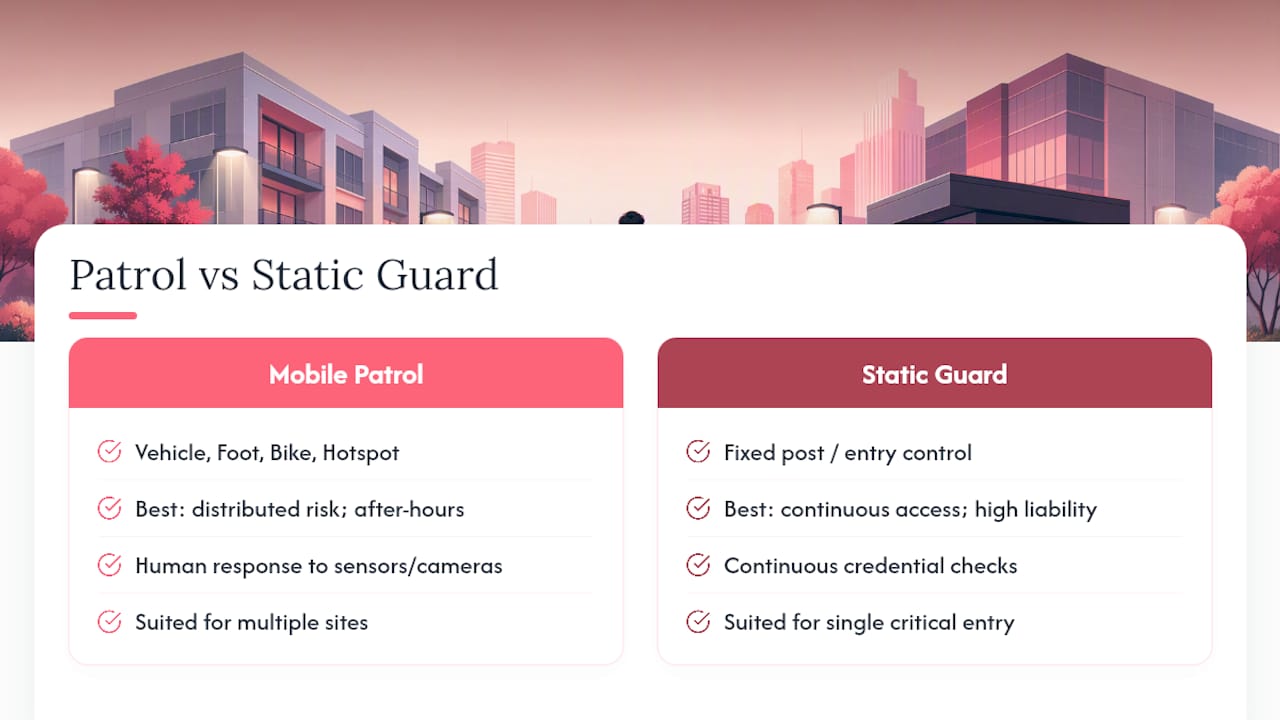
Mobile patrol takes a few operational forms: roving vehicle patrols that sweep a route on a schedule, foot patrols for dense pedestrian areas, bike patrols for parks and campuses, and hotspot tasking, where an officer is directed to a specific trouble spot flagged by data or a prior incident.
The decision between patrol and a stationary guard usually comes down to exposure pattern. Choose patrol when risk is distributed across multiple sites or concentrated in after-hours windows. Choose a static guard when a property needs continuous access control, like a single entry point checking credentials all day, or a high-liability area where any gap in coverage is unacceptable.
The two aren’t mutually exclusive. Many properties run cameras and alarm monitoring as the constant layer, then use patrol as the human response that walks the property, checks blind spots cameras miss, and physically verifies what a sensor only guesses at.
Pricing generally falls into three shapes: per-visit fees, monthly flat packages, or hourly rates for a dedicated roving unit, and each billing method suits a different coverage need. Before signing, confirm four items: what verification technology is included, what the response time commitment is for alarm calls, whether officers are armed or unarmed, and what insurance coverage backs the contract.
Pro Tip: Ask for a two-week trial period with daily GPS logs before committing to a full-year contract. Comparing the logged visit times against what you’re told happened is the fastest way to catch a vendor running predictable, low-effort routes.
Proving the Patrol Actually Happened: Metrics That Matter
Frequency and unpredictability drive results more than raw minutes on-site. The train station trial found that a 41% jump in visits with 29% more total minutes cut victim-generated crime by 16%, and a separate crossover trial testing 15-minute foot patrols in high-crime hot spots found 44% lower serious-violence harm scores and 40% fewer public crimes against personal victims on the days patrols ran. Short, frequent, unpredictable visits outperform long, predictable ones.
That unpredictability works through what researchers call the phantom effect: offenders can’t tell when a patrol will show up, so the perceived risk of getting caught stays elevated even during the hours no one is physically present. Randomized visit windows aren’t a scheduling quirk. They’re the mechanism that makes the deterrence stick.
When you negotiate a contract, ask for these specifics in writing:
- Minimum patrol visits per week, not just “regular checks”
- Minimum dwell time per visit, since a 30-second drive-by proves little
- Average response time to alarm triggers
- Format and frequency of incident reports, ideally with photos and timestamps
- Whether the vendor uses tasking apps to direct officers to flagged hotspots rather than a fixed loop
Audit these numbers monthly against the actual GPS logs, not the vendor’s summary narrative.
Hub Investigative Group’s Approach to Mobile Patrol
Hub Investigative Group was founded in 2004 in Boston, built on more than seventy-five years of combined law enforcement and loss-prevention experience among its team. That background shapes how the firm structures mobile patrol engagements, from vacant-property programs with randomized weekly checks to alarm response coordinated directly with local police.
A professional vendor should hand you, at minimum:
- Verified patrol logs tied to GPS or NFC checkpoints
- Timestamped incident photos when something is flagged
- Documented coordination with police when a response is needed
- Monthly performance summaries you can compare against your contract terms
Property managers evaluating commercial site security or active construction sites can request a site-specific quote to see how these deliverables apply to their property.
What Most Buyers Get Wrong About Patrol Contracts
The biggest procurement mistake is chasing the lowest per-visit price while ignoring verification technology. A cheap “check” with no GPS log proves nothing happened, or that it happened for ten seconds from a car window. Hybrid coverage, cameras paired with patrol, tends to beat either alone for properties with real perimeter exposure. The negotiation wins worth pushing for are a trial period with an audit clause, explicit response-time commitments, and financial penalties for missed visits. Vet the vendor’s staff vetting process too; a background-checked patrol team is worth more than a cheaper one you can’t verify.
— Derek
Get Verified Mobile Patrol Coverage for Your Property
A professional security company runs mobile patrol with randomized visit windows, GPS-verified checkpoints, and documented reports instead of a vague promise that someone “drove by.” A site assessment looks at a property’s layout, access points, and risk profile, then builds a patrol schedule sized to actual exposure rather than a one-size-fits-all loop. Clients typically get logged visitation with timestamps, coordinated alarm response when needed, and monthly reports they can audit against the contract.

If your current coverage can’t produce a GPS log to back up what you’re being billed for, that’s the gap to close first. Request a quote or schedule a site assessment with Hubsecurityandinvestigativegroup to see what a verified patrol program looks like for your property.
Sources
- Lowering the threshold of effective deterrence—Testing the effect of private security agents in public spaces on crime: A randomized controlled trial
- Hiresecuritynow
- Implementation and evaluation of tasking apps for hotspots policing