
NORTH SHORE, MASS. — For people who live in a condominium on Massachusetts’ North Shore, security is rarely something they think about when they first choose a place to live.
By Hub Security and Investigative Group
They think about the view. They think about the location. They think about being close to the water, restaurants, shopping, commuter routes and everything that makes communities such as Salem, Beverly, Peabody, Lynn, Swampscott, Marblehead and surrounding North Shore towns attractive places to call home.
But once residents move in, the realities of condominium living quickly become apparent. Dozens, sometimes hundreds, of people may share the same entrances, hallways, elevators, parking garages and common areas. Delivery drivers arrive throughout the day. Contractors come and go. Guests visit residents. Maintenance workers need access to different parts of the property. Packages accumulate in mailrooms and package rooms. And after dark, the people responsible for managing a building may not even be there.
That is why an increasing number of condominium communities are taking a closer look at professional security. For Hub Security and Investigative Group, the issue is straightforward: a condominium is not simply a collection of individual homes. It is a shared property with shared security responsibilities.
Hub, a Massachusetts-licensed security and investigative company founded in 2004, provides security services for residential buildings, condominiums and commercial properties throughout Massachusetts. The company specifically lists the North Shore among the areas it serves.
The company’s approach goes beyond simply placing a uniformed guard in a lobby. Hub says its officers can handle access control, visitor management, interior and exterior patrols, parking enforcement and tenant-related security issues. Its residential services are designed around the particular needs and vulnerabilities of each property. For condominium residents and the boards that represent them, that distinction can be important.
A Condominium Is a Community, Not Just a Building
The security challenges facing a condominium are different from those facing a single-family home. At a private home, there is generally one household controlling access to the property. In a condominium, the front door may be used by dozens of residents and their guests every day.
Someone carrying a package may be legitimate. Someone entering behind another resident may be legitimate. A contractor may have authorization to be there. A visitor may have been invited. But without proper procedures, it can be difficult to distinguish between people who belong in a building and those who do not. That is where professional security can play an important role.
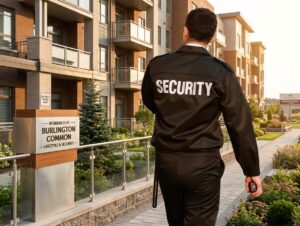
Hub’s building security services include lobby access control, visitor check-ins, vendor passes and monitoring of keycard access systems. Officers can also conduct interior and exterior patrols of hallways, stairwells, garages, laundry facilities and common areas.
The goal isn’t to make residents feel as though they are entering a heavily guarded facility. It is to create an environment where residents know that someone is paying attention.
The North Shore Presents Its Own Security Challenges
The North Shore is a diverse region. A condominium in downtown Salem may face different circumstances than a residential development in Beverly. A waterfront property in Swampscott or Marblehead may have different needs than a larger condominium community in Peabody or Lynn.
Some properties have underground parking. Others have large outdoor lots. Some have concierge desks and controlled elevators. Others have multiple entrances spread across a larger property. Some buildings are occupied around the clock. Others become considerably quieter late at night. There is no single security formula that works for all of them.
Hub’s website emphasizes customized security programs rather than a one-size-fits-all approach. The company says it evaluates individual locations and creates security solutions based on the client’s specific needs. That can be especially important for condominium associations, where security decisions ultimately affect hundreds of residents and a substantial shared investment.
A Uniformed Officer Can Change the Feel of a Property
There is also a psychological component to security. A uniformed officer standing in a lobby or conducting a patrol sends a message. Someone is watching. Someone is available. Someone is responsible for paying attention to what is happening on the property. That visible presence can discourage unwanted behavior while giving residents another person to turn to when something doesn’t look right.
Hub provides uniformed security officers and residential concierge security, with officers trained to combine customer service with security responsibilities. For a condominium, that combination matters. A security officer may be the first person a resident sees when coming home at night. The officer may help a visitor find the correct entrance, direct a delivery driver, monitor access to the building or report a problem to property management. Security, in other words, can be part of the resident experience.
The Package Room Problem
There is another modern reality that condominium communities have had to confront: the explosion in home deliveries. Packages arrive every day. Sometimes dozens arrive within a few hours. Food deliveries, online purchases, prescription deliveries and larger shipments all create additional traffic through residential buildings.
The package room can become one of the busiest areas in a condominium—and one of the areas most difficult for property managers to monitor. Professional security can provide another set of eyes. Officers can monitor entrances, observe unfamiliar activity and make sure visitors and delivery personnel follow established building procedures. That does not eliminate theft. But it can make a property less attractive to someone looking for an easy opportunity.
Parking Garages Are Often Forgotten
Ask residents what areas of their condominium make them most uncomfortable at night, and parking garages are likely to be high on the list. A garage can be quiet, poorly occupied and separated from the main entrance. Residents returning home late may walk alone from their vehicles to an elevator. A professional patrol can change that dynamic.
Hub provides mobile patrol and building security services, including patrols of parking garages and exterior areas. The company’s building-security program also includes scheduled and randomized inspections. For a condominium association, that means security doesn’t necessarily have to stop at the front door.
Security Can Also Mean Preventing Expensive Problems
Crime is not the only concern. A security officer walking a property may notice a damaged door, an unsecured entrance, a broken light, a water leak or another condition that could eventually become a much bigger problem. Hub says its patrol officers are trained to identify security vulnerabilities and environmental hazards during property inspections.
That proactive approach is particularly valuable for property managers. A broken lock discovered during a routine patrol can be repaired. An unsecured door left unnoticed for several days can become a much bigger security issue. The same principle applies to lighting, emergency exits, access points and other parts of a property.
Experience Matters When Something Actually Happens
The real test of a security company isn’t what happens when everything is quiet. It is what happens when something goes wrong. A resident reports a suspicious person. A dispute develops in a common area. Someone attempts to enter a restricted portion of the building. A vehicle is damaged in the parking garage. A resident reports a theft. A door is discovered propped open. In those moments, training and judgment matter.
Hub describes itself as more than a traditional security guard agency. The company is also a Massachusetts-licensed private detective firm, and its senior management team has more than 75 years of combined law-enforcement and loss-prevention experience. That investigative background is one of the characteristics that Hub says separates it from traditional guard companies.
Residents Notice the Difference
Security companies often talk about training, professionalism and responsiveness. Residents and property managers ultimately decide whether those promises are reflected in day-to-day service.
Hub currently displays a 5.0-star Google rating with more than 38 reviews on its website. One customer wrote: “Highly recommend! Derek is extremely professional, thorough and went above and beyond.” Another reviewer described Hub’s responsiveness and ability to handle changing circumstances favorably, while a separate customer praised the company’s effectiveness in managing a crowd and reducing potential risks at an event.
Those comments may have been written about different types of assignments, but the qualities they highlight—professionalism, communication, flexibility and being proactive—are also important to residential communities. A condominium association does not want a security company that simply fills a shift. It wants a company that pays attention.
Consistency Can Be Just as Important as Presence
For residents, familiarity can make a difference. People begin to recognize the security officer at the front desk. The officer learns the property. The officer becomes familiar with regular vendors and contractors. Residents begin to know who to contact when they have a concern.
Hub says that for recurring and long-term assignments, it makes an effort to provide consistent personnel so officers and clients can become familiar with the property, its procedures and its expectations. That consistency can be particularly valuable in condominium communities. Security works better when the people providing it understand the property they are protecting.
The Human Side of Condominium Security
There is another reason condominium communities may want to think carefully about the security company they choose. Security officers are dealing with people. They interact with residents coming home from work. They encounter elderly residents, families, children, guests and contractors. They may be the first person someone approaches after an incident. That requires more than physical presence. It requires judgment and professionalism.
Hub says its officers are licensed in Massachusetts and that its security programs are built around site-specific procedures and training. For residents, the result should be simple: security that feels professional without making the property feel uncomfortable.
North Shore Condo Boards Are Protecting More Than Buildings
For condominium board members and property managers, security decisions involve more than keeping doors locked. They are protecting people’s homes. They are protecting common property. They are protecting parking areas, amenities and building infrastructure. And they are helping protect one of the largest financial investments many residents will ever make.
A well-run security program can become part of the overall management of a property. It can help identify vulnerabilities. It can provide a visible deterrent. It can help control access. It can provide assistance to residents and visitors. And it can give property managers another resource when something unexpected happens.
Why Some North Shore Communities Are Looking Beyond the Traditional Guard Company
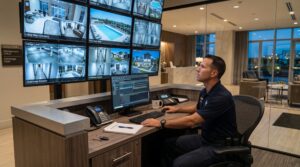
For years, condominium communities often viewed security as a fairly simple proposition: hire guards, put them at the entrance and keep the building secure. The modern condominium is more complicated. There are electronic access systems, surveillance cameras, package rooms, parking garages, multiple entrances, contractors, delivery services and increasingly sophisticated expectations from residents. Security has had to evolve with the property.
Hub’s approach combines physical security with technology, patrols, access control and investigative capabilities. The company says its goal is to develop site-specific security plans rather than relying on generic procedures. For a North Shore condominium, that can mean designing a program around the actual building instead of trying to force the building into a predetermined security package.
From Salem to Beverly, Peabody and Lynn
Hub identifies the North Shore as part of its Massachusetts service area, with its website specifically naming communities including Lynn, Salem, Peabody and Beverly. That local reach is important. A security company doesn’t operate in a vacuum. Understanding the geography of a property, its surrounding neighborhoods, traffic patterns, nearby businesses and local emergency resources can all contribute to a more effective security plan.
Hub says its local roots allow the company to work closely with clients and public-safety stakeholders throughout Massachusetts. For condominium associations, that local relationship can be valuable when developing emergency procedures and determining how security personnel should respond when an incident occurs.
Security Isn’t About Making Residents Afraid
Perhaps the most important point is also the simplest. Good condominium security should not make residents afraid. It should make them feel comfortable. Residents should be able to walk into their lobby, park their car, pick up their packages and return home at night without constantly thinking about security.
The best security programs operate in the background. They are visible when they need to be visible. They are responsive when something happens. And they are professional enough that residents know someone is paying attention. That is the role Hub Security and Investigative Group says it aims to play for residential communities throughout Massachusetts.
A Safer Feeling Starts With the Right Security Partner
There is no security system that can eliminate every risk. There is no guard who can predict every incident. And no condominium can completely control everything that happens around it. But property owners and condominium associations can make decisions that reduce vulnerabilities and create a stronger security environment.
For North Shore condominium communities, that may mean adding a uniformed officer to the lobby, establishing overnight patrols, improving visitor management, monitoring a parking garage or creating a comprehensive security program that combines several of these services. Hub Security and Investigative Group offers those services throughout Massachusetts and specifically serves North Shore communities.
For residents, the benefit is ultimately about peace of mind. For property managers, it is about having a professional resource they can depend on. And for condominium boards, it is about taking a proactive approach to protecting the community they represent.
As one Hub customer put it, the company’s personnel are valued for being “professional” and “always responsive.” Those may sound like simple words. For someone coming home to a condominium late at night, they can mean quite a lot.
Hub Security and Investigative Group
Founded in Massachusetts in 2004, Hub Security and Investigative Group provides security and investigative services throughout the Commonwealth, including the North Shore. The company offers residential and condominium security, uniformed officers, mobile patrols, access control, concierge security, event security and investigative services.
For North Shore condominium associations, property managers or residents interested in discussing their property’s security needs, Hub offers consultations and 24/7 dispatch.
Hub Security and Investigative Group
24/7 Dispatch: (617) 857-1200
Because feeling safe at home should not be a luxury—it should be part of what home means.
https://www.instagram.com/hubsecinvestigative/
https://www.facebook.com/HubSecurityAndInvestigativeGroup/