
Executive Protection Cost: What You Should Budget in 2026

What does executive protection actually cost?
Executive protection cost in the United States varies widely for a single agent, depending on risk level, location, and specialization. Annual programs for high-net-worth families vary significantly based on program scope. That spread is not vague. It reflects real differences in threat profile, detail size, and the depth of services behind the visible agent.
Here is what the pricing landscape looks like in practice:
- Hourly rates: $50 to over $300 depending on risk, location, and specialization, with standard unarmed assignments typically at the lower end and armed or specialized details commanding higher rates
- Daily rates: Vary widely by agent qualification and market, often $1,200 to $2,500 per agent per day
- Basic annual program (Head of Security, three agents, standard technology): $300,000–$450,000
- Mid-tier program (intelligence monitoring, TSCM sweeps, domestic travel security): $600,000–$1,000,000
- Comprehensive international program (full in-house team, multi-property, dedicated intelligence): $1,000,000–$2,500,000
The difference between a solo bodyguard and a full executive protection detail is not just headcount. A complete detail typically includes a lead agent, a driver, and an advance agent who scouts locations before the principal arrives. Each role adds cost, and each role serves a distinct function that a single guard cannot replicate.
Key factors that drive executive security pricing
No two protection programs cost the same, because no two risk profiles are identical. Understanding what moves the number helps you build a budget that matches your actual exposure.
Threat level and risk profile

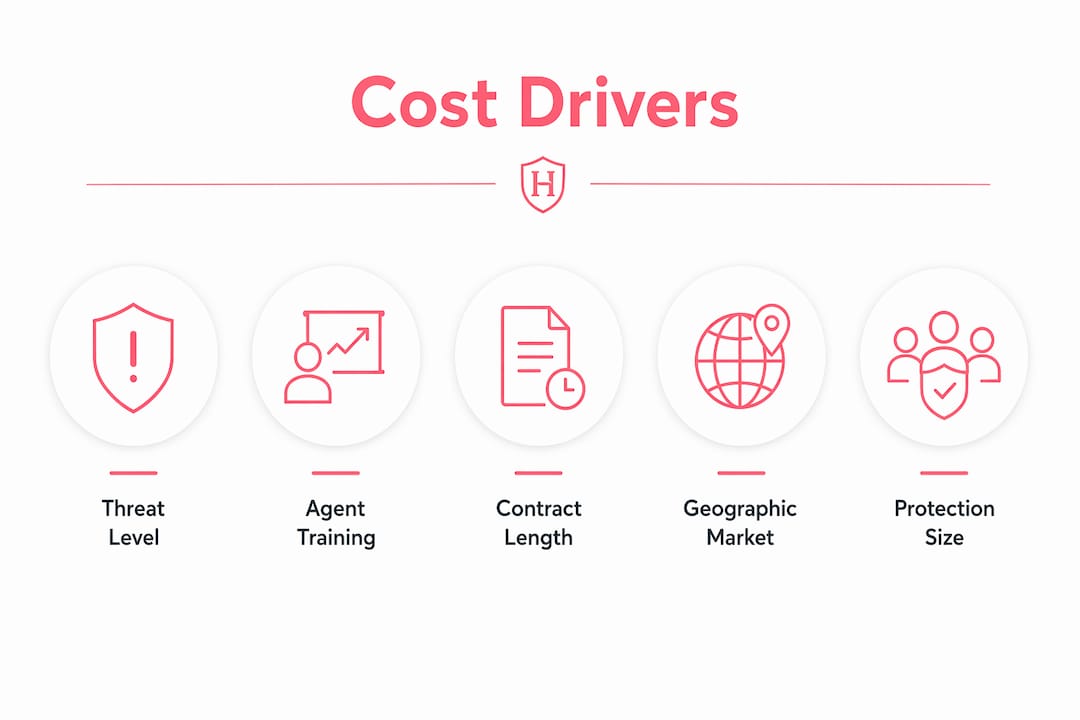
A CEO navigating a public controversy or a corporate restructuring faces a materially different threat surface than a private individual attending a gala. Higher threat levels require more personnel, more sophisticated intelligence monitoring, and faster response infrastructure. The threat assessment, not a price list, should drive the staffing decision.
Armed vs. unarmed protection
Armed details cost significantly more than unarmed assignments. In New York State, armed agents are required to hold a valid pistol permit and complete state-mandated firearms training. Agencies carrying armed personnel also pay higher liability insurance premiums. For many high-profile clients, armed protection is non-negotiable. For others, a discreet unarmed specialist delivers the right posture without the added overhead.
Detail size and team composition
- Solo agent: covers daily movement and basic close protection
- Two-agent team: adds a dedicated driver, enabling simultaneous coverage and advance work
- Full detail: lead agent, driver, and advance agent working in rotation
Agent qualifications and specialized training
Agents with elite military or law enforcement backgrounds command premium rates. Professionals with EMT or paramedic certification, bilingual capabilities, or evasive driving credentials add measurable value in high-stakes environments. That expertise is reflected in their billing rate.

Contract duration and structure
Ad-hoc coverage for a three-day event costs more per day than a long-term monthly retainer. Longer contracts allow agencies to schedule rotating teams efficiently, which reduces per-day overhead. There is a typical breakeven point where shifting from contract to in-house protection becomes financially prudent based on annual spending.
Geographic market
New York City rates tend to be significantly higher than national medians due to licensing complexity, cost of living, and risk profiles. Boston, Los Angeles, and Washington, D.C. carry similar premiums relative to smaller markets.
Pro Tip: Longer-term contracts almost always produce better cost efficiency. A six-month retainer locks in a dedicated team, reduces scheduling gaps, and gives the agency room to invest in advance work and intelligence preparation that short-term engagements cannot support.
Additional costs and hidden expenses you need to budget for
The agent’s daily rate is the visible line item. The operational infrastructure behind that agent is where budgets routinely come up short.
- Travel and advance work: International trips with multi-agent details can add considerable expenses beyond regular compensation for logistics and advance work.
- Technology and security infrastructure: Installation and ongoing costs for camera, surveillance, access control, alarm, and intrusion detection systems vary widely by property size and technology level.
- Secure communications: Secure communications systems for security teams represent a notable investment that varies based on system complexity.
- Armored vehicles: $60,000–$150,000 per vehicle when the threat profile warrants it; standard security vehicles run $45,000–$80,000.
- Multiple properties: Managing multiple properties involves significantly higher infrastructure costs due to the need for separate security systems at each location.
- Management and administrative overhead: 24/7 dispatch capabilities and senior leadership oversight are not optional add-ons. They are what keep agents coordinated, informed, and ready to respond.
- Specialized services: TSCM (technical surveillance countermeasures) sweeps, intelligence monitoring, and medical support add cost but close gaps that standard guarding leaves open.
Technology and infrastructure costs for single-property programs can be substantial upfront, with ongoing annual maintenance expenses. Families and organizations that skip this line item often discover the gap after an incident, not before.
For organizations managing sensitive communications alongside physical security, email security for law firms represents a parallel layer of protection that complements physical executive protection planning.
How to vet an executive protection agency
Price alone tells you almost nothing about whether an agency can actually protect your principal. Here is what to evaluate before signing a contract.
- Threat assessment-driven proposals: A quality proposal is built on a documented threat assessment, not a flat-rate menu. If an agency quotes you a price without first understanding your risk profile, travel patterns, and exposure, that is reactive guarding, not executive protection.
- Agent credentials: Look for verifiable military or law enforcement backgrounds, specialized training records, and relevant certifications. Ask specifically about EMT or paramedic qualifications if medical emergencies are a concern.
- Licensing compliance: For armed details, confirm that every agent holds the required state permits. In New York, that means a valid pistol permit and documented completion of the 47-hour firearms training course.
- Insurance coverage: Agencies operating armed details must carry high-liability insurance. Ask for proof of coverage and confirm it extends to your specific operating environment.
- Operational infrastructure: Does the agency offer 24/7 dispatch? Is there senior leadership oversight on active details? These are not luxury features. They are the difference between a coordinated response and an isolated agent making decisions alone.
- Local intelligence and geographic experience: An agency with deep roots in your operating area brings knowledge that no out-of-market firm can replicate quickly. Former NYPD professionals, for example, understand Manhattan logistics at a precinct level.
Pro Tip: Ask any agency to walk you through their advance work process for a hypothetical trip. A firm that describes scouting routes, identifying trauma centers, and mapping secondary exits is practicing real executive protection. A firm that describes “showing up early” is not.
Why threat assessment-based pricing protects your budget
Flat-rate pricing is the most common mistake buyers make when evaluating personal protection service cost. When an agency prices a program without a documented threat assessment, they are guessing at your risk level. That guess usually produces one of two outcomes: you overpay for coverage you do not need, or you underpay and leave genuine gaps in your security posture.
A properly conducted threat assessment identifies actual vulnerabilities, maps your exposure by location and activity, and produces a staffing and resource plan tied to real risk. That process shapes every line item in the budget, from the number of agents on rotation to whether TSCM sweeps are quarterly or monthly. Pricing based on documented assessments also gives you a defensible record of why each cost exists, which matters when presenting a security budget to a board or a family office.
Reactive guarding, the kind that comes from flat-rate proposals, tends to surface its costs after an incident rather than before. The intelligence-led approach that characterizes genuine executive protection planning costs more upfront and consistently costs less over time.
Typical budget ranges by protection level
Your total annual spend depends on which tier of protection your risk profile actually requires.
| Protection level | Annual budget range | What it covers |
|---|---|---|
| Basic contract detail | $300,000–$450,000 | Residential security, access control, basic travel coordination |
| Mid-tier program | $600,000–$1,000,000 | Adds TSCM sweeps, intelligence monitoring, domestic travel security |
| Comprehensive program | $1,000,000–$2,500,000 | Full in-house team, international travel, multi-property, dedicated intelligence |
| Hybrid model | $300,000–$450,000 | Small in-house core team plus contract support for travel and events |
The hybrid model suits organizations with variable needs. A small permanent team handles daily residential security and program management, while contract agents cover travel, events, or periods of elevated threat. It is the most common structure for families and executives who need consistent protection without the full overhead of a permanent large team.
What standard pricing includes vs. what costs extra
Knowing what a base contract covers prevents budget surprises when the invoice arrives.
Typically included in standard pricing:
- Close protection during scheduled movements
- Driver and vehicle coordination for daily routes
- Basic advance work for known locations
- Agent scheduling and rotation management
- Incident reporting and communication with the client
Common add-ons that increase cost:
- International travel logistics and foreign jurisdiction advance work
- TSCM sweeps and electronic surveillance detection
- Dedicated intelligence monitoring and social media threat tracking
- Armored vehicle procurement and maintenance
- Medical support personnel or EMT-certified agents on detail
- Safe room installation and residential hardening
- Multi-property security infrastructure beyond the primary residence
Understanding security guard pricing factors helps you read a contract line by line and ask the right questions before you sign. The gap between what a standard contract covers and what your situation actually requires is where most clients encounter unexpected costs.
Hubsecurityandinvestigativegroup offers executive protection services leveraging extensive law enforcement and loss prevention experience.
Hubsecurityandinvestigativegroup brings over seventy-five years of combined law enforcement and loss prevention experience to every client engagement. Based in Boston and established in 2004, we build protection programs around your actual risk profile, not a price list. That means every proposal starts with a threat assessment, every agent carries verifiable credentials, and every detail is backed by the operational infrastructure that keeps protection proactive rather than reactive.
Whether you need a single qualified agent for a high-profile event, a full close protection detail for extended travel, or a layered residential security program, we tailor the scope to your exposure. Our team includes professionals with military, law enforcement, and specialized investigative backgrounds, and we offer both armed and unarmed protection depending on your risk level and jurisdiction. For executives, corporate clients, and high-profile individuals who need personal protection services they can trust, Hubsecurityandinvestigativegroup is the firm that treats your safety as a partnership, not a transaction. Contact us today to request a threat assessment and get a program proposal built around your specific needs.
Key Takeaways
Executive protection cost is determined by threat level, detail size, agent qualifications, and contract structure, with annual program costs varying widely based on scope.
| Point | Details |
|---|---|
| Hourly rates for executive protection agents typically range from $50 to over $300 depending on risk level, location, and specialization. Daily rates vary widely by market and agent qualifications. | |
| Travel adds significant cost | International trips with multi-agent details typically add significant logistical expenses beyond regular compensation. |
| Infrastructure is a major line item | Technology and security system costs for a single property can be substantial initially, with ongoing annual expenses. |
| Threat assessment drives accurate budgeting | Flat-rate proposals signal reactive guarding; documented assessments align spending with actual risk. |
| Hubsecurityandinvestigativegroup | Offers threat assessment-based executive protection in Boston, with armed and unarmed options backed by law enforcement expertise. |
Recommended
- Understanding Security Guard Pricing: What Determines the Cost of Protection? – Hub Security & Investigative Group
- 1.Understanding Security Guard Pricing: What Determines the Cost of Protection? – Hub Security & Investigative Group
- $1,000,000 Is That A Lot For Executive Security: Why Hub Security and Investigative Group Are the Best Choice to Protect Your Leadership – Hub Security & Investigative Group
- Political Event Security: Why Stronger Protection Plans Are Essential to Prevent Shootings – Hub Security & Investigative Group