
Protective intelligence is the proactive process of identifying, assessing, and managing people or behaviors that could pose a targeted threat before that threat becomes an incident. Its primary goal is prevention, not reaction. Executives, corporate security teams, and investigators use it to spot warning signs early and intervene while options are still open, rather than responding after a confrontation has already happened.
TL;DR:
- Most protective intelligence programs should focus on monitoring social media, public records, and tip lines for early warning signals before escalation occurs.
- Assessments must evaluate intent, capability, proximity, and escalation patterns, requiring continuous risk reevaluation over time.
- Corroboration through factual evidence and lawfully obtained information is essential to distinguish genuine threats from false positives.
- Small organizations can start with simple OSINT hygiene and alerts, scaling to case management and professional support as risk increases.
- Legal, privacy, and resource limitations demand strict boundaries and experienced judgment to balance threat response with ethical considerations.
Table of Contents
- What Is Protective Intelligence, and When Do Organizations Use It?
- How Does the Identify, Assess, Mitigate Process Work?
- What Investigative Methods and Principles Guide Protective Intelligence?
- How Do You Build a Basic Protective Intelligence Capability?
- Practical Checklist: Reducing Exposure and Starting Basic Monitoring
- What Role Do Risk Assessment Frameworks Play?
- What Are the Basic Methods for Threat Assessment and Prioritization?
- What Challenges Limit Protective Intelligence Programs?
- How Practitioner Experience Shapes Protective Intelligence Work
- Where to Learn More About Protective Intelligence
- Sources
- FAQ
What Is Protective Intelligence, and When Do Organizations Use It?
Protective intelligence sits at the intersection of investigation and prevention. It differs from general threat intelligence, which tends to focus on broad categories of risk like cybercrime trends or industry-wide fraud patterns, and from executive protection, which is the physical, boots-on-the-ground work of guarding a person. Protective intelligence is the analytical layer that tells a protection team who might pose a risk, how serious that risk is, and what to do about it. Industry guides describe protective intelligence as a proactive program that blends monitoring, behavioral assessment, investigation, and case management to prevent targeted violence before it starts.
Organizations typically build a protective intelligence capability after a triggering event, a public controversy, an executive departure that draws blame, or simply because leadership’s public profile has grown enough that the risk calculus has changed. Common threat categories that a basic program addresses include:
- Stalking and fixated behavior, where someone develops an unhealthy preoccupation with a specific person
- Targeted attacks, planned violence aimed at a named individual or facility
- Workplace violence, often tied to termination, disciplinary action, or interpersonal conflict
- Impersonation and identity-based fraud, where someone poses as an executive or staffer to manipulate employees or clients
How Does the Identify, Assess, Mitigate Process Work?
Protective intelligence runs on a repeatable workflow. The NIJ guide, built on Secret Service research, frames the discipline around three phases: identify, assess, and manage. Each phase has a distinct job, and skipping one usually means missing something a trained analyst would have caught.
- Identification. This phase means monitoring the sources where early indicators surface: social media posts, public records, tip lines, HR complaints, and direct communications sent to the target. The goal is catching a signal before it escalates into an approach or attack.
- Assessment. Once a person of concern is flagged, analysts evaluate intent, capability, proximity to the target, and rate of escalation. Someone posting angry comments online is a different risk profile than someone who has purchased a weapon, mapped a target’s commute, or shown up uninvited at a location. Ontic’s industry framework treats case management and continuous monitoring as inseparable from this assessment step, since risk levels shift over time.
- Mitigation and case management. This is where the program acts: interventions can range from a documented warning, to coordination with HR or legal, to notifying law enforcement, to deploying physical protective resources. Every step gets documented, and cases stay open with periodic review until the risk has genuinely subsided, not just gone quiet for a few weeks.
That third phase is where a lot of informal efforts fall apart. Identifying a concerning person is the easy part. Managing the case responsibly, with documentation that would hold up if law enforcement or legal counsel ever needs it, is the harder skill.
What Investigative Methods and Principles Guide Protective Intelligence?
The Secret Service’s Exceptional Case Study Project reviewed 83 cases of people who attacked or approached public figures, and the resulting guidance boils down to three principles: investigative skill, corroboration, and common sense. None of those principles are exotic. They are, in practice, what separates a rigorous protective intelligence investigation from a pile of unverified social media screenshots.
Corroboration matters more than most people assume. A single anonymous tip about someone’s behavior means little on its own. NIJ guidance built on that same ECSP research recommends collecting and cross-checking factual evidence, things like travel receipts, witness statements, and financial records, against five areas of inquiry: motive, means, opportunity, behavior, and the systems around a subject (family, employment, mental health history, criminal justice involvement).
OSINT (open source intelligence) does most of the early legwork here. Investigators pull from:
- Surface web sources — social media, news coverage, court records, business filings
- Deep web sources — data behind paywalls or logins, professional databases, licensing records
- Dark web monitoring — used sparingly, mostly to check for doxxing or threat chatter tied to a specific target
Human review still decides what matters. Explainers aimed at corporate security leaders note that continuous OSINT monitoring combined with trained analyst review is what separates genuine signal from background noise, since automated alerts alone tend to flag far more than any team can reasonably act on. Anyone building this skill set should also understand its limits: OSINT tells you what’s publicly discoverable, not what’s true, which is exactly why corroboration is a separate step and not an afterthought. Investigators need a working grasp of OSINT techniques before they can responsibly interpret what those searches turn up.
Legal and privacy boundaries shape every step of this work; investigators stick to publicly available or lawfully obtained information and coordinate with legal counsel whenever a case might involve surveillance, employment action, or law enforcement referral.
Pro Tip: Treat every unverified tip as a hypothesis, not a fact. The moment a team starts acting on a single, uncorroborated data point, the program stops being intelligence and starts being guesswork with a badge on it.
How Do You Build a Basic Protective Intelligence Capability?
Standing up a protective intelligence function doesn’t require a large security department. It requires clear roles, the right tool categories, and a workflow everyone actually follows.
Roles worth staffing or contracting for:
- An analyst who monitors sources and flags anomalies
- An investigator who corroborates facts and interviews sources when needed
- A case manager who owns documentation, escalation decisions, and closure criteria
Tool categories that matter more than specific vendors:
- Monitoring and alerting tools that scan public and semi-public sources for mentions of a protected person or organization
- Case management systems that track a subject’s history, risk rating, and every action taken
- Reporting tools that turn raw findings into something executives and legal teams can actually act on
The operational workflow follows a simple sequence: intake, a concern gets logged, triage, someone decides if it needs a full investigation, investigation, facts get gathered and corroborated, escalate, if the risk rating warrants it, and close, with documentation retained for future reference. Industry checklists for mature programs point to 24/7 monitoring, trained analysts, clear threat ratings, and defined remediation steps as the markers that separate a functioning program from an ad hoc watchlist someone updates when they remember to.
Training and knowledge transfer deserve real attention. Case files should outlive the person who opened them, since threats resurface, and a new analyst inheriting a case with no history is starting from zero on something that might already have three years of documented behavior behind it.
Practical Checklist: Reducing Exposure and Starting Basic Monitoring
Before building a full program, individuals and small teams can take steps that meaningfully reduce risk on their own. Practitioner training resources point to a few first moves that consistently pay off, OSINT hygiene, alerts, and simple triage rules, well before any formal case management system is in place.
- Audit what’s publicly findable, home address records, family details, daily routines, and remove or restrict what you can.
- Tighten privacy settings across social platforms and limit geotagged posts.
- Set up watchlists and alerts for the protected person’s name, company, and known aliases.
- Define simple triage rules in advance, so a vague comment doesn’t get the same response as a direct threat.
- Decide now who gets notified internally and at what threshold local law enforcement gets a call.
| Situation | Immediate action |
|---|---|
| Vague online complaint, no specifics | Log and monitor, no escalation yet |
| Repeated contact after being told to stop | Escalate to case manager, begin documentation |
| Direct threat naming a person, place, or date | Escalate immediately, notify law enforcement |
| Evidence of surveillance or physical approach | Treat as active risk, engage protective resources |
What Role Do Risk Assessment Frameworks Play?
Risk assessment frameworks give protective intelligence its consistency. Without one, two analysts can look at the same case file and reach wildly different conclusions about how serious it is. A framework forces everyone to weigh the same factors, intent, capability, proximity, and history of escalation, in the same order, every time.
Most frameworks used in this field trace back to the behavioral threat assessment model developed through the ECSP research, which treats risk as something built from concrete, documented factors rather than gut instinct. That doesn’t mean instinct has no place. Experienced investigators develop pattern recognition that a checklist alone can’t replicate. But a framework keeps that instinct honest by requiring it to be backed by evidence at each step, not just a feeling that “something’s off.”
Frameworks also solve a practical problem: they let organizations rate cases consistently enough to prioritize resources. A program juggling twelve open cases needs a way to know which three deserve daily attention and which nine can be reviewed weekly. Without a shared rating structure, that triage becomes arbitrary, and arbitrary triage is how a genuinely dangerous case gets buried under a stack of noisy but harmless ones.
The best frameworks stay flexible enough to update a risk rating the moment new information arrives. A case rated low risk in January can look very different in March if the subject has started showing up at a target’s neighborhood or has made a specific, dated threat. Static risk ratings are close to useless in a discipline built on tracking change over time.
What Are the Basic Methods for Threat Assessment and Prioritization?
Threat assessment in protective intelligence usually comes down to answering a small set of questions about each subject: What is the motive? Does the person have the means to act? Have they had, or could they get, the opportunity? And what behavioral indicators, direct statements, unusual purchases, travel toward the target’s location, suggest movement from thought to action?
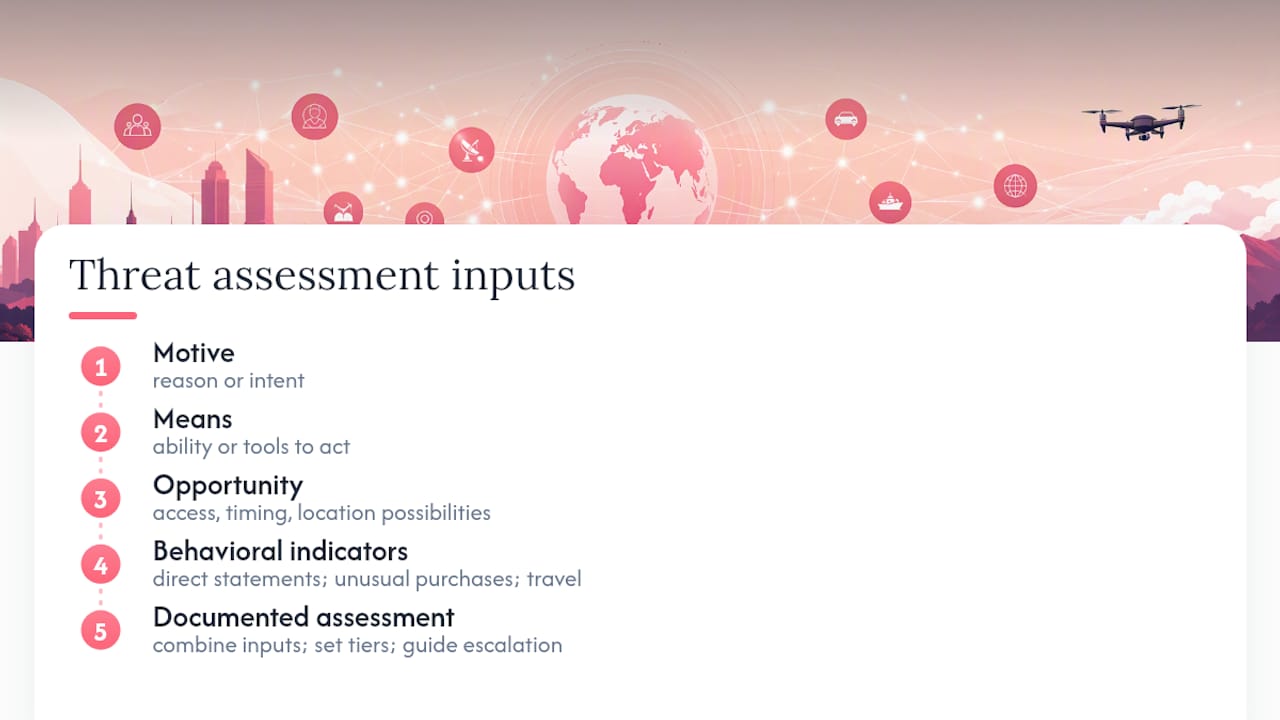
Prioritization then sorts cases by a combination of severity and momentum. A subject who has made one comment and shown no further activity in six months sits at a different priority level than someone whose behavior is escalating week over week, even if the initial comment seemed less alarming. Analysts typically bucket cases into tiers, something like monitor, active investigation, and imminent risk, and each tier carries different review frequency and different authority to escalate.
Escalation rate often matters more than the severity of any single incident. A person who goes from social media comments to identifying a target’s home address to showing up nearby, all within a matter of weeks, represents a faster-moving risk than someone who has expressed hostility consistently for years without any behavioral escalation. Basic methodologies for this kind of assessment lean heavily on documented behavior over time, not a single data point in isolation.
Prioritization also has to account for access. A disgruntled former employee with badge access still active is a higher near-term priority than an anonymous online commenter with no known connection to the physical location, regardless of how aggressive the online language sounds.
What Challenges Limit Protective Intelligence Programs?
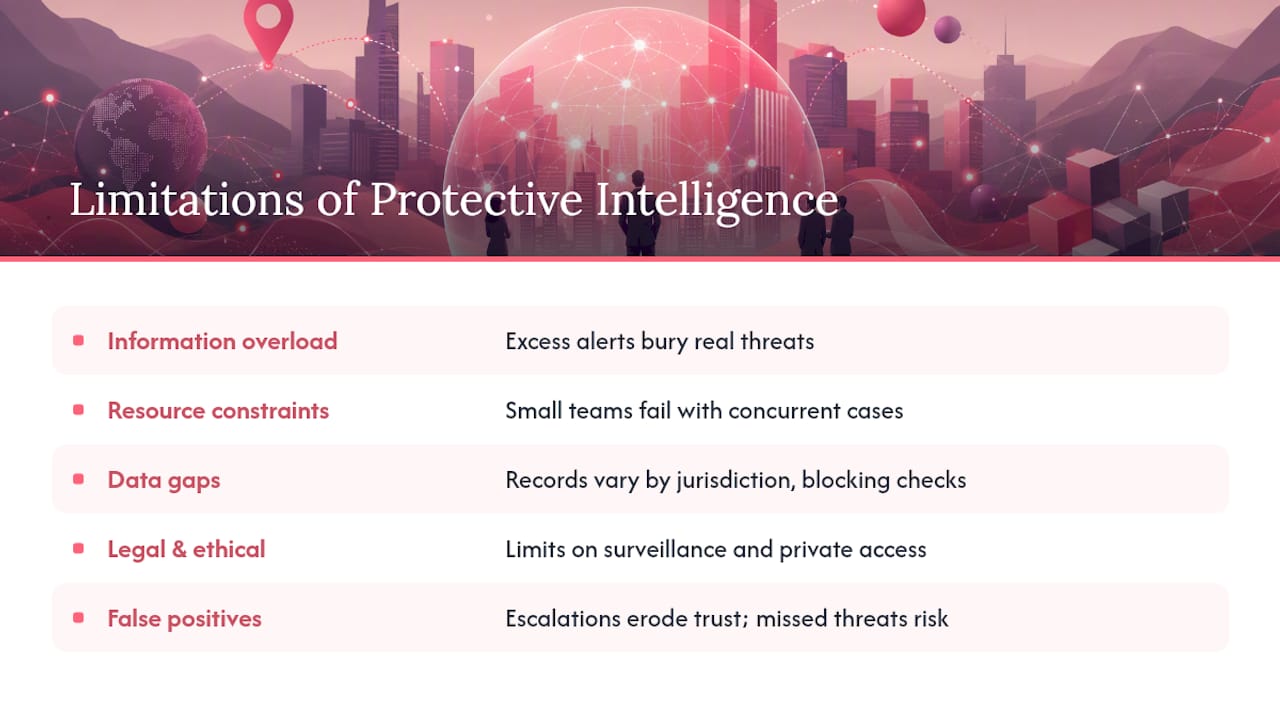
Even well-designed programs run into recurring limitations. Information overload is probably the most common one: modern monitoring tools surface far more mentions, posts, and public records than any small team can review manually, and without trained analyst judgment, real threats get lost in a flood of low-value alerts.
Resource constraints hit smaller organizations especially hard. A protective intelligence function built around a part-time analyst and no dedicated case management system will struggle the moment more than one or two cases go active at the same time. Cases don’t wait for staffing to catch up.
Data gaps are another persistent problem. Public records vary wildly by state and country, some jurisdictions make court filings easy to search, others bury them behind paywalled databases or don’t digitize them at all. That inconsistency means an investigation that’s thorough in one region might hit walls in another, simply because the underlying records aren’t accessible.
Legal and ethical boundaries also constrain what a program can do, and rightly so. Investigators can’t surveil someone without cause, can’t access private communications without authorization, and have to weigh a subject’s privacy rights against the protective need at every step. That tension doesn’t have a clean resolution; it requires judgment case by case, usually with legal counsel involved.
Finally, false positives carry real costs. Escalating every ambiguous case erodes trust with employees and can expose an organization to liability, while under escalating even one case that turns out to be genuine can be catastrophic. Getting that balance right is less a technical problem than an experience problem, which is a large part of why organizations eventually bring in people who have handled dozens of these cases before.
How Practitioner Experience Shapes Protective Intelligence Work
Reading about investigative skill, corroboration, and common sense is one thing. Applying those principles under time pressure, with incomplete information, is another. A professional investigative team can spend decades building protective and investigative programs, drawing on cumulative law enforcement and loss prevention experience.
DIY monitoring works fine for basic hygiene, tightening privacy settings, setting alerts, watching for obvious red flags. It runs into trouble the moment a case requires corroborating a claim, interviewing a witness, or coordinating with law enforcement without tipping off the subject. That’s the point where an executive protection planning team earns its keep, because protective intelligence and physical protection work best when they inform each other, not when they operate in separate silos.
Engaging a professional makes sense the moment a case involves ambiguous evidence, an escalating pattern, or any hint that law enforcement coordination might become necessary.
— Derek
Where to Learn More About Protective Intelligence
The NIJ guide remains the most complete public breakdown of the identify, assess, manage framework. For firsthand behavioral analysis of real cases, the original ECSP study is worth reading in full. For risk prioritization thinking applied to high-value individuals and families, this family office security resource offers a useful adjacent perspective.
Sources
- Exceptional Case Study Project (ECSP) — U.S. Secret Service
- Protective Intelligence Threat Assessment Investigation: A Guide for State and Local Law Enforcement Officials — NIJ
- What is Protective Intelligence? — Ontic
FAQ
What Is the Main Goal of Protective Intelligence?
The main goal is preventing targeted harm by identifying people or behaviors of concern early, assessing how serious the risk actually is, and intervening before an incident occurs.
How Is Protective Intelligence Different From Executive Protection?
Protective intelligence is the analytical process of identifying and assessing threats; executive protection is the physical security work of guarding a person. The two functions work together, with intelligence findings guiding when and how protective resources deploy.
What Are the Three Guiding Principles From the ECSP Study?
The Secret Service’s ECSP research identifies investigative skill, corroboration, and common sense as the three core principles behind sound protective intelligence investigations.
Do Small Organizations Need a Full Protective Intelligence Program?
Not necessarily. Many small teams start with basic OSINT hygiene, watchlists, and simple triage rules, then scale toward formal case management only as risk exposure or case volume grows.
When Should Someone Bring in a Professional Investigator?
Bring in professional support once a case involves ambiguous or unverified evidence, a clear escalation pattern, or any possibility that law enforcement coordination will be needed. Hub Investigative Group’s surveillance investigation and executive protection services are built for exactly that transition point.