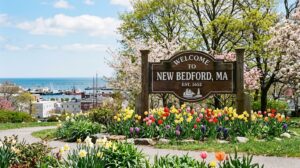
Hub Security and Investigative Group combines guards with genuine local know-how to provide dependable security throughout New Bedford, MA.
In 1857, at the height of its power, the harbor at New Bedford held 329 whaling vessels worth more than $12 million — and made the city the richest per capita in North America.
Herman Melville set Moby-Dick here for a reason: New Bedford was the whaling capital of the world, and the fortune that industry generated built the granite counting houses and merchant mansions that still stand downtown today. Petroleum discoveries in 1859 ended whaling’s dominance within a generation, but the waterfront infrastructure and downtown street grid built to move whale oil and house whaling money never went away — they were simply repurposed, first for textile manufacturing and later for what New Bedford is now: the most valuable commercial fishing port in the United States, generating $451 million in catch value in 2019, most of it scallops.
By Derek Kreymer, Operations Manager 
That layered history — whaling wealth, then textile mills, then a modern working waterfront — left New Bedford with nine separate National Register historic districts and a downtown built for a much richer city than its current population might suggest, and it shapes how Hub Security and Investigative Group approaches coverage here. Hub provides security guard services in New Bedford, MA — armed and unarmed guards, mobile patrol, and licensed private investigation services — for a Bristol County city of 100,998 residents (2024 Census Bureau estimate), the state’s ninth-largest. New Bedford is home to the New Bedford Whaling National Historical Park, the Whaling Museum, a working commercial fishing port, and major employers including Southcoast Health and Titleist.
Security in New Bedford, MA
Local businesses and residents in New Bedford, MA turn to Hub Security and Investigative Group for licensed armed and unarmed guard services, mobile patrol, and private investigation work.
Security Built Around New Bedford’s Districts
The whaling-era downtown and the modern working waterfront are, in effect, two different security environments sitting next to each other. The historic downtown, with its museums, galleries, and merchant-era buildings, draws steady tourist traffic and depends on retail security for shops and visitor attractions. The working waterfront and port, where scallop and groundfish vessels unload catch worth hundreds of millions of dollars a year, requires corporate security for processing facilities, cold storage, and dock operations where cargo theft and unauthorized access are real risks.
New Bedford’s residential neighborhoods, including its historic districts of dense triple-decker housing, benefit from residential security guard coverage. And ongoing redevelopment of former mill buildings into housing and commercial space keeps construction site security in steady demand across the city.
What Local Crime Data Actually Shows
New Bedford recorded a violent crime rate of 3.61 per 1,000 residents and a property crime rate of 13.75 per 1,000 residents, according to crime data compiled by NeighborhoodScout — modestly above the Massachusetts state average of 3.15 for violent crime and above the state’s 11.12 property crime average. NeighborhoodScout ranks New Bedford as safer than 21% of U.S.
cities, with 7 homicides recorded in the most recent reporting year.
Those numbers put New Bedford closer to the state average than some of its South Coast neighbors, but a working port city with a large seasonal fishing workforce, valuable equipment on the docks, and a tourist-heavy historic downtown has a security profile that a simple crime-rate comparison does not fully capture. Hub plans coverage around what is actually at each site — a fishing vessel’s catch, a museum’s collection, a downtown storefront — rather than treating New Bedford as a single uniform risk zone.
Coverage by District
| District | Key Local Features | Hub Focus |
|---|---|---|
| Historic Downtown | Whaling Museum, National Historical Park, galleries | Retail and visitor-site security |
| Working Waterfront / Port | Commercial fishing fleet, processing, cold storage | Corporate and dock-area security |
| Historic Residential Districts | Dense triple-decker housing, nine historic districts | Residential guard coverage |
| Former Mill Sites | Ongoing residential/commercial redevelopment | Construction site security |

What Hub Provides in New Bedford
- Uniformed armed and unarmed guards for downtown museums, galleries, and retail businesses
- Corporate and dock-area security for fishing fleet operators, processors, and cold storage facilities
- Residential security guard coverage for New Bedford’s historic residential districts
- Construction site security guards for former mill and redevelopment projects
- Mobile patrol services across the downtown and waterfront corridors
- Background check services and corporate investigations for New Bedford employers
Serving New Bedford and the Surrounding Area
New Bedford anchors the South Coast, and Hub’s coverage extends to the surrounding South Shore communities that share its port-town character and commuter connections to Boston.

- Our coverage in Plymouth
- Our coverage in Brockton
- Our coverage in Marshfield
Why New Bedford Businesses and Residents Choose Hub
- Massachusetts-licensed for both security guard services and private investigation work
- Fully trained, with background-checked officers assigned to every post
- GPS-tracked patrol routes and unannounced supervisor inspections on every shift
- Local management that knows New Bedford’s waterfront and neighborhoods firsthand — not a national call center or app-based guard broker
- 24/7 emergency dispatch at (617) 857-1200
How Hub Saves New Bedford Customers Money
Consolidating under one Hub contract also tends to cost less than piecing together separate vendors for guards, patrol, and investigative work: one onboarding process instead of several, no coverage gaps that force you to pay a second vendor’s overtime rate to fill them, and one predictable monthly invoice instead of surprise call-out fees. That matters in New Bedford, where the working waterfront and downtown’s historic granite counting houses sit close to residential neighborhoods — Hub can bundle waterfront or downtown commercial coverage with residential checks nearby under a single route instead of billing each separately.
New Bedford’s own history is world-famous: in 1857, at the height of its power, the harbor held 329 whaling vessels worth more than $12 million — and made the city the richest per capita in North America. Herman Melville set Moby-Dick here for a reason: New Bedford was the whaling capital of the world, and the fortune that industry generated built the granite counting houses and merchant mansions that still stand downtown today. Hub’s guards protect both New Bedford’s historic downtown and its working waterfront.
Supporting Bristol Community College
New Bedford is home to a Bristol Community College campus in the downtown area, serving students from across the South Coast.
Hub provides mobile patrol and unarmed security guard protection for campus-adjacent properties and events, helping the college and its surrounding downtown community stay secure without staffing a full-time in-house security department.
Licensing, Insurance, and What Hub Offers for Security in New Bedford, MA
Every guard we place for security in New Bedford, MA carries a Massachusetts Security Guard License (License #LP0203L, held by Hub since 2004), and Hub Security and Investigative Group operates under a $Proof of both is available on request for 3 million general liability insurance policy. New Bedford property managers and business owners before they sign. Beyond standard patrols, Hub’s New Bedford services include mobile patrol checks near the working waterfront and downtown historic district, armed guards for higher-risk properties, unarmed guards for day-to-day access control, crowd-certified event management for local events, and licensed private investigator and background-check services for tenant screening and pre-employment vetting.
- Mobile security patrols across New Bedford neighborhoods, from the waterfront to Buttonwood Park
- Armed security guards for banks, retail, and higher-risk commercial sites
- Unarmed security guards for office buildings, apartment lobbies, and retail centers
- Crowd-certified event management, including MA Dept. of Fire Services Crowd Manager certification, CPR/First Aid, and Narcan training for guards working large public events
- Licensed private investigation and background-check services for landlords and employers
Why New Bedford’s Apartment Communities Choose Hub
New Bedford’s residential communities, including The Residences at Buttonwood near Buttonwood Park, benefit from a visible, consistent security presence. Condo associations and apartment property managers across New Bedford hire Hub for security in New Bedford, MA to reduce package theft, monitor visitor access, and provide a fast, professional response to noise complaints or trespassing concerns — all without the overhead of hiring in-house staff.
Vetting a Security Provider in New Bedford, MA
Before signing with a security company in New Bedford, ask for their guard license number, proof of insurance, and references from other local properties. A legitimate provider should hand these over without hesitation. Hub supplies all three, plus supervisors who run unannounced checks to keep coverage consistent.
Setting Up Patrol Coverage in New Bedford, MA
Patrol schedules in New Bedford, whether recurring or for a single event, are arranged directly through Hub rather than a third-party booking system. For a property manager handling more than one New Bedford location, combining those stops into one route usually costs less than billing each separately. Hub takes pride in serving New Bedford with consistent, professional patrol coverage.
Condo, Apartment, and Business Complex Security in New Bedford
Apartment communities in New Bedford, like Bedford Towers, house many residents behind shared lobbies, parking areas, and mailrooms — common spaces that benefit from professional oversight but that no individual tenant can secure alone. Property management or a condo association can contract Hub to patrol these areas and monitor access, splitting the cost across the whole building rather than leaving residents to arrange their own protection. Hub Security and Investigative Group’s officers help deter break-ins, package theft, and unauthorized visitors, giving residents a visible, dependable security presence at the entrances and common areas they share every day.
New Bedford Business Park brings together numerous companies across a shared industrial and commercial campus, with common roadways, parking, and building perimeters. Rather than each business arranging its own coverage, property owners or a tenant association can contract Hub Security and Investigative Group to patrol the grounds, monitor entry points, and respond to incidents around the clock, spreading the cost across every occupant. Hub’s officers help protect equipment, inventory, and after-hours facilities from theft and vandalism, giving businesses of every size the kind of coordinated security coverage that would be far costlier to arrange individually.
Hub officers are also trained and certified to staff public and private events in New Bedford — from town festivals and community gatherings to a condo association’s holiday party or a business complex’s tenant event — and hold current Massachusetts Crowd Manager certification through the MA Department of Fire Services, in addition to CPR/First Aid and Narcan (naloxone) certification. That combination means an officer staffing a crowded New Bedford event isn’t just a visible presence — they’re certified to manage occupancy limits and respond to a medical emergency until first responders arrive, which is the standard property owners and event organizers should expect from event security.
Frequently Asked Questions
Does Hub provide armed guards in New Bedford?
Yes. Hub is Massachusetts-licensed to provide both armed and unarmed guards in New Bedford, with officer assignment based on site risk and client request.
How does New Bedford’s crime rate compare to the Massachusetts state average?
It is modestly higher. NeighborhoodScout reports a violent crime rate of 3.61 per 1,000 residents in New Bedford, compared to the Massachusetts state average of 3.15, and a property crime rate of 13.75 per 1,000 against a state average of 11.12.
Can Hub protect a working waterfront or fishing operation?
Yes. Hub provides corporate and dock-area security for processing facilities, cold storage, and vessel operators along New Bedford’s working waterfront, where equipment and catch value make security a practical necessity, not a formality.
Does Hub offer private investigation services in New Bedford, in addition to guards?
Yes. Hub holds a Massachusetts private investigator license and provides background checks and corporate investigations to New Bedford businesses alongside its guard services.
Call Hub Security & Investigative Group at (617) 857-1200 for a free consultation on security in New Bedford, MA, or request a quote online.
Follow us on Instagram and Facebook.