
Executive travel security is an intelligence-led program that protects leaders while they’re in transit, not a guard riding in the back seat. The first action for any security manager is a trip-specific threat assessment aligned to ISO 31030, the international duty-of-care benchmark. Everything else, transportation, close protection, monitoring, gets sized off that assessment.
TL;DR:
- A thorough threat assessment is essential before any trip and should guide all other security measures, including transportation and monitoring.
- Security response should scale appropriately with the risk, from low-profile escorts for routine trips to full security details for credible threats.
- Pre-trip planning must include venue intelligence, vehicle vetting, medical and legal contacts, device security, and direct traveler briefings.
- During travel, route planning, real-time monitoring, and clear escalation paths are crucial to responding effectively to emerging threats.
- Post-trip reviews improve future security by analyzing near-misses and vendor performance, with costs driven by team size, trip risk level, and scope of advance work.
Table of Contents
- What Does an Executive Travel Security Program Actually Include?
- When Should You Bring in Executive Protection for Travel?
- How Do You Prepare for a Secure Business Trip?
- What Does Secure Transportation Look Like During the Trip?
- How Do You Turn Each Trip Into a Better Program?
- What Drives the Cost of an Executive Travel Security Program?
- Who Is Behind This Guide, and How Does Hub Apply It?
- What’s the One Change Worth Making This Week?
- Ready to Put a Threat-Assessment-First Program in Place?
- Sources
- FAQ
What Does an Executive Travel Security Program Actually Include?
A serious program is built from interlocking pieces, not a single guard hire. Each component covers a different phase of the trip, and skipping one creates a gap the others can’t close.
- Threat assessment. A structured review of the destination, the traveler’s visibility, and any specific hostility directed at the company or the individual before departure.
- Protective intelligence. Ongoing monitoring of open-source and local information that could change the risk picture mid-trip, not a one-time report filed and forgotten.
- Journey management. The planning discipline behind routes, timing, and venue access, so movement never depends on improvisation.
- Close protection. Trained personnel physically positioned to prevent, detect, and respond to a threat in real time.
- An operations center. The hub that keeps eyes on the traveler and can redirect a route or trigger an extraction the moment something changes.
- Post-trip review. The feedback loop that turns each trip into better data for the next one.
These pieces work in sequence. Threat assessment shapes the advance work, which shapes the transport plan, which shapes how the operations center monitors that specific day. ASIS frames this as a proactive model built on pre-trip mitigation, on-the-move controls, and continuous reassessment, rather than a static plan set once and left alone. Buyers who ask a provider to walk through each of these components, and show how they connect, usually get a much clearer answer than buyers who just ask for a quote on “a couple of guys for the trip.”
Anchoring the program to ISO 31030 also matters for governance. It gives your legal and risk teams a documented standard to point to if a duty-of-care question ever comes up after an incident.
When Should You Bring in Executive Protection for Travel?
Not every trip needs a detail. The decision comes down to a threshold: does the assessed risk exceed what the traveler’s normal judgment and situational awareness can manage alone? Several triggers push a trip past that line.
- A credible or specific threat against the executive, the company, or an active corporate action (layoffs, litigation, activist campaigns).
- High-visibility exposure, such as a public speaking engagement, industry conference, or press event where the schedule is published in advance.
- Travel to a higher-risk location, whether due to crime rates, political instability, or unfamiliarity with local infrastructure.
- Sensitive corporate events like earnings announcements, acquisitions, or restructuring that could provoke a hostile reaction toward leadership.
- Family exposure, when a spouse or children travel with the executive or are independently identifiable as targets.
Once a trigger is confirmed, the response should scale with it rather than default to the biggest possible team. Fortaris describes executive protection as a risk-based program that flexes from light advance work up through a full multi-agent detail, and travel is one of the most common moments that pushes a company to engage protection for the first time. A moderate risk might call for advance work plus a single, experienced close protection officer working low-profile. A confirmed, specific threat calls for a multi-agent detail with dedicated transportation and a standing communication line to an operations center. The decision framework is simple: identify the trigger, assess its severity, then size the response to match, never the reverse.
How Do You Prepare for a Secure Business Trip?
Pre-trip planning is where most incidents actually get prevented, well before the executive boards a plane. A disciplined checklist covers four areas: destination intelligence, transportation, digital hygiene, and traveler briefing.
- Run destination and venue intelligence. Review local crime trends, political conditions, and any event-specific risk, then complete a venue advance that maps entry points, choke points, and nearby medical facilities.
- Vet drivers and vehicles. Confirm licensing, background, and driving history for any driver, and inspect vehicles for mechanical reliability before they’re assigned. Route reconnaissance with a primary and alternate path is standard tradecraft, not an extra step.
- Establish medical and legal contacts. Identify the nearest appropriate hospital and a local attorney or fixer who can be reached immediately if something goes wrong.
- Lock down devices before departure. Issue a clean travel device where possible, enable multi-factor authentication on every account the traveler will use, and set clear rules on what gets posted to social media and when.
- Brief the traveler directly. Walk through the itinerary, the emergency contacts, and the behavioral discipline expected, no impromptu detours, no broadcasting real-time location.
NSSG’s guidance on executive travel treats digital preparation as equal in importance to the physical advance work, and that’s a shift many security teams still underweight. A hacked calendar invite or a geotagged photo can undo a well-run physical plan in seconds.
Pro Tip: Build the pre-trip brief as a one-page document, not a slide deck. If the executive won’t read past page one, page one needs to contain the route, the emergency numbers, and the one behavior rule that matters most for that specific trip.
What Does Secure Transportation Look Like During the Trip?
Once the executive is moving, the plan lives or dies on journey management. That means route planning with a primary and alternate option, a clear call on low-profile versus overt movement, and a driver who has actually been vetted rather than pulled from a general car service roster.
- Route planning should account for time-of-day traffic patterns, choke points, and predictable stops, and it should never be finalized the morning of travel.
- Low-profile movement works for most business trips; an unmarked sedan and a trained driver draw far less attention than a visible convoy.
- Vehicle and driver vetting covers licensing, background checks, and a working knowledge of the specific route, not just a general familiarity with the city.
- Real-time monitoring through an operations center keeps a live line on the traveler’s location and status throughout the day.
- Escalation paths need to be defined before departure, who gets called, in what order, and what triggers a route change versus a full extraction.
An operations center is the piece that separates a plan on paper from a program that actually responds. NSSG describes this kind of 24/7 monitoring as the mechanism that turns raw intelligence into a real decision, like rerouting a motorcade before a protest reaches the venue, instead of just logging an alert nobody acts on. Close-protection posture should flex with the day’s risk too: a discreet single officer for a routine client dinner, a fuller detail with medical support built in for a high-visibility appearance where a delayed response isn’t an option.
How Do You Turn Each Trip Into a Better Program?
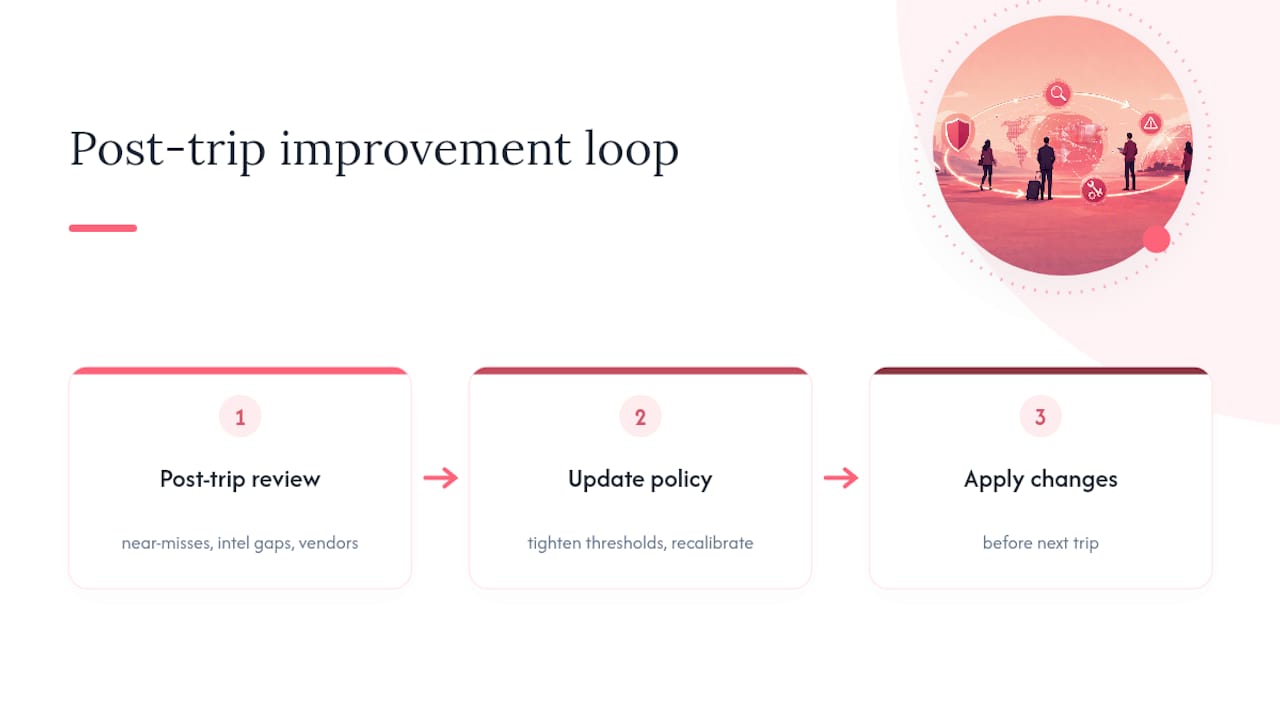
A post-trip review is where the program actually improves. Capture near-misses, even the ones that felt minor at the time, along with any place the intelligence picture didn’t match what happened on the ground. Note vendor performance specifically: did the driver arrive early, did the operations center flag the schedule change fast enough, did the close protection officer read the room correctly at the venue.
That review should feed directly back into policy. If a threshold missed a real risk, tighten it. If a location kept triggering false alarms, recalibrate. ISO 31030 frames this loop as a continuous improvement expectation, not a courtesy debrief, and treating it that way is what keeps a travel security program from going stale after the first few trips it handles well.
What Drives the Cost of an Executive Travel Security Program?
Price varies more than most first-time buyers expect, and the variation almost always traces back to a handful of factors.
- Number of agents assigned, from a single close protection officer to a full multi-agent detail.
- Trip duration and travel distance, including whether agents fly commercial, drive, or require their own transportation logistics.
- Advance work scope, how much venue and route reconnaissance happens before the executive ever lands.
- Destination risk level, since higher-risk locations typically require more intelligence work and tighter contingency planning.
- Family or residential coverage, if protection extends beyond the executive to a spouse, children, or a home address.
Boards have been paying closer attention to this spending since 2024’s high-profile targeted attack on a healthcare executive drove a documented rise in corporate security budgets, according to Reuters. That shift means procurement teams should expect, and demand, a written justification tied to an actual risk threshold rather than a flat annual line item.
When vetting a provider, three questions separate a diligent security firm from a staffing vendor: does the engagement start with a protective threat assessment, is there an operations center behind the plan, and can the lead analyst show real credentials and licensing? A provider that can’t answer all three clearly is selling bodies, not a program. Understanding security guard pricing and executive protection budgeting side by side helps clarify where the real cost differences come from.
Who Is Behind This Guide, and How Does Hub Apply It?
This guide draws on Derek’s background in law enforcement and investigative work, experience that shapes how Hub Investigative Group builds every travel security engagement from the ground up. Founded in 2004 and based in Boston, Hub combines over seventy-five years of collective law enforcement and loss prevention experience across its team.
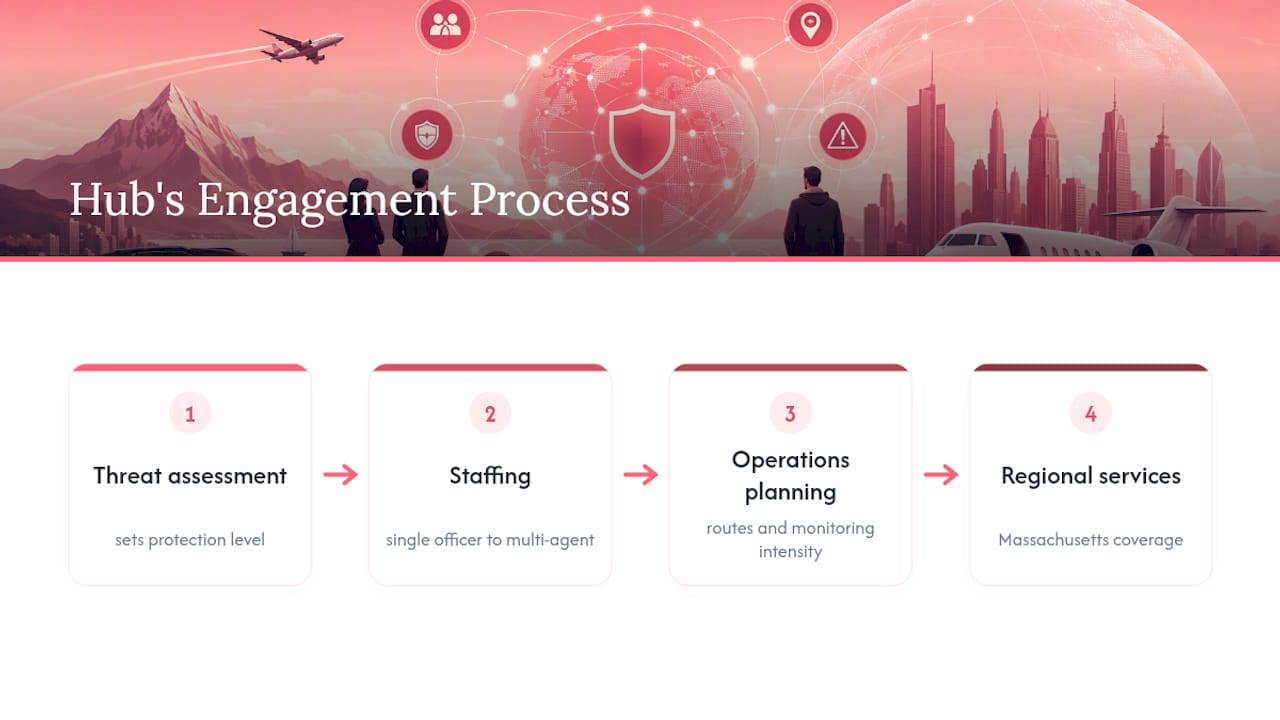
Hub’s process starts where this article started: a threat assessment. That assessment determines whether a client needs a single low-profile officer for a client dinner or a multi-agent detail with dedicated transportation for a week of high-visibility appearances. Staffing, route planning, and monitoring intensity all flow from that first step rather than a generic package. Readers can review the full scope of executive travel security services Hub provides across the Massachusetts region.
What’s the One Change Worth Making This Week?
If your travel policy doesn’t already require a threat assessment for any trip outside the home metro area, fix that first. Everything else in this guide depends on it. Build a one-page risk brief for every trip, route, threat level, emergency contacts, and make sure whoever owns physical security internally sees it before departure, not after something goes wrong. A short consult with a firm that starts the same way is the fastest way to test whether your current provider actually works this way or just says they do.
— Derek
Ready to Put a Threat-Assessment-First Program in Place?
Hub Investigative Group builds executive travel security the way this guide describes: starting with a threat assessment, then scaling protection, transportation, and monitoring to match what that assessment actually finds, instead of selling a fixed package regardless of risk.

An initial consult covers the scope of the threat assessment itself, a realistic timeline for advance work before your next trip, and a clear picture of what staffing and monitoring the assessment recommends, not what’s easiest to sell. That might mean a single discreet officer for a routine trip or a full detail with secure transportation and real-time monitoring for a high-visibility one. Hub’s team, built on decades of combined law enforcement and loss prevention experience, handles executive protection planning for corporate clients across Massachusetts, and pairs it with secure transportation and monitoring support when the risk calls for it. If digital exposure is part of your risk picture, coordinating with a partner offering managed cybersecurity monitoring alongside physical protection closes a gap many travel programs leave open. Visit Hub’s full services page to request a consult and get a threat assessment scoped for your next trip.
Sources
- Executive Travel Security: How to Protect Executives During Travel (NSSG)
- Don’t Wait for a Tragedy to Implement Proactive Executive Travel Security (ASIS)
- Executive protection for corporate leaders (Fortaris)
FAQ
What Does Executive Security Do?
Executive security protects leaders through an intelligence-led program covering threat assessment, protective intelligence, secure transportation, and close protection, rather than just physical guarding. It’s built to prevent an incident before it happens, not just react once it starts.
What Are the Levels of Security for Travel?
Levels range from light advance work with no visible presence, to a discreet single close protection officer, up to a multi-agent detail with dedicated transportation and a monitoring center. The right level is determined by the threat assessment, not by a fixed package.
How Many Security Guards Travel With High-Profile Executives?
The number varies widely based on assessed risk, ranging from a single low-profile officer for routine travel to multi-agent details for executives facing specific, credible threats. There’s no universal figure. Team size should always trace back to a documented risk assessment rather than perceived status.
How Do You Get Into Executive Security?
Most professionals enter through law enforcement, military service, or investigative backgrounds, then add specialized training in close protection, journey management, and protective intelligence. Firms like Hub Investigative Group typically look for licensed, trained personnel with that kind of operational background before assigning them to client details.