
When you hire a surveillance investigator, expect a structured process, not a stakeout scene from a movie: intake and legal review, a tailored field plan, careful documentation, and a final report built on time-stamped photos and video. The work stays within federal boundaries like 18 U.S.C. § 2511, and it avoids trespass or wiretapping. What you receive at the end is a chronological, evidence-backed record designed to hold up in a legal or administrative setting, not a dramatic reveal.
TL;DR:
- Surveillance tactics depend on the case type, with tailing used for infidelity and fixed observation for claims or custody disputes.
- Lawful surveillance must adhere to federal laws like 18 U.S.C. § 2511, with recording laws varying significantly by state.
- Investigation duration varies from a single day to several months, depending on subject habits, weather, and legal reviews.
- Final reports include detailed logs, unedited evidence files, and a summary suitable for legal or HR proceedings.
- Proper case management involves clear objectives, legal compliance, and a structured team to reduce detection risk and ensure evidence integrity.
Table of Contents
- Surveillance investigation expectations: methods investigators actually use
- What legal limits apply to surveillance investigations?
- How long does a surveillance investigation take, and what does it cost?
- What deliverables should you expect from the final report?
- What should you provide before surveillance begins?
- How does a professional team plan and run a surveillance case?
- Hiring advice from someone who has seen the common mistakes
- How Hub Investigative Group approaches surveillance work
- Where to check the legal rules yourself
- Sources
Surveillance investigation expectations: methods investigators actually use
Investigators choose tactics based on the subject, the setting, and the goal of the case, not habit. Mobile surveillance, tailing a subject’s vehicle through the day, often uses a lead and box relay team so the subject never spots the same car twice in a row. Fixed stakeouts work better for predictable routines, like watching a residence or a jobsite entrance, and most of this work happens overtly, from public vantage points, though some cases call for a lower profile.
Lawful technical aids include high-resolution cameras, secure timestamping software, and open-source research, sometimes called OSINT, during the planning phase. Audio recording, GPS trackers, and drones sit in a different category entirely, restricted by state and federal law, and a careful firm treats them as exceptions rather than defaults.
- Infidelity cases rely heavily on mobile tailing and photo documentation of meetings and patterns.
- Insurance claims often need fixed observation to verify physical activity against reported injury.
- Custody disputes call for documented routines: pickups, drop-offs, and household visitors.
- Corporate investigations may combine limited surveillance with lawful background research.
Pro Tip: Ask your investigator up front which methods they plan to use and why. A professional will explain the reasoning, not just the schedule.
What legal limits apply to surveillance investigations?
Federal law sets a hard boundary here. 18 U.S.C. § 2511 criminalizes unauthorized interception of wire, oral, or electronic communications, which is why no legitimate investigator wiretaps a phone or intercepts email without consent. Private investigators also have no special legal standing: they cannot trespass onto private property, and the line between a public sidewalk and a fenced backyard matters a great deal, as the Department of Justice’s own overview makes clear.
Audio recording consent varies significantly by state. Some states allow recording with one party’s consent; others require everyone in the conversation to agree, and Massachusetts residents should understand their state’s specific consent rules before assuming a recording is usable. Drone surveillance adds another layer of restriction under FAA commercial operator guidance, which is why most firms skip drones unless a clear legal basis and the right permits exist.
- GPS trackers, covert audio, and account access are high-risk tactics that vary by jurisdiction.
- Public property observation is generally lawful; private property access generally is not.
- Recording consent laws differ enough between states that assuming permissibility is a real risk.
- Ambiguous privacy situations are worth a call to an attorney, and resources through the American Bar Association can help you find one.
How long does a surveillance investigation take, and what does it cost?
Some cases resolve in a single day. Others take days or weeks, and a few stretch across months, particularly when a subject rarely leaves a predictable routine or the objective requires multiple confirmed observations rather than one.
- Subject habits matter most: a subject who works from home and rarely goes out in public gives investigators less to document.
- Weather and seasonal factors can delay outdoor surveillance or limit visibility.
- Legal review adds time upfront, particularly in cases touching custody or workplace disputes.
- Billing structure typically follows an hourly rate, a daily rate, or a retainer, with mileage and equipment sometimes itemized separately.
A reasonable investigator gives you a time estimate during intake and updates that estimate as the case develops, rather than locking you into a fixed number of hours before any fieldwork begins.
What deliverables should you expect from the final report?
The final product typically includes a minute-by-minute activity log, time-stamped video and high-resolution photos, numbered exhibits, and a written summary from the investigator. Industry practice, as Baldwin Legal Investigations describes in its step-by-step breakdown, moves through intake, planning, field deployment, documentation, and a final report with a clear timeline and labeled media.
Chain of custody matters as much as the footage itself. Original files should remain unedited and metadata intact, with any trimmed clips clearly marked as extracts rather than passed off as the full record. A report built for a lawyer or an HR department typically organizes around a timeline, followed by exhibits, followed by conclusions, so a reader can move from what happened to the proof to the investigator’s professional assessment.
- Minute-by-minute logs tied to timestamps, not vague summaries.
- Original, unedited video and photo files preserved alongside any edited highlight reel.
- A written investigator summary or affidavit suitable for legal proceedings.
Pro Tip: If you plan to use the report in court or an HR proceeding, ask for the original unedited files in addition to any highlight package. Admissibility depends on it, as legal resources on what investigators can lawfully document consistently point out.
What should you provide before surveillance begins?
Intake works best when you arrive with specifics: your objective, known addresses, typical schedules, and any legal constraints tied to the case, such as an active custody order. Most firms communicate through daily highlight summaries or a scheduled check-in rather than constant real-time updates, with the full findings reserved for the final report. Evidence gets secured through controlled access and documented file handling.
- Bring clear objectives, addresses, and schedule details to your first consultation.
- Expect periodic updates rather than live, minute-to-minute contact during fieldwork.
- Confidentiality should be addressed explicitly, including how files are stored and who can access them.
- Treat promises of guaranteed results or illegal tactics, and any investigator without visible licensing or insurance, as a red flag.
How does a professional team plan and run a surveillance case?
A well-run case divides labor: a lead investigator manages strategy, a box or relay team handles mobile tailing, and a documentation specialist organizes exhibits while a case manager keeps the client informed. This structure, described in Department of Justice guidance on lawful investigative practice, reduces detection risk and keeps evidence handling consistent from the first day of fieldwork to the final report.
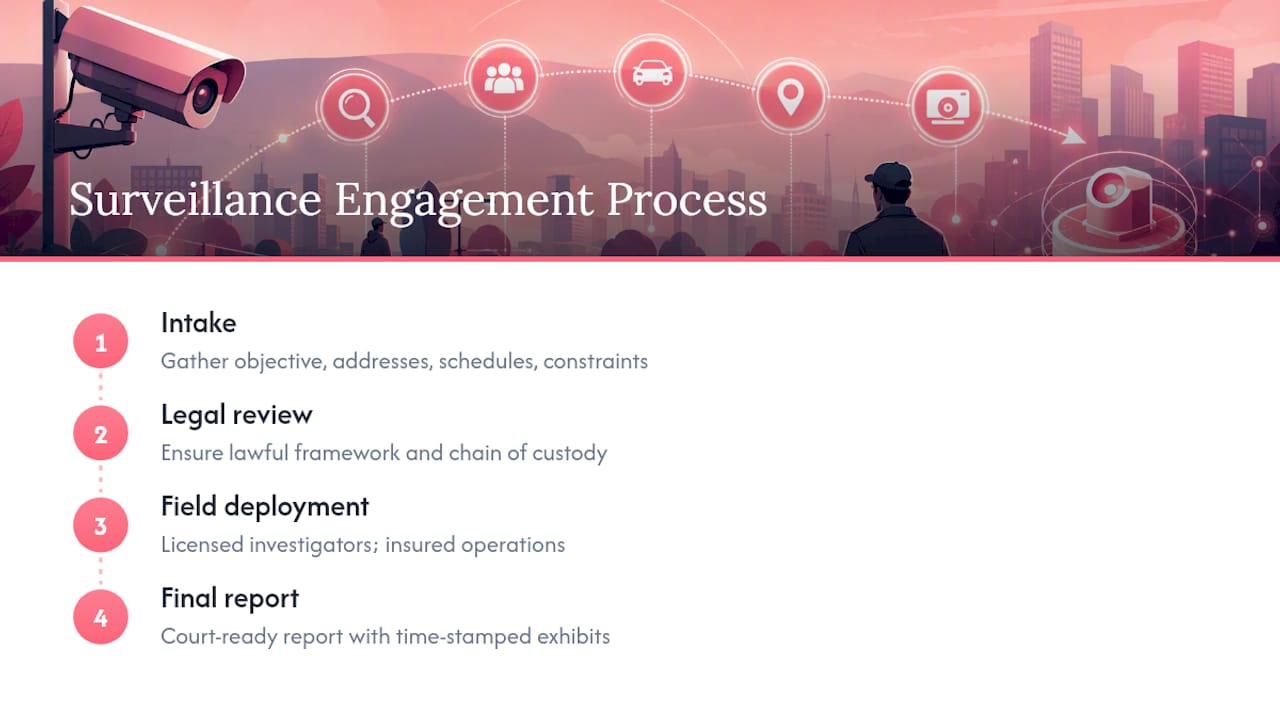
Legal review runs through the entire case, not just the planning stage, checking that each tactic stays within state and federal limits before it’s used. A typical flow looks like this: intake defines the objective, planning maps the subject’s likely patterns, field teams document activity over the agreed window, and a final report ties the timeline to labeled exhibits.
- Lead investigator sets strategy and reviews legal constraints before fieldwork starts.
- Relay teams reduce the chance of detection during mobile tailing.
- A documentation specialist organizes logs, photos, and video into a coherent exhibit set.
- A case manager keeps the client updated without compromising the investigation.
Hiring advice from someone who has seen the common mistakes
Two misconceptions cause most client frustration: that investigators carry police powers, and that results arrive overnight. Neither is true. A private investigator cannot compel evidence or make an arrest, and thorough documentation takes the time it takes.
Before signing anything, confirm four things: an active license, liability insurance, a clear reporting standard, and a demonstrated commitment to legal compliance. Keep your own notes on dates and events you share with the investigator. It protects both your privacy and the case.
— Derek
How Hub Investigative Group approaches surveillance work
The surveillance practice described here incorporates extensive experience in law enforcement and loss prevention, which influences how cases are planned, documented, and delivered. Every engagement runs through the same lawful framework covered above: intake, legal review, field deployment, and a court-ready final report with time-stamped exhibits.

That structure matters if you’re comparing a full-service investigative firm against a solo operator working without a documented chain of custody. A case built around licensed investigators, insured operations, and reporting standards suited to legal or HR use gives you something a bargain alternative usually can’t: evidence that survives scrutiny after the case closes.
If you’re ready to move forward, gather your objective, relevant addresses, schedules, and any legal constraints before your first call. From there, request a confidential consultation to discuss your case and get a realistic timeline, or review the firm’s full range of private investigation services to see how surveillance fits into a broader plan.
Where to check the legal rules yourself
A few primary sources are worth bookmarking if you want to verify the legal boundaries covered here on your own.
- 18 U.S.C. § 2511: the federal statute governing unauthorized interception of communications.
- FAA commercial UAS operator guidance: registration and certification rules for drone-based surveillance.
- American Bar Association: a starting point for finding legal counsel on state-specific recording consent or privacy questions.
- PC 647(j) California invasion of privacy statute: one example of how invasion-of-privacy law varies by state.
Sources
- U.S. Code — 18 U.S.C. § 2511
- FAA — UAS: commercial operators
- Baldwin Legal Investigations — What happens during a surveillance operation? (step-by-step)
- Private Investigator USA — What can a private investigator legally do