
Secure VIP transport is a protective movement discipline that combines vetted vehicles, trained protective drivers or agents, and continuous operational control to reduce exposure for high-visibility principals. It is not luxury chauffeuring with a security label attached. Anyone with elevated public visibility, a contested business dispute, or a schedule of announced public appearances should treat professional secure transport as a baseline safeguard, not an upgrade.
TL;DR:
- Vehicles should be vetted, maintained according to compliance, and suited to route complexity to prevent mechanical failures or security gaps.
- Advance route validation, choke-point mapping, and contingency protocols are essential for planning fully prepared and flexible movements.
- A thorough provider evaluation includes verifying driver training, vehicle documentation, operational technology, and clear escalation procedures.
- The transition phase between vehicle and principal is the highest risk, requiring rehearsed handoffs and defined authority for route adjustments.
- Budget should be based on threat level and exposure, with recurring high-profile movements justifying full, dedicated security programs.
Table of Contents
- What Makes VIP Transport Security Different From a Chauffeur Service
- When Does Someone Actually Need Secure Transport?
- How Are Secure Transport Movements Actually Planned?
- What Should You Ask Before Hiring a Secure Transport Provider
- How Hub Investigative Group Applies These Standards
- The Mistake That Costs Clients the Most
- Get a Secure Transport Assessment From Hub Investigative Group
- Sources
What Makes VIP Transport Security Different From a Chauffeur Service
A chauffeur gets you somewhere comfortably. Secure transport gets you there while actively managing risk along the way, and the difference shows up in four operational layers.
Vehicle posture is the first layer. A single vehicle works for low-visibility movements. A lead-and-follow configuration adds redundancy and a buffer against surveillance or a blocking maneuver. Complex arrivals, like a public event with a known crowd, often call for an advance vehicle or decoy to confirm the route and split attention before the principal arrives.
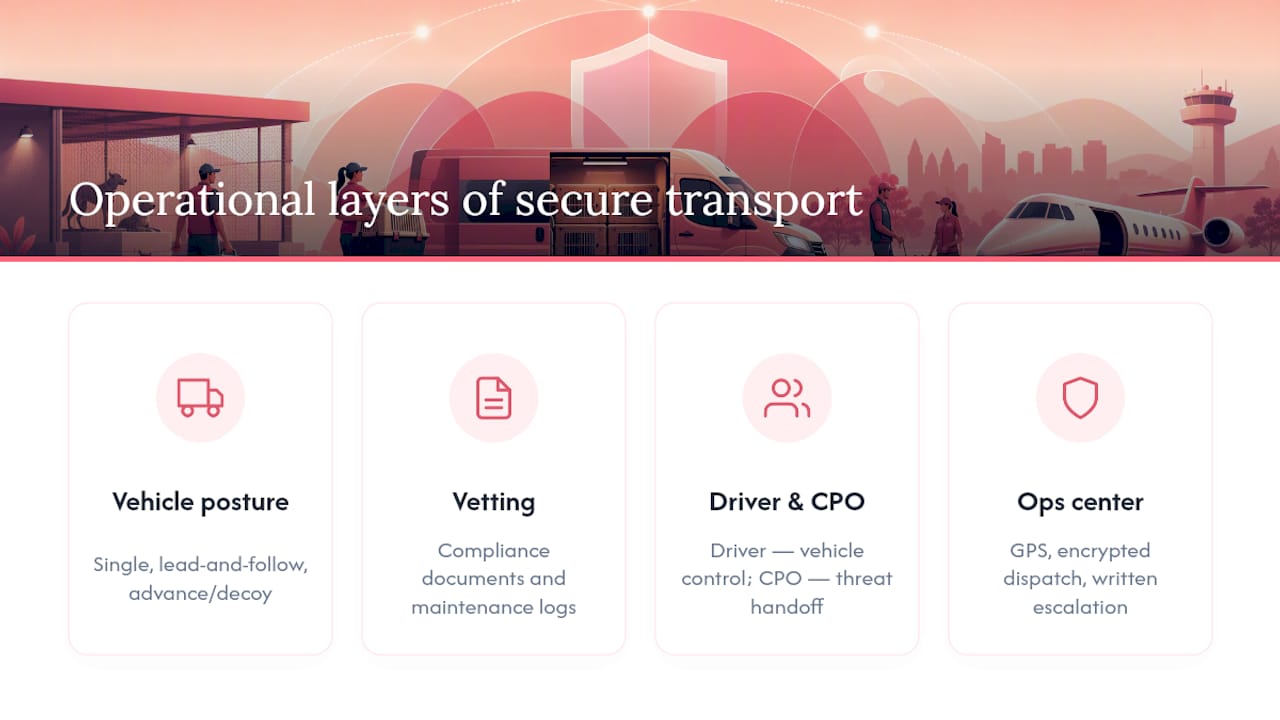
Vehicle vetting and maintenance matter more than most buyers realize. Any provider running armored or modified vehicles should maintain compliance documentation and current maintenance logs, because a mechanical failure during a movement is as dangerous as a security gap.
Driver versus close-protection officer (CPO) roles often get blurred, but they are distinct disciplines. A driver trained in defensive driving handles the vehicle under stress. A CPO handles situational awareness, communication, and the handoff at arrival. The best programs coordinate both explicitly rather than assuming one person can do both jobs well.
The operations center ties it together. Live GPS tracking, encrypted dispatch, and a defined escalation procedure keep the principal connected to a monitoring team rather than isolated with just a driver. That centralized hub is also where OSINT and protest monitoring feed into pre-trip threat assessments, flagging demonstrations, road closures, or venue-specific concerns before the vehicle ever leaves the garage.
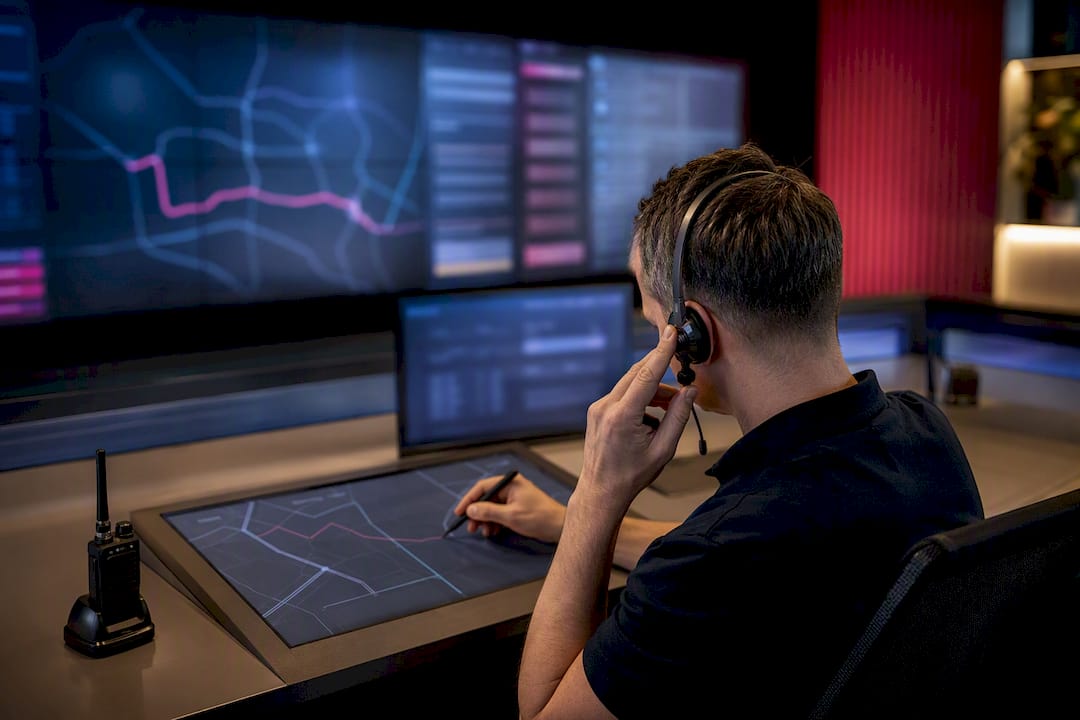
Pro Tip: Ask any provider how their operations center handles a “no comms” scenario, meaning the driver or CPO goes silent for more than a few minutes. If they don’t have a written escalation protocol, that’s a real gap.
When Does Someone Actually Need Secure Transport?
Not every executive needs an armored sedan and a two-car detail. The decision comes down to exposure, not prestige. Consider hiring security-grade transport when:
- You or your organization have a public profile that makes your schedule predictable or your identity easily recognized.
- You have scheduled public appearances, especially ones announced in advance on a website, press release, or social media.
- You’re involved in active litigation, a labor dispute, or a controversial business decision that has generated public anger.
- Travel takes you into unfamiliar cities or areas with materially higher crime rates than your home market, making travel risk management for school groups a useful model for understanding trip-specific risk assessment approaches.
- Nearly 90% of business travelers report some form of travel disruption, and disruptions compound risk for anyone who can’t afford to be stranded or delayed in public view.
Frequency changes the calculation, too. A single high-visibility trip might justify a lead-and-follow posture for one day. A recurring travel pattern, like weekly board meetings or a standing public schedule, usually justifies a full program with dedicated vehicles and a consistent driver-agent team. Budget by threat level, not by how it looks. A modest single-vehicle posture with a well-trained driver often protects better than an expensive convoy with no real planning behind it.
How Are Secure Transport Movements Actually Planned?
Every professional movement starts with advance work, well before the principal ever gets in the car. That means validating the route, mapping choke points where a vehicle could be boxed in, and building at least one alternate route with adjusted timing windows.
Staging comes next. Vehicles need to be positioned before arrival, not scrambled into place as the principal walks out. Poor staging creates the single biggest vulnerability in the entire movement.
- Route validation checks traffic patterns, construction, and known problem intersections in advance.
- Choke-point mapping identifies spots where the vehicle has limited ability to maneuver or exit.
- Timing windows build in flexibility so a delayed departure doesn’t force a rushed, unplanned route.
- Contingency protocols define abort criteria and pre-identified safe havens if something goes wrong mid-route.
The vehicle-to-person transition, the moment someone steps out of the car, is widely recognized as the highest-risk phase of any movement. This is where driver and protective agent choreography either works or fails. A rehearsed handoff, where the CPO opens the door at a pre-agreed signal and the driver holds position until the principal clears the vehicle, closes the gap that an unplanned exit leaves wide open.
Picture two scenarios: a routine office arrival where the driver simply pulls to the curb, versus a public gala where an advance vehicle scouts the entrance, a decoy pulls up first, and the principal’s car arrives only once the path to the door is confirmed clear. Same city, same client, completely different postures because the exposure is different.
Contingency planning also includes local law-enforcement coordination for high-profile events, since knowing who to call and how fast they can respond changes the entire risk calculus.
What Should You Ask Before Hiring a Secure Transport Provider
Vetting a provider is where most buyers either get real security or get an expensive chauffeur wearing a security label. Work through this before signing anything:
- Request documented training records, including defensive-driving certifications and background vetting procedures for every driver and agent assigned to your account.
- Ask for fleet maintenance logs, insurance limits, and any vehicle-modification paperwork if armored or up-armored vehicles are involved.
- Confirm the operational technology in place: live GPS tracking, encrypted dispatch, staffed operations center hours, and a written escalation flow for emergencies.
- Get client references and ask whether the provider offers a rehearsal or dry run before a high-stakes movement.
- Nail down the scope-of-service contract terms, including cancellation policy, emergency response terms, and exactly who has authority to alter a route mid-movement.
Don’t accept vague language like “security trained” or “military background” without verification. Ask for actual documentation, not a sales pitch. A provider who can produce real training records and maintenance logs on request is operating a program. One who can’t is operating a marketing claim.
Pro Tip: Before signing a contract, ask the provider to walk you through what happens in the first sixty seconds after a route deviation. Their answer tells you more about competence than any brochure.
How Hub Investigative Group Applies These Standards
Hub Investigative Group built its transport security approach on more than seventy-five years of combined law enforcement and loss-prevention experience across its team, and that background shapes how every movement gets planned rather than just driven.
Our team runs vehicle vetting and maintenance verification as a standing part of every engagement, coordinates driver and agent handoffs the way advance choreography for events requires, and benchmarks program elements against the ASIS executive protection standard, which explicitly calls for vehicle vetting, driver training, and pre-planned safe routes as auditable program requirements. Transport doesn’t operate in isolation. It integrates directly with broader executive protection planning, because a movement plan disconnected from the protective detail is exactly where gaps open up.
The Mistake That Costs Clients the Most
The biggest error I see isn’t a bad driver. It’s confusing a polished luxury chauffeur with an actual security program. A chauffeur who shows up in a clean black SUV and knows the fastest route to the airport is solving a comfort problem, not a threat problem.
The real exposure sits in the transition, the ten seconds between the car door opening and the principal reaching a controlled space. Providers who rehearse that handoff and assign clear authority for route changes mid-trip are the ones worth paying for. Verified training records and a five-minute pre-movement check cost almost nothing next to what a botched transition can cost.
— Derek
Get a Secure Transport Assessment From Hub Investigative Group
Hub Investigative Group is the practical alternative to hiring a luxury car service and hoping it covers your actual exposure. Where a chauffeur company sells comfort, our team builds a transport plan around your specific threat profile, using the same vehicle vetting, driver training documentation, and operations-center protocols outlined above.

Before your consultation, have your itinerary, any known threat concerns, and a basic passenger profile ready. That lets us scope posture correctly instead of defaulting to the most expensive option. If you’re still working out what a realistic program costs, our executive protection budget guide breaks down how pricing scales with threat level. When you’re ready to move forward, request a secure transport and executive protection consultation and we’ll walk through your specific movements before we ever put a vehicle on the road.
Sources
- Almost 90% of business travelers face disruptions, says report
- Open-source intelligence for executive protection
- Security Management Magazine (ASIS) — article on transition risk and transport planning