
A vulnerability assessment finds the specific holes in your defenses. A risk assessment weighs those holes against real threats and their consequences, then tells you what to fix first and how much to spend doing it. If you need a fast fix for an event or a single site issue, hire a vulnerability assessment. If you’re making budget, construction, or executive-protection decisions, you need a risk assessment.
Here’s how to decide right now:
- Event coming up in weeks, or you found one obvious gap? Book a vulnerability assessment.
- New facility, high-value assets, or a board asking “how much risk are we carrying?” Commission a full risk assessment.
- Not sure which? Start with a risk assessment. It includes vulnerability identification as one of its steps, so you never end up under-scoped.
Key Takeaways
Choosing between a vulnerability assessment and a risk assessment comes down to whether you need a quick fix or a defensible, budgeted mitigation plan.
| Point | Details |
|---|---|
| Definitions differ by scope | Vulnerability assessments find specific weaknesses; risk assessments weigh threat, vulnerability, and consequence together. |
| ISC RMP sets the standard | The five-step Risk Management Process links assessment findings to FSL and baseline LOP. |
| Prioritize with a risk matrix | A 5×5 likelihood-by-consequence matrix sorts findings into Critical, High, Medium, and Low tiers. |
| Document risk acceptance | A senior official, not the report author, should sign off when a finding won’t be fixed immediately. |
| Hub Investigative Group scopes both | Hub Investigative Group runs vulnerability checks and full physical security risk assessments in the Boston area, tied to client budgets. |
Table of Contents
- Vulnerability Assessment vs Risk Assessment: The Plain-English Difference
- How Each Assessment Actually Gets Done
- When to Use Each One, and Who Should Run It
- What the Reports Look Like and How to Prioritize Findings
- Turning Findings Into Action, Not Just a Binder on a Shelf
- A Quick Checklist for Common Physical Vulnerabilities
- How We Decide Which Assessment a Client Actually Needs
- How Hub Investigative Group Turns Findings Into Protection
- Frequently Asked Questions
- Sources
Vulnerability Assessment vs Risk Assessment: The Plain-English Difference
A vulnerability assessment identifies specific, exploitable weaknesses in a facility, event site, or set of procedures. Think of it as a diagnostic: it tells you the loading dock door doesn’t lock properly or the west parking lot has no camera coverage after dusk.
A risk assessment goes further. It weighs threats (who or what might exploit those weaknesses), vulnerabilities (the weaknesses themselves), and consequences (what happens if exploitation succeeds) to produce a prioritized risk picture you can actually budget against. The Interagency Security Committee’s Risk Management Process frames this cleanly: risk is a function of threat, vulnerability, and consequence together, not any one of those alone.
That distinction matters for terminology too. You’ll hear “physical security audit,” “PSAV” (Protective Security Advisory Visit), and “SRA” (Security Risk Assessment) used loosely, sometimes interchangeably. They aren’t the same thing. A PSAV is observational and fast; an SRA is structured, documented, and defensible in front of a board or insurer.
| Dimension | Vulnerability Assessment | Risk Assessment |
|---|---|---|
| Primary focus | What is weak, and where | What could happen, and how bad |
| Scope | Specific assets, controls, or access points | Assets, people, processes, and threat scenarios together |
| Typical output | List of exploitable gaps with quick fixes | Prioritized risk matrix with mitigation and cost options |
| Who leads it | Field assessor or security engineer | Multidisciplinary risk team or credentialed assessor |
| Timescale | Hours to a few days | One to several weeks |
How Each Assessment Actually Gets Done
A vulnerability assessment follows a tight, repeatable sequence:
- Scope the target. Define which building, entry points, or event zones are under review.
- Walk the site. An assessor physically inspects access control, lighting, camera coverage, and barriers.
- Test for exploit paths. Can someone tailgate through a badge reader? Is a fire exit propped open?
- Flag quick wins. Cheap, immediate fixes get called out separately from bigger structural gaps.
- Deliver a findings report. Short, specific, and action-oriented.
A risk assessment runs a longer, more analytical process:
- Define scope and assets. What (and who) are you actually protecting?
- Analyze threats. Who or what realistically targets this facility or event, based on history and context?
- Analyze vulnerabilities. This step absorbs everything a standalone vulnerability assessment produces.
- Rank consequences. What’s the cost, in dollars, safety, or reputation, if each scenario plays out?
- Build a risk matrix. Combine likelihood and consequence into prioritized tiers.
- Present mitigation options. Multiple paths at different cost points, not just one fix.
- Deliver a formal report. Documented, defensible, and tied to budget cycles.
Steps two through six map directly onto the ISC’s five-step Risk Management Process, which also introduces Facility Security Level (FSL) and baseline Level of Protection (LOP) concepts. Those constructs let an assessor translate a facility’s risk profile into a defined, documented protection standard rather than a vague sense of “we should probably add cameras.”
Pro Tip: Before signing a scope of work, ask the assessor point-blank whether the engagement is an advisory walk-through or a full risk assessment. A one-hour advisory visit and a multi-week structured risk assessment often get quoted using similar language, and confusing the two leaves gaps that surface only after an incident.
When to Use Each One, and Who Should Run It
Vulnerability assessments fit specific, near-term triggers: an event happening in a few weeks, a post-incident review after a break-in, a pre-renovation check before contractors show up, or a technology upgrade like new access-control hardware. A field assessor or security engineer with hands-on facility experience can usually handle this alone.

Risk assessments fit bigger, structural decisions: a new construction project, a determination about whether an executive needs protective detail, high-consequence assets like data centers or cash-handling operations, or a regulatory requirement demanding documented risk analysis. These need a multidisciplinary team, or at minimum a credentialed assessor with law-enforcement or loss-prevention background who can defend the findings to a board.
Before hiring either, request:
- A written scope of work naming exact assets, zones, or scenarios covered.
- A sample deliverable so you know what the report actually looks like.
- Clarity on which stakeholders (facilities, legal, executive team) need to sign off on findings.
What the Reports Look Like and How to Prioritize Findings
A solid risk assessment report has consistent bones: executive summary, methodology, asset criticality ranking, vulnerability list, recommended mitigations, cost and impact estimates, an assigned implementation owner, and a timeline. A vulnerability assessment report is thinner by design, usually just the findings and quick-fix recommendations.
Prioritization typically runs on a 5×5 risk matrix: likelihood (Rare to Almost Certain) on one axis, consequence (Insignificant to Catastrophic) on the other. Where they intersect determines the tier: Critical, High, Medium, or Low. Reserve “Catastrophic” for scenarios that genuinely threaten life safety or business continuity, not every finding that makes a manager nervous.
This is where FSL and LOP earn their place. Once a facility’s Facility Security Level is established, the assessment defines a baseline Level of Protection, the minimum acceptable set of controls for that risk tier. A risk assessment doesn’t just flag problems; it updates that baseline, which is what procurement and budget committees actually need to approve spending.
Findings that get organized into Critical/High/Moderate/Low tiers with named owners and deadlines move through approval processes far faster than a flat list of problems ever will.
Turning Findings Into Action, Not Just a Binder on a Shelf
A report that sits unread fixes nothing. Converting findings into real mitigation takes a defined process:
- Assign an owner to every open finding, not just the critical ones.
- Cost each fix so budget conversations happen with real numbers instead of guesses.
- Schedule implementation against your actual budget cycle, not an arbitrary deadline.
- Implement the fix.
- Validate it with a follow-up vulnerability check or PSAV to confirm the gap actually closed.
Some findings won’t get fixed immediately, and that’s a legitimate outcome as long as it’s documented. Risk acceptance should be signed off by a senior official or the person with budget authority, not quietly absorbed by whoever wrote the report. Ongoing monitoring and periodic reassessment keep the whole cycle current rather than static, which is the point of treating this as a process instead of a one-time event.
Pro Tip: Tie remediation timelines to your existing budget cycle, not the assessment’s delivery date. A report landing in October with a “60-day fix window” often collides with year-end freezes, and executives respond better to a mitigation plan that already speaks their fiscal calendar.
A Quick Checklist for Common Physical Vulnerabilities
Run this before calling in a professional, or hand it to whoever you hire to sharpen the scope of work:
- Access control gaps: doors that don’t fully latch, shared codes, unmonitored side entrances
- Unlit approaches and parking areas after dark
- Camera blind spots, especially at loading docks and stairwells
- Tailgating paths where badge readers exist but aren’t enforced
- Unsecured loading docks and delivery areas, a common target in multifamily and commercial settings
- Propped-open doors and disabled auto-close hardware
- Legacy card readers that haven’t been updated with current firmware
For events specifically, add: perimeter staging, backstage and green-room access, credentialing procedures, crowd-control barrier placement, and clear emergency exit routes. A useful exercise is a 10-minute walk-through the morning of the event: photograph every access point, note anyone without visible credentials, and confirm exits aren’t blocked by staging or vendor equipment.
How We Decide Which Assessment a Client Actually Needs
At Hub Investigative Group, we default to a vulnerability check when a client has one clear problem and a near-term deadline, an event, a specific incident, a single building concern. We push for a full risk assessment when the decision on the table involves budget, executive exposure, or new construction. One retail client called us after a single break-in expecting a quick patch; the walk-through revealed a pattern across three locations that only a full risk assessment could properly price and prioritize.
How Hub Investigative Group Turns Findings Into Protection
Hub Investigative Group is the alternative to guessing at your own security gaps: a Boston-based team built on over seventy-five years of combined law enforcement and loss-prevention experience, running both vulnerability checks and full physical security risk assessments with recommendations tied directly to your actual budget, not a generic vendor checklist.
Whether you need a fast pre-event walk-through or a documented risk assessment to bring to your board, our team scopes the engagement around what you’re actually deciding, not a one-size template. That includes remediation project support once the report lands, so findings don’t sit in a folder. If your facility, event, or executive exposure needs a clear answer on where the real risk sits, request a building security assessment and get a scoped quote before your next decision deadline.
Frequently Asked Questions
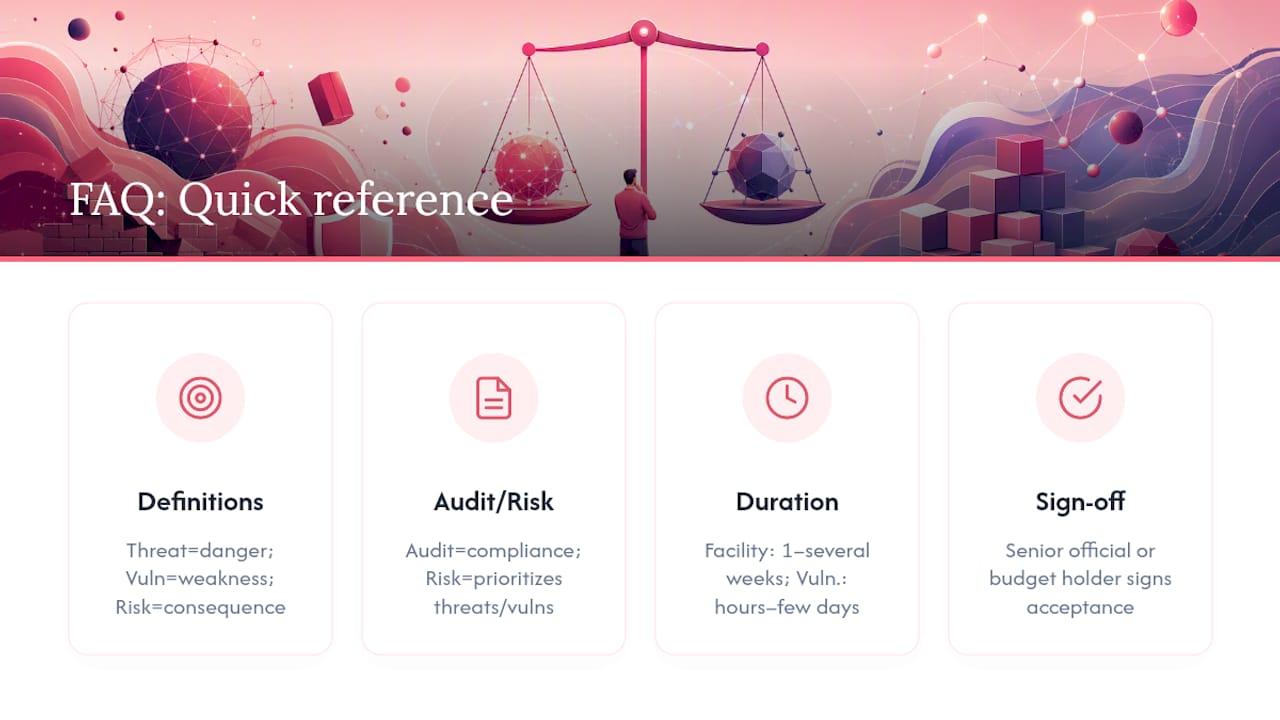
What’s the difference between a threat, a vulnerability, and a risk?
A threat is a potential danger, someone or something that could cause harm. A vulnerability is the weakness that threat could exploit. Risk is what happens when you combine both with the consequence if exploitation succeeds.
Is a risk assessment the same as an audit?
No. An audit typically checks compliance against an existing standard or policy. A risk assessment builds a prioritized picture of threats and vulnerabilities from scratch and doesn’t assume a standard already exists to check against.
How long does a physical security risk assessment take?
Most facility-level risk assessments run one to several weeks, depending on site size and how many stakeholders need to weigh in. A standalone vulnerability assessment can often be completed in hours to a few days.
Do small businesses or single events really need a full risk assessment?
Not always. If you’re solving one clear problem on a tight timeline, a vulnerability assessment is usually enough. Reach for a full risk assessment when budget, construction, or executive-protection decisions are on the table.
Who signs off on accepting a known risk instead of fixing it?
That decision belongs to a senior official or whoever holds budget authority, not the assessor who wrote the report. Documenting that sign-off is what makes the acceptance defensible later.
Sources
The ISC Risk Management Process remains the foundational federal standard behind FSL and LOP concepts. For process detail, see physical security assessment methodology and a step-by-step threat assessment guide. For your own facility, start with our physical security risk assessment guide.
- Physical Security Assessment Best Practices 2026: The Complete Methodology Guide
- Physical Security Risk Assessment: 10 Step Guide + Checklist