
If a restraining order names someone connected to your workplace, call the police the moment you suspect a violation, and put a licensed standby guard on-site as a documented deterrent. Run a quick threat assessment first, keep knowledge of the order limited to a small authorized group, and loop in HR and legal before anyone deploys security. That sequence protects your staff and your company at the same time.
TL;DR:
- Security response should be coordinated, limited in knowledge, and involve HR and legal to avoid escalation and legal issues.
- Immediate steps include verifying and documenting the order, restricting internal information, and calling law enforcement if a violation occurs.
- Use trained, licensed guards for deterrence, escorting, perimeter checks, and access denial, with response scope tailored to threat levels.
- Cost varies based on threat evidence, duration, location complexity, and whether guards are armed or unarmed, with clear scope and response protocols.
- Planning and rehearsals with a security provider beforehand significantly reduce response time and improve effectiveness during a crisis.
Table of Contents
- What Workplace Restraining Order Security Actually Involves
- Immediate Steps When an Order Is Filed or Violated
- What a Professional Security Provider Should Deliver
- Armed vs. Unarmed Coverage and What Drives the Cost
- A Ready-to-Use Checklist for HR and Security Teams
- Why Planning Ahead Beats Reacting
- How Hub Investigative Group Supports Employers Enforcing These Orders
- Sources
- FAQ
What Workplace Restraining Order Security Actually Involves
Workplace restraining order security is not one product. It is a set of coordinated services that give a court order teeth inside the building, on the sidewalk, and in the parking garage where the order itself has no reach. A judge’s signature stops nothing on its own; a trained guard standing at the right door does.
Most engagements draw from a handful of core roles:
- Standby guard presence — a licensed officer stationed near the protected employee’s work area, often deliberately low key so the arrangement does not itself provoke conflict.
- Building escort — walking the protected person to and from their vehicle, transit stop, or another building, especially at shift start and end.
- Post-departure perimeter check — a guard sweep of the parking lot or entrance after a terminated or restrained individual leaves, confirming they are actually gone.
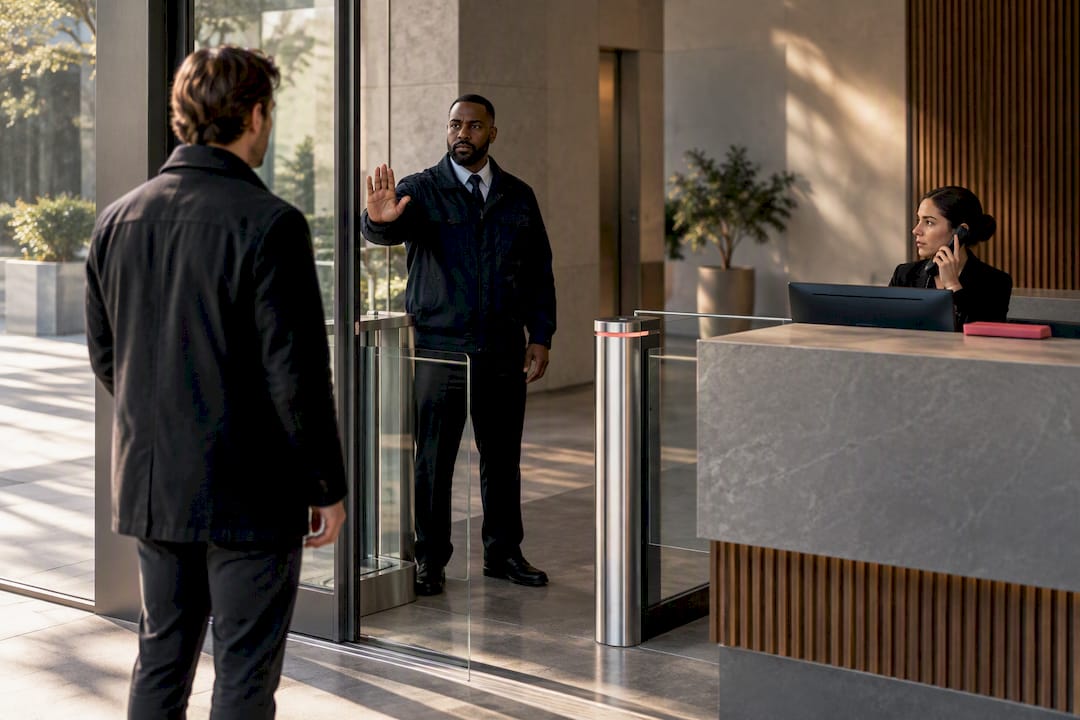
- Access denial at entry points — reception and door staff briefed to refuse entry to a named individual and to call security or police immediately if that person tries to enter.
- Short-term mobile patrol — periodic drive-bys or walk-throughs of a property during the highest-risk window, typically the days immediately following a termination or a served order.
The objective behind every one of these tasks is the same: deter contact before it happens, keep the protected employee moving safely, de-escalate if contact occurs anyway, and generate a clean record police can use. A discreet, nearby guard presence often reduces escalation risk more effectively than a visibly confrontational posture, particularly during high-risk terminations where a show of force can bait a reaction.
Immediate Steps When an Order Is Filed or Violated
The window right after a restraining order lands on your desk is the one that determines whether the rest of the process goes smoothly. Work through it in this order.
- Secure and verify the order. Get a physical or scanned copy of the order into the workplace file, and photograph the relevant pages so reception and security can confirm details in seconds rather than minutes. Courts specifically recommend keeping a copy on-site, since law enforcement can verify orders through databases, but a paper or photo copy fills the gap when an order has not yet been entered into those systems.
- Notify on a need-to-know basis only. Brief reception, the direct manager, and any on-site guard with exactly what they need: a name, a photo, and what to do if that person shows up. Skip the rest of the building. Limiting case details to a small, authorized group balances safety with the protected employee’s privacy and cuts your legal exposure.
- If a violation happens, deny entry and call 911 immediately. Do not attempt to detain the individual beyond what a citizen’s arrest would allow. Get the protected employee to a secured area first, then handle the confrontation.
- Preserve evidence in real time. Photos, door-camera footage, and a timestamped written account matter more than memory. Guards should log minute-by-minute notes during any incident and hand originals, not copies, to responding officers.
- Decide on extended or armed coverage based on what just happened, not on how the day started.
Roughly 3 to 6 hours is the typical booking window for a single guard covering a separation or an active enforcement window, long enough to cover a shift change or a termination meeting without locking you into an open-ended contract.
Pro Tip: Keep a laminated one-page action card with the guard’s contact number, the restrained individual’s photo, and the exact wording front-desk staff should use to refuse entry. Rehearsed language beats improvised language every time someone is actually standing at the door.
What a Professional Security Provider Should Deliver
Not every security company that answers the phone is equipped for restraining order enforcement, and the difference shows up fast when something goes wrong. Before signing anything, confirm the basics: current state licensing, liability insurance, and documented training in conflict de-escalation, not just physical presence. A guard who can talk a tense situation down is worth more than one who can only stand there.
Ask for specifics in the scope of work, not vague assurances:
- Guaranteed response time if you need same-day coverage
- Defined escalation triggers, meaning the exact conditions under which the guard calls police versus simply repositioning
- A written incident report format, delivered within a set window after any event
- A clear evidence handoff procedure so photos, video, and logs go straight to law enforcement without gaps in the chain of custody
Coordinating with HR and legal before booking remains standard advice, since retaining private security for high-risk terminations or order enforcement works best when it is planned rather than improvised at the last minute. Booking options generally range from a single standby shift to escorted movement across a full workday, mobile patrols of a property over several days, and, when the situation calls for it, follow-up investigative work such as surveillance investigation to document ongoing contact attempts. The scope of work you sign should also spell out confidentiality terms, your limited-disclosure list, and cancellation or extension terms in case the shift needs to run long. Professional security guard services typically build these terms into the initial consultation rather than treating them as an afterthought.
Armed vs. Unarmed Coverage and What Drives the Cost
The decision between armed and unarmed guards should follow the threat evidence, not a gut feeling about how serious the situation “seems.” Documented indicators such as a disclosed weapon, an explicit threat of violence, or a prior arrest for assault push a case toward armed coverage. Absent those markers, unarmed standby is usually sufficient, and a calmer, less confrontational presence can actually lower the odds of a physical confrontation rather than raise them.
A few practical factors move the price and staffing plan more than people expect:
- Duration — a 3 to 6 hour separation window costs far less than an open-ended, multi-day assignment.
- Location complexity — a single-entrance office is a simpler job than a campus with a parking structure, multiple lobbies, and after-hours access.
- Event type — a scheduled termination meeting can be staffed in advance; a sudden violation report needs same-day mobilization.
- Guard classification — armed officers carry additional licensing and insurance costs that unarmed standby does not.
Before signing, always confirm proof of current licensure and insurance, and clarify extension terms in writing. Cost drivers for security guard bookings break down guard type and duration in more detail if you are building a budget for the first time.
A Ready-to-Use Checklist for HR and Security Teams
Build this into your incident-response binder now, before you need it under pressure.
- Keep a current copy of the order and a photo of the restrained individual accessible to authorized staff only.
- Maintain a written list of who is allowed to know the details: typically reception, the direct manager, and on-site security.
- Give front-desk and security staff exact entry-point instructions and refusal language.
- Keep a police and security-provider contact list posted at every relevant checkpoint.
- Use a standing incident-log template so timestamps and details get recorded the same way every time.
- Draft staff-briefing language in advance so managers are not improvising sensitive conversations on the spot.
Two guardrails matter as much as the checklist itself. First, never offer off-duty personal protection to an employee, since doing so can create a new legal duty of care the company did not previously have; secure the workplace perimeter instead and point employees toward law enforcement for off-site concerns. Second, run every plan past legal counsel before it goes into effect, not after.
After any incident, close the loop: file the written report, hand original evidence to police, follow up with the affected employee through HR, and hold a short after-action review to catch what the plan missed. A one-page workplace violence response plan gives you a template to adapt rather than building one from scratch.
Pro Tip: Run a tabletop drill with reception and one manager twice a year, even with no active order in place. Staff who have rehearsed the refusal script once respond far better than staff hearing it for the first time during a real event.
Why Planning Ahead Beats Reacting
Private security supplements law enforcement here; it never replaces it. That distinction gets lost when a crisis is unfolding and someone wants a single call to fix everything. The real value of hiring a security provider shows up long before any order gets served.
Employers who establish a relationship with a security provider before a crisis cuts response time and reduces miscommunication considerably, because the provider already has your floor plan, your authorized-contact list, and a verified process for confirming an order’s authenticity. A cold call to an unfamiliar vendor during an active threat wastes minutes you do not have. Routine threat assessments and a rehearsed drill cost far less than an emergency same-day mobilization, and they usually make that emergency mobilization unnecessary in the first place.
— Derek
How Hub Investigative Group Supports Employers Enforcing These Orders
A professional security provider brings extensive experience in law enforcement and loss prevention to exactly this kind of situation, which is different from a generic guard company showing up with a uniform and no plan. We staff standby escorts, armed and unarmed guard coverage, and full workplace executive protection for employees named in a restraining order, and we back that with formal threat assessments and investigative follow-up when a situation needs more than a guard at the door.

To respond quickly, security providers typically ask for a copy of the order, a photo of the restrained individual, and a list of authorized contacts, which are commonly part of an internal checklist. It is recommended to involve HR and legal before a security booking goes final and to work within that process rather than around it. If you need coverage this week or want a threat assessment before anything happens, visit our services page to request a consultation and get a guard or investigator assigned to your situation.
Sources
- Enforce a workplace violence restraining order | California Courts | Self Help Guide
- How To Respond If A Worker Is Served With A Restraining Order | ERE
- Workplace violence & termination security: Protecting your team | Calvis
- Protective order workplace enforcement: how employers help | Bateson Law
FAQ
Do I have to call police for every restraining order violation?
Yes. Any suspected violation should go to police immediately, since only law enforcement can act on a criminal violation of the order. Private security documents and controls the scene but cannot enforce the order itself.
How long does a typical standby security booking last?
Most separation or enforcement bookings run 3 to 6 hours, covering a termination meeting or a shift change window. Longer or recurring coverage can be arranged if the threat assessment supports it.
Should we tell the whole office about the restraining order?
No. Share details only with reception, the employee’s manager, and on-site security, since limiting disclosure protects the affected employee’s privacy and reduces the company’s legal exposure.
Do some security providers offer armed guard coverage for these situations?
Yes. Hub provides both armed and unarmed guard coverage depending on documented threat indicators, along with threat assessments and escort services; current pricing and service details are available on the services page.
Can we offer an employee personal protection outside work hours?
Avoid it. Offering off-duty protection can create a new legal duty of care for the employer. Secure the workplace perimeter instead and direct the employee to law enforcement for off-site safety concerns.