
The best access control systems for U.S. facilities are not hardware platforms. They are guard-led, policy-first programs that combine trained officers, documented standard operating procedures, visitor and credential workflows, and targeted logging technology. The Interagency Security Committee’s facility access control guidance establishes this layered approach as the baseline for federal and federal-adjacent sites, and it translates directly to commercial buildings, events, and residential properties. Hubsecurityandinvestigativegroup applies this model daily across Boston and beyond, which is why this article uses its operational experience as the working example throughout.
Key Takeaways
Guard-led, policy-first access control requires trained officers, written SOPs, a governed “do not admit” roster, and targeted logging technology to be auditable and effective.
| Point | Details |
|---|---|
| Policy before technology | Write SOPs, escort rules, and credential standards before selecting any tech platform. |
| Staffing model drives cost | Labor, relief coverage, and dual-post requirements are the primary budget variables to negotiate. |
| Audits close the loop | Monthly reviews and an annual drill with SOP updates keep the program reliable after launch. |
| Governance prevents drift | Assign an FSC or named owner before launch; without one, rosters go stale and SOPs erode. |
| Hubsecurityandinvestigativegroup | Provides guard-led access control programs combining trained officers, documented SOPs, and pilot-driven SOP refinement for commercial, event, and residential sites. |
Table of Contents
- What should your RFP include for guard-led access control?
- How do you choose the right guard-led access control provider?
- How do you deploy a guard-led access control program step by step?
- What visitor and credential workflows should your guards follow?
- What drives the cost of a guard-led access control program?
- What training, audits, and KPIs should you require?
- How should you structure governance for your access control program?
- Where does technology help, and where does it fall short?
- How Hubsecurityandinvestigativegroup delivered measurable results for a commercial client
- Why human judgment still defines the best access control programs
- Hubsecurityandinvestigativegroup: guard-led access control built for your facility
- Sources
What should your RFP include for guard-led access control?
A well-structured RFP prevents scope gaps before a contract is signed. Every solicitation for a guard-led access control program should include these elements:
Minimum requirements:
- Written post orders covering every entry point and shift
- One-person-one-credential policy with no shared badges or passes
- Visitor pre-registration and appointment verification before arrival
- Government-issued photo ID check for all non-credentialed entrants
- Documented escort rules specifying who requires an escort and at what ratio
- Incident reporting templates with defined escalation paths
- A maintained “do not admit” roster with a clear update and communication process
Recommended additions:
- PIV-compatible ID acceptance for federal-adjacent or high-assurance sites (per ISC/CISA guidance)
- Digital visitor log with exportable audit trail
- Supervisor overwatch role at high-traffic entry points, separate from the verification officer
Pro Tip: Never staff a single officer at a critical entry point without a relief plan. The ISC’s Armed Contract Security Officers guidance recommends separating the verification and overwatch roles at busy entrances. A single officer handling both functions creates a procedural gap that a determined entrant can exploit during a distraction.
How do you choose the right guard-led access control provider?
Prioritize operational SOPs and verifiable training over polished proposals. A vendor who cannot produce written post orders, a training curriculum, and a sample incident report during the sales process almost certainly cannot produce them after contract signing.
What to verify in every proposal:
- Staffing model: how relief coverage is handled, whether supervisors are on-site or remote, and how surge periods are managed
- Background check standards: state licensing compliance, criminal history screening depth, and drug testing policy
- Training curricula: credential fraud detection, de-escalation, escort procedures, and emergency response
- SOP documentation: written procedures for credential confiscation, “do not admit” enforcement, and visitor escort
- Incident reporting tools: whether officers use paper logs, mobile apps, or integrated platforms
- Escalation templates: defined paths from officer to supervisor to client contact
Sample questions to ask during vetting:
- “Can you share a redacted sample post order from a comparable site?”
- “How do you handle a guard calling out sick mid-shift at a single-post location?”
- “What is your audit schedule, and who reviews the findings?”
Red flags to watch for:
- Vague SOPs that defer all decisions to “officer discretion”
- No documented audit schedule or evidence of prior audits
- Staffing proposals that rely on a single officer with no relief plan
- No reference to ISC, CISA, or recognized industry standards in their methodology
- Contract language that omits KPI definitions or audit rights
Contract checklist: insist on defined service levels, relief coverage guarantees, KPI definitions, penalty clauses for non-compliance, and your right to audit post orders and training records at any time.
How do you deploy a guard-led access control program step by step?
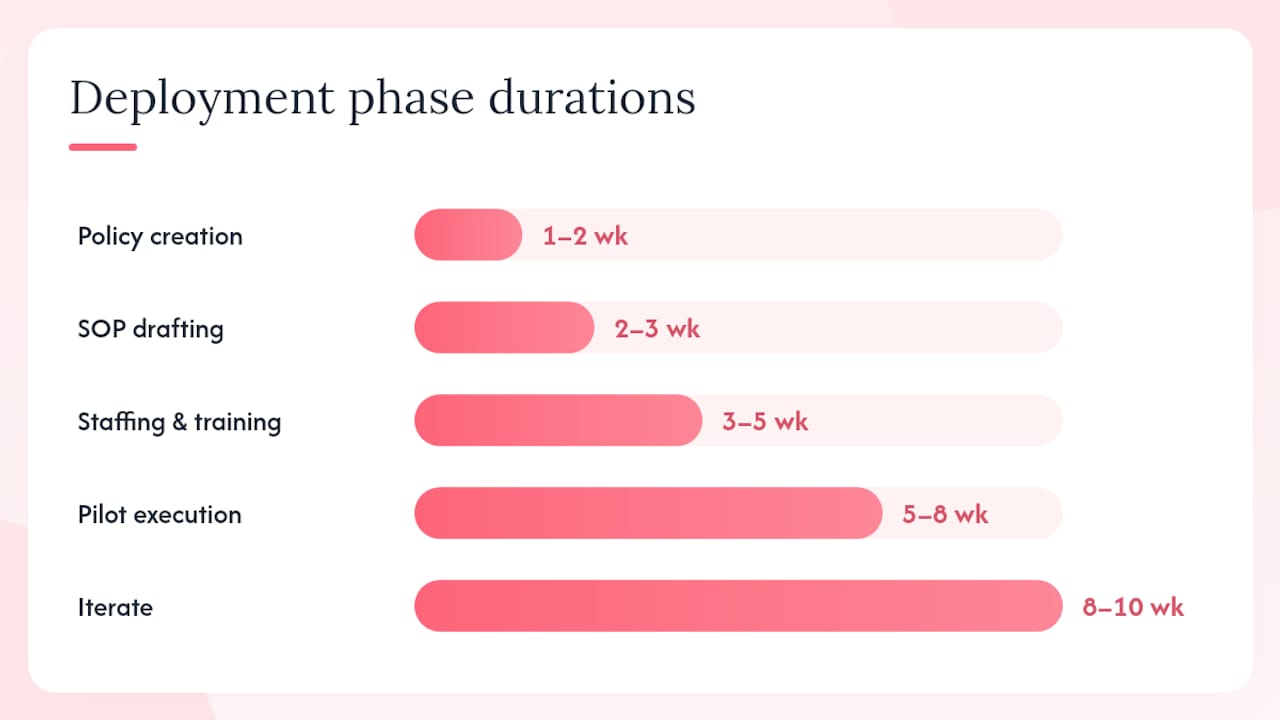
A phased approach reduces risk and produces measurable results before full rollout. The sequence is: policy first, then pilot, then iterate, then scale.
- Policy creation (weeks 1–2): Draft the access control policy, define accepted ID types, write escort rules, and establish the “do not admit” roster process. Assign a policy owner or Facility Security Committee (FSC).
- SOP drafting (weeks 2–3): Convert policy into written post orders for each entry point. Include credential confiscation procedures, visitor processing steps, and incident escalation paths.
- Staffing and training (weeks 3–5): Hire or contract officers, complete background checks, and run initial training covering credential inspection, de-escalation, and emergency response.
- Pilot execution (weeks 5–8): Run the program at one entry point or one event. Track the metrics below.
- Iterate (weeks 8–10): Review pilot data, update SOPs where gaps appear, and retrain on any failed procedures.
- Full deployment (week 10+): Roll out to all entry points with the refined SOPs and a defined audit schedule.
| Pilot metric | What it measures | Target |
|---|---|---|
| Time-to-admit | Average seconds from arrival to entry grant | Establish baseline; reduce after iteration |
| Incidents detected | Unauthorized attempts or credential issues caught | Track volume; zero undetected breaches |
| False-admit rate | Entries granted without proper verification | Zero tolerance |
| Escort adherence | Percentage of required escorts completed per SOP | 100% compliance |
Modernize legacy physical access control policies when a risk-based trigger occurs: a security incident, a change in occupancy classification, or a new ISC/CISA guidance release.
What visitor and credential workflows should your guards follow?
The defensible workflow is: pre-register the visitor, verify the appointment and host, check government-issued ID, issue a temporary credential, then escort or release with stated movement limits. Visitor management best practices require sign-in and sign-out, host verification, and annual orientation updates for recurring visitors at regulated sites.
Accepted ID types by assurance level:
- Standard: state driver’s license, U.S. passport, military ID
- Higher assurance (federal-adjacent sites): PIV card per FIPS 201, as specified in ISC guidance
- Alternate: two secondary documents when primary ID is unavailable, subject to supervisor approval
Guards must physically inspect each credential, match the name against the authorized or pre-registered list, and check for signs of tampering or expiration. At lower-traffic entry points a single officer can manage verification; higher-traffic checkpoints require a second officer for overwatch to prevent tailgating and credential fraud.
Escort rules belong in the SOP, not in verbal instructions. Specify the escort ratio, the areas requiring escort, and what the escort officer must do if the visitor deviates from the approved route. For hotel and high-turnover properties, escort rules are especially critical because visitor volume is high and staff familiarity with guests is low.
Credential confiscation policy: if a credential is expired, damaged, reported lost, or flagged on the “do not admit” roster, the officer confiscates it, issues a receipt, and notifies the supervisor immediately. The roster update process must be documented so the confiscation is reflected in the system within a defined window, typically within one business day.
Pro Tip: Post your accepted ID types and visitor procedures at the entry point and on your pre-visit confirmation emails. The ISC recommends communicating access procedures through multiple channels so visitors arrive prepared, which reduces processing time and friction at the checkpoint.
What drives the cost of a guard-led access control program?
Labor is the dominant cost driver, and it compounds quickly when you factor in relief coverage, dual-post requirements, and training amortization. A single-post, low-traffic lobby costs far less than a screened multi-entry commercial campus, and event surge coverage carries its own pricing logic entirely.
| Cost driver | Low-traffic single post | Multi-post screened entry | Event surge coverage |
|---|---|---|---|
| Base officer hours | Standard shift rate | Multiple concurrent shifts | Variable; often premium rate |
| Relief coverage | Planned breaks only | Dedicated relief officer | Staffed per event schedule |
| Training amortization | Lower per-officer cost | Higher; more officers trained | Included in event contract |
| Supervisor/admin fees | Minimal | Proportional to post count | Event coordinator fee |
| Tech integration | Optional digital log | Visitor management system | Temporary credentialing system |
Negotiating guidance:
- Require a defined relief coverage guarantee in the contract, not a best-efforts clause
- Cap surge pricing at a stated multiplier above the base rate
- Include audit and penalty clauses: if post orders are not followed, the client receives a credit or remediation plan
- Clarify whether training costs are included in the hourly rate or billed separately
For small-business access control, the cost calculus often favors a single trained officer with a strong SOP over a more expensive technology-heavy solution that still requires human oversight.
What training, audits, and KPIs should you require?
Continuous training and scheduled audits are what keep a guard-led program reliable after the pilot phase ends. Require these training elements in every contract:
- Credential fraud detection: how to spot altered documents, expired credentials, and mismatched photos
- De-escalation: verbal techniques for managing non-compliant visitors without force
- SOP walkthroughs: hands-on practice of the exact post orders for each assigned entry point
- Emergency response: lockdown procedures, evacuation coordination, and law enforcement handoff
KPIs to write into the contract:
- Average admission time per visitor
- Escort adherence rate (target: 100%)
- Incident response time from detection to supervisor notification
- Audit pass rate on monthly supervisory reviews
The audit schedule should include daily supervisor spot-checks, monthly post-order reviews, and an annual full SOP audit with a live drill. Audit findings feed directly back into SOP revisions and the next training cycle. Guard competency standards from public-sector job specifications confirm that access authorization, patrol, and monitoring for security breaches are core measurable duties, not optional add-ons.
How should you structure governance for your access control program?
Assign governance to a Facility Security Committee or a named policy owner before the program launches. Without a defined owner, SOPs drift, “do not admit” rosters go stale, and audit findings sit unaddressed. The FSC’s core responsibilities include approving the access control policy, reviewing audit findings, authorizing changes to accepted ID types, and coordinating with HR on suspension and removal actions.
Policy checklist for the FSC:
- Identity document policy: accepted types, assurance levels, and alternate procedures
- Inclusion and exclusion lists: who maintains them, how often they are reviewed, and how changes are communicated to guards
- Revocation process: steps from HR notification to credential deactivation and “do not admit” roster update
- Tenant and visitor communications: how entry requirements are posted and distributed
- Record retention: how long visitor logs, incident reports, and audit records are kept
The suspension and removal flow runs from HR or the requesting authority to the FSC or policy owner, then to the security supervisor, and finally to the guard post. Every step must be documented. For medical facility environments, where HIPAA and patient-safety obligations intersect with access control, this documentation chain is especially important.
When a facility lacks electronic physical access control systems, the ISC recommends maintaining robust manual controls: a current exclusion roster, written escort requirements, and documented incident reporting to preserve auditability.
Where does technology help, and where does it fall short?
Technology should assist logging and decision support. Human officers must retain final judgment. Practitioner guidance is consistent on this point: mobile apps and digital logs improve accuracy and support audits, but no automated system catches the behavioral anomalies a trained officer observes in person.
Common and appropriate uses of technology in a guard-led program:
- Visitor management systems for pre-registration and appointment verification
- ID scanners that flag obvious fraud indicators, used as a second check, not a replacement for visual inspection
- Digital logs with exportable audit trails for investigations and compliance reviews
- Remote unlock for low-risk secondary access points where a guard is monitoring remotely
The risks of overreliance are real. False positives from ID scanners can create confrontational situations; false negatives can allow fraudulent credentials through if the officer defers entirely to the machine. Require that all technology contracts include API access and exportable log formats so your audit team and investigators can pull records independently. 24-hour guard coverage consistently outperforms alarm-only systems precisely because human judgment fills the gap that automated alerts cannot.
How Hubsecurityandinvestigativegroup delivered measurable results for a commercial client
A mid-size commercial property in the Boston area engaged Hubsecurityandinvestigativegroup to replace an informal sign-in sheet process with a structured, guard-led access control program. The scope included a single main entry, one freight access point, and periodic after-hours events.
During the eight-week pilot, the team deployed two officers at peak hours (one for verification, one for overwatch), introduced a pre-registration workflow for scheduled visitors, and established a written “do not admit” roster with a 24-hour update cycle.
| Metric | Pre-program | Post-pilot |
|---|---|---|
| Unauthorized entry attempts detected | Not tracked | Tracked; zero successful breaches |
| Average visitor admission time | No baseline | Established and documented |
| Escort adherence | Informal | 100% per SOP |
| Audit pass rate | No audits | Monthly reviews initiated |
The pilot revealed that the freight entry was the highest-risk point, not the main lobby. Shifting overwatch coverage to the freight entrance during delivery windows closed the gap the previous informal process had missed entirely.
That finding reshaped the SOP for the full rollout. Professional security guards bring situational awareness that no pre-deployment risk assessment fully anticipates, which is why a structured pilot with real metrics matters more than a perfect plan on paper.
Why human judgment still defines the best access control programs
The conversation in security procurement keeps drifting toward technology as the answer. We understand the appeal: software is scalable, auditable, and easy to demo. But after more than two decades of deploying guard-led programs across commercial properties, events, and high-profile engagements, we keep arriving at the same conclusion. The moment that matters most in access control is the one where a trained officer reads a situation that no algorithm has been taught to recognize.
The ISC/CISA guidance does not treat human officers as a legacy workaround for facilities that cannot afford electronic systems. It treats them as the primary control, with technology in a supporting role. That framing matches what we see operationally. A visitor who pre-registered, passed an ID scan, and holds a valid temporary credential can still behave in a way that warrants a second look. Only a trained officer catches that.
The facilities that get this right are the ones that invest in post orders, training, and audit cycles before they invest in visitor management software. The software is useful. The officer is the system.
Hubsecurityandinvestigativegroup: guard-led access control built for your facility

Hubsecurityandinvestigativegroup has delivered guard-led access control programs since 2004, drawing on over seventy-five years of combined law enforcement and loss prevention experience. For facility managers, event planners, and property managers who need a program that works from day one, we offer armed and unarmed guard programs, event security with credentialing and crowd-management SOPs, building security services combining guards and risk assessments, and armed security for high-risk sites and high-profile personnel. Every engagement starts with a site assessment and a pilot plan, not a one-size contract. Contact us to schedule a discovery call and receive a tailored access control proposal for your facility.
Sources
These are the primary authority sources referenced throughout this article. Each one is worth reading directly if you are drafting an RFP, building an FSC charter, or benchmarking your current program.
- Facility Access Control – An Interagency Security Committee Best Practice (CISA)
- Access Control and Visitor Management Program (ContractorsWeb / Mosaic)
- Gate guards enforce entry procedure change (U.S. Army)
- Security Officer Access Control: Roles and Best Practices (Belfry Software blog)
- Security Guard Series Class Spec (SUCSS Illinois)
Recommended
- Medical Facility Security: Access Control & Data Protection
- Top Security Threats Facing the United States Right Now in 2025 – Hub Security & Investigative Group
- Top Security Threats in the United States: What You Need to Know in 2025 – Hub Security & Investigative Group
- Best Mass Notification Systems for U.S. Organizations in 2026 – Hub Security & Investigative Group