
The single most effective step you can take is implementing a documented, layered security program anchored by a formal risk assessment, with elevator access control and visitor management as your top two priorities. Everything else—cameras, guards, hardened doors—supports that core structure rather than replacing it.
If you’re responsible for a tower right now, start with three moves this week: schedule a risk assessment that maps every entry point and elevator credential, confirm your camera retention windows and chain-of-custody procedures actually hold up, and audit which credentials open which floors. A high-rise building doesn’t behave like a low-rise property with more square footage. It behaves like a vertical neighborhood, and the controls need to reflect that.
This guide walks through the components that make up a real program:
- Access control and elevator integration
- Video surveillance placement and retention
- Physical hardening and entry management
- Emergency planning and evacuation protocols
- Staffing models and documentation standards
- Ongoing risk assessment and maintenance cycles
- Tenant engagement as a security multiplier
Key Takeaways
A layered, documented security program built around elevator access control, retained video evidence, and trained staff is what actually prevents and resolves high-rise incidents.
| Point | Details |
|---|---|
| Start with a risk assessment | Map every entry point and elevator credential before adding new hardware or staff. |
| Treat elevators as a primary control point | Restrict credentials to authorized floors and test fail-safe behavior during fire alarms. |
| Set clear retention defaults | Keep CCTV footage 30 to 90 days, patrol logs 2 or more years, with litigation holds as needed. |
| Train and document guard staff | Require certified training, background checks, and timestamped, photo-backed patrol logs. |
| Get a professional site survey | Hub Investigative Group’s building security services can identify your property’s specific gaps. |
Table of Contents
- Why High-Rise Security Best Practices Differ From Standard Building Security
- Access Control, Surveillance, and Physical Hardening: The Core Components
- Integrating Smart Building Technology With Security Systems
- How to Plan Emergency Evacuation and Response for High-Rise Buildings
- Staffing Your Building: Guards, Patrols, and Documentation Standards
- Building a Closed-Loop Risk Assessment and Maintenance Program
- Turning Tenants Into Partners in Building Security
- Your Field-Ready High-Rise Security Checklist
- Where to Go for Deeper Standards and Guidance
- What Building Managers Consistently Get Wrong
- Get a Building Security Assessment From a Boston-Based Team
- Frequently Asked Questions About High-Rise Security Best Practices
- Sources
Why High-Rise Security Best Practices Differ From Standard Building Security
A high-rise concentrates risk in ways a single-story property never does. Shared common areas, lobbies, mailrooms, parking garages, amenity floors, put hundreds or thousands of people through the same chokepoints every day, which means a single lapse at the front door doesn’t just affect one unit. It affects everyone above the second floor.
Four structural realities drive nearly every best practice in this guide:
- Shared spaces multiply exposure. A lobby, mailroom, or garage in a high-rise serves every tenant on every floor, so a weakness there isn’t localized. It’s systemic.
- Elevators turn one breach into building-wide access. If a bad actor tailgates into an elevator bank without a floor-restricted credential, they can reach any level in the tower. This is the defining vulnerability of vertical buildings, and it’s why ASIS Security Management Magazine treats elevator integration as a mandatory layer, not an optional upgrade, for multitenant high-rises.
- Height complicates emergency response. Fire crews and EMS face longer response times to upper floors, elevators that may be locked down during alarms, and stairwells that must function correctly under pressure. Your security systems have to integrate cleanly with life-safety systems, not work around them.
- Occupant behavior creates recurring gaps. Tailgating, propped stairwell doors, and unlogged amenity access are the everyday failures that undo expensive hardware. A 2012 review of high-rise security controls found that occupant involvement and basic building maintenance were as important to reducing crime and fear as any technical system, a finding that still holds because the underlying behavior hasn’t changed.
None of this means towers are inherently less safe. It means the playbook has to account for vertical circulation, shared amenities, and the sheer number of people moving through a handful of controlled points every day. That’s the lens for every section that follows.
Access Control, Surveillance, and Physical Hardening: The Core Components
Every high-rise security program rests on four pillars: who gets in, what gets recorded, what gets hardened, and how deliveries and amenities get managed without becoming liabilities. Get these right and most incidents get prevented or documented well enough to act on.
Lobby controls and perimeter decisions
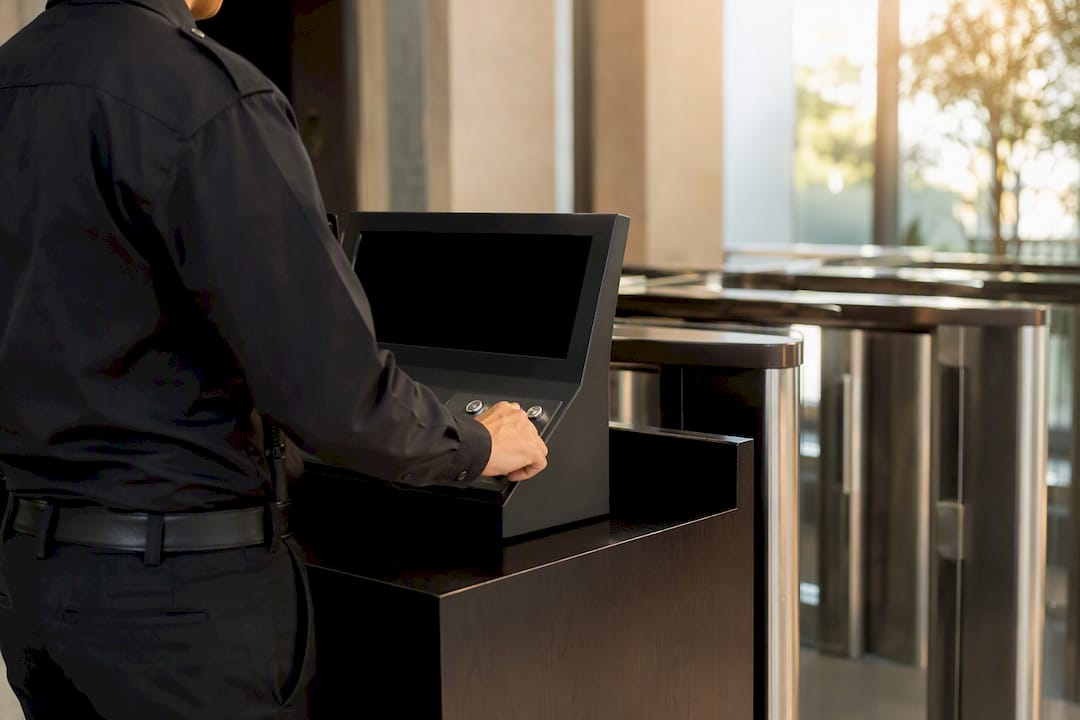
Speed gates and turnstiles make sense in high-traffic commercial towers where hundreds of credentialed employees move through in a short morning window. A staffed reception desk works better in residential and mixed-use buildings where visitor screening, package handling, and a human presence matter more than throughput speed. Many towers use both: a staffed desk for judgment calls and speed gates for routine credentialed entry. The mistake we see most often is choosing one model because it looks more modern, rather than matching it to actual traffic patterns and tenant mix.
Credential strategy and elevator integration
This is where high-rise security diverges most sharply from ground-level buildings. A credential should never simply “open the building.” It should map to a specific set of floors, and the elevator system should enforce that mapping through destination-dispatch logic rather than relying on a tenant to press the right button honestly.
- Confirm every access credential is tied to an explicit floor list, not a blanket building permission.
- Require destination-dispatch or floor-restriction hardware on all passenger elevators serving tenant floors.
- Test credential-to-floor mapping quarterly, since staff turnover and tenant changes create drift fast.
- Document who approved each credential and when, for later audit or incident review.
Pro Tip: Run a “ghost credential” audit twice a year, pull every active card or fob and manually verify it belongs to a current tenant, employee, or vendor. Dormant credentials from move-outs are one of the most common access gaps we find in Boston high-rises.
Video strategy: placement, retention, and chain of custody
Camera placement should follow a blind-spot analysis, not a budget-driven guess. Priority zones are lobby entrances, elevator lobbies on every floor (not just the ground level), stairwell doors, garage entry/exit points, mailrooms, and amenity access points. Recent research on super high-rise buildings recommends dynamic vulnerability analysis using digital twin models to identify surveillance blind spots that static camera plans miss, particularly useful when a building adds floors, renovates common areas, or changes tenant mix.
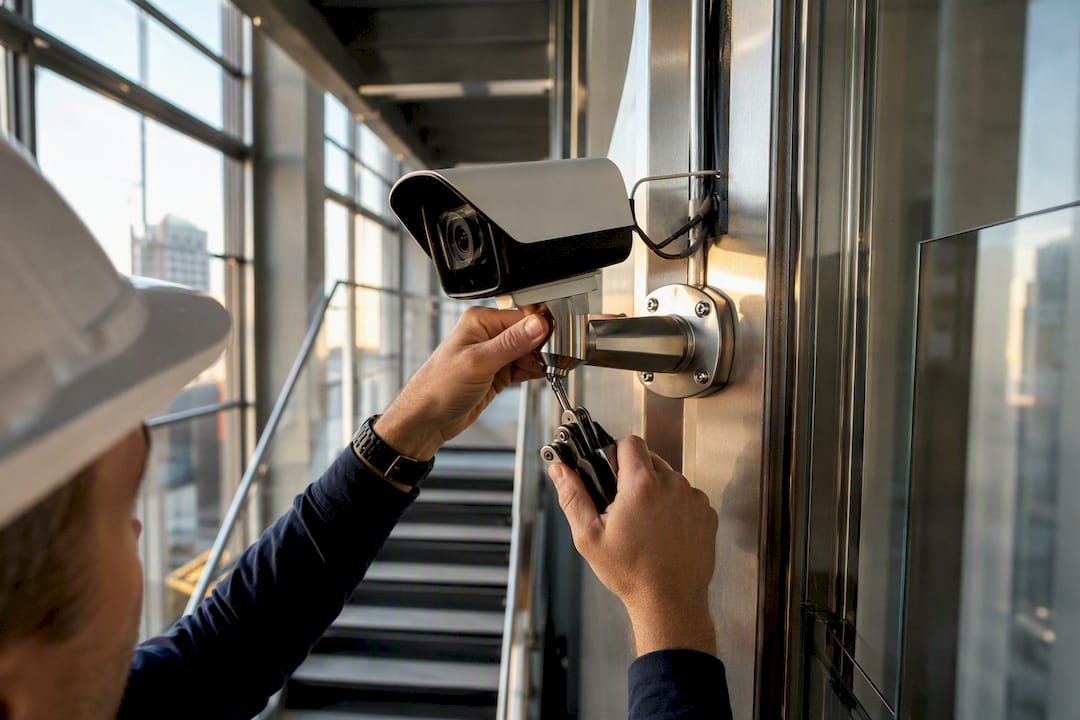
Retention matters as much as placement. Footage that isn’t retained long enough, or can’t be located quickly after an incident, has no evidentiary value. Property-management guidance recommends retaining CCTV footage for 30 to 90 days under normal conditions, with a litigation hold process that preserves specific footage indefinitely once a claim or incident is flagged.
Physical hardening without over-fortifying
Lighting, locks, bollards, and controlled service doors matter, but the goal is proportionate hardening, not a fortress. A 2012 NIH review of high-rise security lists physical security measures alongside CCTV and documented emergency procedures as baseline countermeasures, and pairs them with occupant involvement rather than treating hardware as a complete solution on its own.
- Stairwell doors should self-lock from the stairwell side but never trap someone during an evacuation.
- Service and loading dock doors need the same credential discipline as the main lobby, not a shared key that’s been photocopied for a decade.
- Exterior lighting should eliminate shadowed approach paths to entrances and garage ramps.
Mailroom, parcel, and amenity access
Package theft and amenity misuse are the day-to-day headaches that erode tenant trust fastest, even when they never make the news. Smart lockers with timed pickup windows cut theft dramatically compared to open mail rooms, and logging amenity access, gyms, rooftop decks, coworking lounges, creates a record that resolves disputes and deters misuse. A facilities guide on high-rise security tips notes that package theft and amenity liability are among the most common complaints property managers field, and both respond well to targeted access control rather than blanket restrictions.
Integrating Smart Building Technology With Security Systems
The building managers who get the best results treat security as one unified platform rather than a stack of separate systems that happen to share a building. A unified platform gives you a single audit trail, consistent access policies across every entry point, and one dashboard instead of five logins during an incident. Siloed systems, a separate elevator vendor, a separate camera system, a separate visitor log, create gaps precisely where an incident review needs continuity.
Elevator tie-ins deserve special attention during any technology upgrade. Every credential-to-floor mapping should be commissioned and tested, not just configured and assumed to work. Practical guidance on high-rise access control recommends testing fire-panel and elevator interfaces as part of commissioning, verifying that elevators fail safe (unlocking or recalling to the ground floor) during a fire alarm, and confirming that firmware updates don’t silently break that fail-safe behavior.
Visitor management has moved well past a paper sign-in sheet. A workable system issues:
- Temporary QR or mobile credentials tied to a specific floor and time window
- Pre-registration by the tenant hosting the visit, so front desk staff aren’t guessing
- Concierge verification against photo ID for anyone without a pre-registered credential
- An automatic expiration on every visitor credential at the end of the visit window
Video analytics can flag loitering, tailgating, and unusual after-hours movement, but treat the output as a lead, not a verdict. False positives are common, and analytics that trigger on every delivery driver or dog walker will train your staff to ignore alerts entirely. Privacy considerations matter too, especially in residential towers where amenity-floor cameras can raise legitimate tenant concerns if placement isn’t communicated clearly.
Cybersecurity is no longer a separate conversation from physical security. Access control panels, camera systems, and elevator controllers are all networked devices now, which means they’re all attack surfaces. Segment building-systems networks from tenant Wi-Fi and guest networks, require multi-factor authentication for any remote administrative access, and put every vendor on a documented firmware patching schedule with a service-level agreement that specifies response time for critical vulnerabilities.
How to Plan Emergency Evacuation and Response for High-Rise Buildings
Emergency planning in a tower isn’t a scaled-up version of a low-rise fire drill. It requires documented coordination between your security systems, your life-safety systems, and the people who actually have to move down (or in some cases, stay put) during an emergency.
- Tie security controls to fire and life-safety systems with documented fail-safe behavior. Every access-controlled door and elevator bank needs a tested, written record of what happens during a fire alarm, not an assumption that “it should unlock.” Include stairwell egress hardware in this documentation, since code compliance during alarm conditions is where many buildings quietly fail inspection.
- Build occupant-specific evacuation plans, not a single generic one. Upper floors, lower floors, and below-grade parking all need distinct muster points and communication paths, with named roles for who directs traffic and who confirms headcounts.
- Run at least one full evacuation drill annually, supplemented by table-top exercises with local fire and police departments so responders already know your building’s layout before an actual emergency.
- Plan explicitly for occupants with mobility limitations. This means designated evacuation assistance areas, staff trained in assisted evacuation, and clear shelter-in-place guidance for situations where full evacuation isn’t the safest option.
- Use layered mass notification. SMS alerts, PA announcements, and a building app push notification together reach more people faster than any single channel, especially when occupants are spread across sixty floors and not all near a speaker.
Pro Tip: After every drill, document what broke, a door that didn’t unlock, a muster point that got overcrowded, a notification that arrived late, and fix it before the next one. A drill that doesn’t produce a defect list wasn’t a real test.
Coordinate directly with your local fire marshal and police liaison on floor plans, elevator recall sequences, and staging areas well before you need them in an emergency. That relationship, built during quiet periods, is what makes response time during an actual event faster than the building’s design alone would predict.
Staffing Your Building: Guards, Patrols, and Documentation Standards
Choosing between posted guards, mobile patrols, and remote monitoring isn’t about picking the “best” option in isolation. It’s about matching coverage to your building’s actual risk profile and traffic patterns.
Posted guards station a trained officer at a fixed point, typically the lobby, and work best for towers with heavy foot traffic, frequent visitors, or a high-profile tenant mix that benefits from a visible presence. Mobile patrols move through the property on a scheduled or randomized route, covering garages, stairwells, and amenity floors that a fixed post can’t see. Courtesy officers, often residents who receive reduced rent for a light security presence, add eyes on the ground in residential buildings at lower cost, though they shouldn’t replace trained security staff for anything beyond basic observation. Remote or virtual guard services monitor camera feeds and access points off-site, a lower-cost option that trades physical presence for constant digital oversight.
Most high-rises land on a hybrid: posted coverage during peak hours, mobile patrols overnight, and remote monitoring filling the gaps between physical checks. The trade-offs between 24-hour posted coverage and alarm-based monitoring come down to how much value you place on a human being able to intervene in real time versus the lower cost of remote detection.
Training matters more than the staffing model you choose. A guard without building-specific induction, evacuation role assignments, conflict de-escalation training, and clear reporting standards is a warm body, not a security asset. When contracting guard services, require:
- Documentation of certified training and completed background checks for every assigned officer
- A written service-level agreement defining response times and verification procedures
- Timestamped, photo-backed patrol logs and daily activity reports, not a signature on a clipboard
Detailed, timestamped documentation isn’t paperwork for its own sake. Property-management guidance notes that professional patrol logs with photo backing materially strengthen a property’s position if a security incident later leads to a negligent-security claim. A security team trained to prevent crime through visible presence and consistent reporting does double duty: deterrence today, defensible records tomorrow.
Building a Closed-Loop Risk Assessment and Maintenance Program
Security in a high-rise isn’t a project you finish. It’s a cycle you run, and the buildings that stay ahead of problems treat assessment and maintenance as one continuous loop rather than separate line items.
Set your assessment cadence on three timelines: quarterly spot checks on high-traffic points like lobby entrances and elevator credential mapping, an annual comprehensive risk assessment covering the entire property, and dynamic updates triggered by specific events rather than the calendar. A physical security risk assessment gives you the baseline every later comparison depends on.
Hardware and firmware need their own maintenance rhythm. Practical access-control guidance recommends professional maintenance at least twice a year to keep card readers, door controllers, and elevator interfaces reliable, plus a commissioning check after every firmware update to confirm nothing broke in the process.
- Track every reported defect through a closed loop: report, remediate, verify, with a timestamp at each stage.
- Reassess immediately after an incident cluster, even minor ones, rather than waiting for the annual cycle.
- Watch nearby crime trend changes and resident complaint patterns as early triggers for a targeted reassessment.
- Keep a written maintenance log for every access point and camera, not just a service invoice filed away.
A property-management guide on multifamily and commercial security recommends retaining CCTV footage for 30 to 90 days, patrol logs for a substantial multi-year period, and incident reports as required by applicable statute of limitations, figures that assume no active litigation hold extends them further.
This is also where a security risk assessment checklist from a facility-analytics resource earns its place on your desk. It’s a useful cross-check against your own audit, particularly for buildings that haven’t formalized a written assessment process yet.
Turning Tenants Into Partners in Building Security
Tenants aren’t passive occupants of your security program. They’re either reinforcing it every day or quietly undermining it, and which one depends largely on how well you’ve communicated what you need from them.
- Include a security-specific page in every onboarding packet: how the credential system works, who to call for a suspicious visitor, and what amenity access hours look like.
- Post brief, non-alarming reminders in elevators and lobbies rather than lengthy notices no one reads.
- Form a small tenant safety committee that walks the property periodically and flags issues staff might miss.
- Reinforce one simple rule constantly: never open a secured door for someone you don’t know, even if they claim to be a delivery driver.
- Log amenity access with real timestamps rather than an honor-system sign-in sheet.
The goal is comfort and security together, not a building that feels like it’s under lockdown. Over-securitizing a property erodes the trust that makes tenants report problems in the first place.
Your Field-Ready High-Rise Security Checklist
Reading about best practices only gets you so far. Here’s how to sequence the work.
Immediate (this week): Audit every active access credential against current tenants and staff. Confirm camera retention settings match your target window and that a litigation-hold process exists. Walk the lobby, garage, and stairwells looking for propped doors or burned-out lighting.
Within 30 days: Commission a full elevator credential-to-floor mapping test, including fire-panel fail-safe verification. Review guard contracts for training documentation and background-check proof. Draft or update written evacuation roles for each floor zone.
Within 90 days: Complete a comprehensive risk assessment covering every entry point, camera position, and credential policy. Run a full evacuation drill with local fire department coordination. Install or upgrade parcel lockers if package theft has been a recurring complaint.
A sample retention framework to work from:
| Record Type | Recommended Retention |
|---|---|
| Standard CCTV footage | 30 to 90 days, extended under litigation hold |
| Patrol logs and activity reports | a substantial multi-year period |
| Incident reports | As required by applicable statute of limitations |
| Access credential change logs | 2 or more years |
Hub Investigative Group has operated in Boston since 2004, drawing on more than seventy-five years of combined law enforcement and loss-prevention experience across executive protection, investigative work, and commercial building security programs. That background shapes the checklist above, built from what actually holds up during a real incident review, not just what looks thorough on paper.
The clearest next step for most building managers is a site survey: a walk-through that identifies your specific gaps rather than a generic template applied to a unique property.
Where to Go for Deeper Standards and Guidance
For commissioning specifics and legal compliance, consult primary standards rather than relying on secondary summaries. The ASIS CRISP report on tall-building security covers layered design in depth, while NFPA life-safety codes govern fire-panel and egress requirements your access-control commissioning must satisfy. The NIH review of high-rise security remains a solid baseline reference for physical-controls research, and a practical security risk assessment checklist offers a useful working template for your own audits.
What Building Managers Consistently Get Wrong
Most high-rise security failures I’ve analyzed don’t come from missing technology. They come from treating security as a collection of purchases instead of a documented, tested system. A building can have cameras on every floor and still fail, if nobody can locate footage fast enough after an incident, or if the elevator credential mapping hasn’t been checked since the last tenant turnover eighteen months ago.
The mismatch that costs buildings the most is grading their program to the wrong risk level. A 40-story mixed-use tower with a ground-floor retail concourse doesn’t need the same posture as a 12-unit residential building, but plenty of managers copy a peer’s security plan wholesale instead of matching controls to their own foreseeable risks. Documentation is the piece that gets skipped first under budget pressure, and it’s the piece that matters most when something actually goes wrong. A commissioning test that was never written down might as well not have happened.
Match your program’s grade to your building’s actual risk, document every decision and every test, and request a site survey before assuming your current setup covers you.
Get a Building Security Assessment From a Boston-Based Team
Hub Investigative Group is the practical alternative to guessing at your building’s gaps or hiring a generic guard company that treats every property the same. We build programs around what a specific tower actually needs, whether that means a formal risk assessment, posted or mobile guard coverage, emergency-planning support, or system commissioning after an access-control upgrade.

Our services for building managers include on-site risk assessments that map credential gaps and blind spots, posted and armed security options where a building’s risk profile calls for it, mobile patrol coverage for overnight and off-hours gaps, and emergency-planning support that ties your evacuation procedures to your actual life-safety systems. Every engagement starts with understanding your building’s specific traffic patterns and tenant mix, not a template pulled from a different property type.
If your last risk assessment predates your current tenant mix, or you’ve never had one, that’s the place to start. Request a site survey through our comprehensive building security services and we’ll walk your property, flag the gaps that matter most, and scope a program built for what your building actually faces.
Frequently Asked Questions About High-Rise Security Best Practices
What is the most important high-rise security best practice?
Elevator access control tied to a formal risk assessment. Elevators are the single control point that turns one lobby breach into building-wide access, which makes credential-to-floor mapping the highest-priority fix for most towers.
How often should a high-rise building security audit happen?
Run quarterly spot checks on high-traffic points like the lobby and elevator credentials, a full comprehensive risk assessment annually, and additional reassessments any time there’s an incident cluster, a tenant-mix change, or a nearby crime pattern shift.
How long should high-rise buildings retain security camera footage?
Standard practice is 30 to 90 days for CCTV footage, with a litigation hold extending retention indefinitely once an incident or claim is flagged. Patrol logs typically get archived for two years or more.
Do high-rise buildings need posted guards, or is remote monitoring enough?
It depends on traffic volume and risk profile. Buildings with heavy visitor traffic or high-profile tenants generally benefit from posted coverage during peak hours, supplemented by mobile patrols and remote monitoring during off-hours, rather than relying on one model alone.
What should be included in a high-rise emergency evacuation plan?
Floor-specific muster points, named roles for directing traffic and confirming headcounts, tested fail-safe behavior for elevators and access-controlled doors during fire alarms, mobility-limitation provisions, and layered mass notification across SMS, PA, and a building app.
How does elevator integration improve building security?
Elevator integration restricts each access credential to a specific set of authorized floors through destination-dispatch logic, so a stolen or shared credential can’t grant someone access to every level in the building.
Sources
- ASIS Security Management Magazine: layered access control for multitenant high-rises (2025)
- High-Rise Security* — PMC (NIH)
- Hiresecuritynow
- Dynamic vulnerability analysis for super high-rise building security (ScienceDirect)
Recommended
- Hotel Security Management: What Every Property Must Require
- Executive Residence Security for High-Profile Households
- Top 10 Security Mistakes Property Owners Must Avoid in 2025 – Hub Security & Investigative Group
- Apartment Security in Boston, MA: Professional Security Services for Apartment Communities – Hub Security & Investigative Group