
Whether armed guards are warranted comes down to documented threat indicators and a formal risk assessment, not gut instinct. The FBI, OSHA, and CISA each point to the same triggers: a documented history of violence or credible threats, high-value assets or cash handling, large or high-profile crowds, or a contractual requirement. Hiring should follow a written risk assessment and include licensed, properly trained personnel backed by adequate insurance.
TL;DR:
- Armed guards are justified primarily in environments with documented violent incidents, credible threats, or high-value assets, especially where police response is slow.
- Licensing and continuous training verification are crucial, with guards needing valid state licenses, firearm permits, and documented regular qualification on their weapons.
- Incorporating armed guards into a layered emergency plan requires a formal risk assessment, clear roles, communication protocols, and joint drills with staff.
- Armed guards can deter targeted crime and provide quick response, but liability and insurance considerations increase, emphasizing the need for well-defined use-of-force policies.
- A thorough risk assessment should precede staffing decisions, and provider vetting must include license checks, training records, and incident reports to ensure compliance and effectiveness.
Table of Contents
- Concrete situations and risk indicators that justify armed guards
- Legal, licensing, and regulatory checklist to verify first
- What training, vetting, and qualifications to require
- How armed guards fit into a layered emergency operations plan
- Benefits, risks, and insurance and liability implications
- Actionable decision checklist and provider questions
- Why Hub trusts risk-led decisions
- How Hub can help with assessments and armed security
- Sources
- FAQ
Concrete situations and risk indicators that justify armed guards
Some environments clear the threshold on their own, and others need a closer look before you commit to armed staffing. The scenarios that most often warrant armed guards share a few traits: repeated violent incidents, targeted or credible threats, high-value inventory, heavy cash operations, large or high-profile gatherings, and remote sites where police response times run long.
- A retail pharmacy that has been robbed multiple times in a year has a documented pattern, not a hypothetical risk.
- A political rally that receives specific, credible threats against a speaker or attendees needs a different response than a routine community event.
- A jewelry store or cash-intensive business carries a baseline exposure that many general retailers do not.
- An event expecting a large, high-profile crowd in a location with limited exits raises the stakes on crowd control and response time.
Frequency, severity, and predictability change the calculus. One isolated incident rarely justifies armed staffing on its own, but a pattern of escalating severity, or a single credible and specific threat, usually does. A property manager should weigh how often incidents occur, how serious they have been, and whether they can be reasonably anticipated before deciding that armed guards, rather than unarmed guards or added cameras and access control, is the right layer to add.
Legal, licensing, and regulatory checklist to verify first
Licensing requirements for armed guards vary by state, and firearm permits often carry separate rules from the general guard license. Before signing a contract, confirm that the individual guards assigned to your site hold both a valid state security license and the specific firearm authorization required in your jurisdiction.
- Verify the guard’s state license and firearm permit directly, not just the company’s business license.
- Confirm background checks and fingerprinting have been completed for each armed guard, not just at hire but on a recurring basis.
- Request evidence of liability insurance that specifically covers firearm-related incidents, since general liability policies often exclude them.
- Ask how the provider trains guards on state and local use-of-force law, which differs from one jurisdiction to the next.
Most states require licensing and more rigorous screening for armed guards than for unarmed guards, according to the Bureau of Labor Statistics. Skipping this verification step is the single most common gap property managers overlook when a contract is signed quickly.
What training, vetting, and qualifications to require
Firearms training and vetting standards separate a reliable armed guard program from a liability waiting to happen. At minimum, require documented weapons proficiency with annual qualification, not a one-time certification from years ago.
- Ask for records showing when each guard last qualified on the specific firearm they carry.
- Give preference to candidates with prior law enforcement or military experience, paired with de-escalation training.
- Confirm the provider runs background screening consistent with state licensing law and maintains written standard operating procedures.
- Ask how often guards receive continuing education beyond the minimum required to keep a license active.
Model regulatory guidance from the Office of Justice Programs recommends mandatory pre-issue classroom training and annual in-service range qualification for armed private security personnel.
Pro Tip: Ask your provider for a sample training log, not just a policy statement. A real log shows dates, instructors, and qualification scores.
How armed guards fit into a layered emergency operations plan
Armed guards work best as one layer inside a written plan, not as a standalone fix bolted on after a scare. Start with a formal risk assessment that evaluates likelihood, impact, and exposure, the same approach OSHA recommends for identifying foreseeable emergency scenarios and prioritizing controls by severity.
- Complete a written risk assessment before adding armed personnel, covering access control, surveillance, and communications gaps.
- Place armed guards within a layered structure that also includes access control, camera coverage, and a medical response plan.
- Assign clear roles so guards know their post, their escalation path, and who has final authority on-site.
- Build communication protocols with 9-1-1 and local first responders before an incident, not during one.
- Run joint drills with staff so everyone understands their part under Run, Hide, Fight guidance.
The FBI’s active shooter guidance for businesses frames this clearly: armed security is most effective when it is combined with staff training and a rehearsed communication plan, not deployed as an isolated response.
Benefits, risks, and insurance and liability implications
Armed guards offer real deterrence and an on-site response capability that unarmed staff or cameras alone cannot match. They are not, however, a substitute for early-warning detection or threat reporting, which research on pre-attack behavior consistently identifies as the more effective prevention layer.
- Deterrence value tends to be highest at sites with a documented history of targeted crime.
- On-site armed response shortens the time between an incident starting and a trained person intervening.
- Liability exposure rises with an armed presence, so specialized insurance and tight use-of-force SOPs matter more than headcount.
- Visible armed guards can create reputational concerns at some venues, which limited visibility, clear signage, and community communication can help manage.
Pre-attack information, often tips and reported suspicious activity, frequently prevents incidents before an armed response is ever needed, according to RAND research. Armed guards work best when they sit alongside that kind of early detection, not in place of it.
Actionable decision checklist and provider questions
Once your risk assessment points toward armed staffing, a short, disciplined process keeps the decision sound and the contract clean.
- Complete the formal risk assessment first, and keep a written copy for your files and insurer.
- Consult your legal counsel and insurance carrier before signing, since armed coverage terms vary widely.
- Verify the provider’s licensing, firearm permits, and training records for every guard assigned to your site.
- Pilot the deployment for a defined period before committing to a long-term contract.
- Debrief after the pilot and adjust staffing levels, hours, or posts based on what the incident log actually shows.
When vetting a provider, ask directly: how often do your armed guards requalify, have they worked sites like mine before, what are your SOPs for use of force, what are your insurance limits, and can you provide references and incident reporting records? Temporary event staffing and long-term site contracts carry different pricing and commitment terms, so clarify the timeline before you negotiate the budget.
Why Hub trusts risk-led decisions
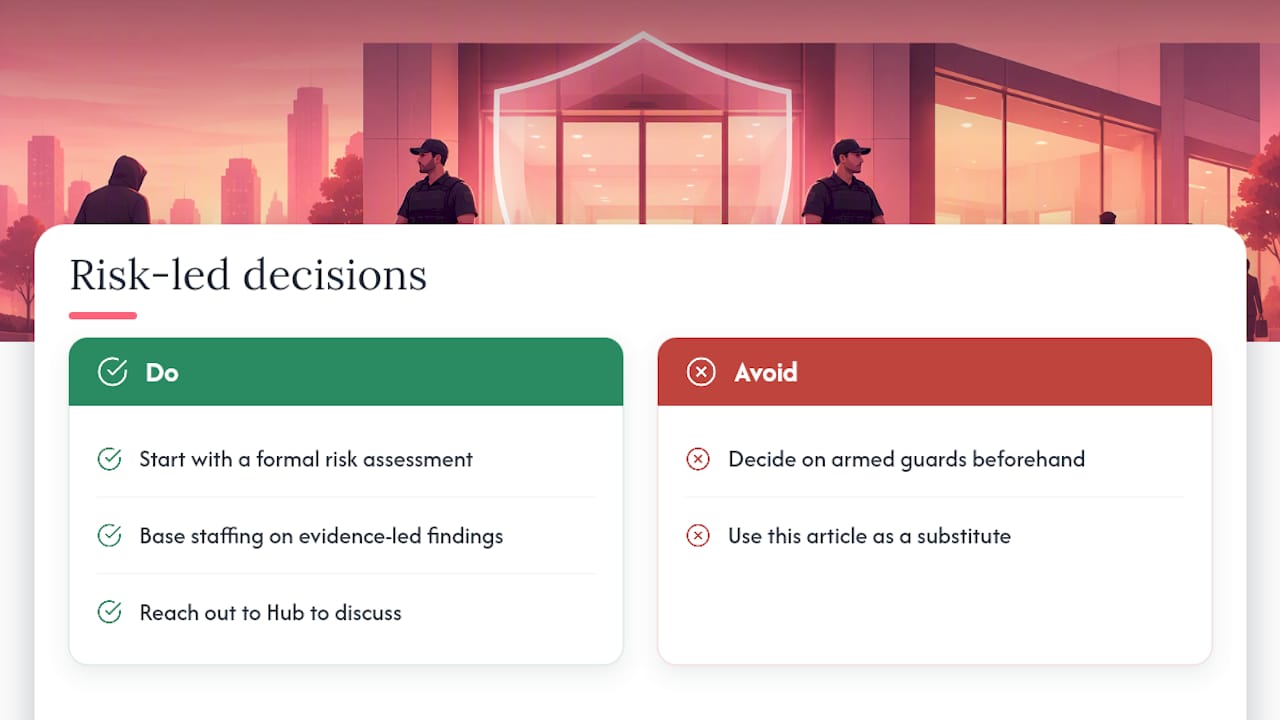
Some firms build their approach around extensive combined law enforcement and loss-prevention experience, shaping how they think about armed staffing: as a decision that follows evidence, not one that precedes it. This article is guidance, not a substitute for a site-specific risk assessment.
If you are weighing armed versus unarmed protection for a property or event, we recommend starting with a formal risk assessment before any staffing decision. Reach out to Hub when you are ready to have that conversation.
— Derek
How Hub can help with assessments and armed security
Deciding whether your site needs armed guards is easier when the assessment and the staffing come from the same team. Hub Investigative Group offers Security Risk Assessment services alongside Armed Security Guard, Event Security Services, and Executive Protection, so the same evaluators who identify your risk profile can also staff the response.

We have supported businesses, property managers, and event organizers across Massachusetts with tailored security plans built on prevention rather than reaction. If you are still deciding between armed and unarmed coverage, our team can walk through your specific risk factors and recommend the right mix. Contact us through our services page to request a security risk assessment or a quote for armed or unarmed guard staffing.
Sources
- FBI — Active Shooter Guide for Businesses (March 2018)
- OSHA — Safety management: Hazard identification
- BLS — Security guards and gambling surveillance officers (Occupational Outlook Handbook)
- CISA — Venue guide for security enhancements (2025)
- OJP — Scope of legal authority of private security (model guidance)
FAQ
Can a normal person hire a bodyguard?
Yes, bodyguard services are available to private individuals, not only corporations or public figures, through firms offering executive protection and secure transportation. The scope and cost depend on the client’s risk profile and how many protective personnel the assignment requires.
Is it worth being an armed security guard?
Armed guard roles typically require more rigorous training, licensing, and background screening than unarmed positions, according to the Bureau of Labor Statistics. Whether the added responsibility is worth it depends on a candidate’s tolerance for that higher bar and the demands of carrying a firearm on the job.
What are the 5 C’s of security guards?
Definitions vary across the industry, and no single official source ties a formal “5 C’s” framework specifically to armed guard standards. Common versions reference concepts like conduct, competence, communication, and vigilance, but readers should treat any specific list as a training convention rather than a regulatory requirement.
How much do bodyguards usually cost?
Bodyguard and executive protection pricing depends on factors like the client’s risk level, the number of protective personnel assigned, and whether secure transportation is included. Providers typically quote pricing after an initial consultation rather than publishing a flat rate, since each assignment’s scope differs.